Back to search
nopus
SkillGitHub
Deterministic prose checks for clearer coding-agent responses
Safety scan
A static text scan, not a guarantee. Select the badge to see what was scanned and every finding.
Checked today
Badge for your README
Markdown
[](/listings/vistyy--nopus)HTML
<a href="/listings/vistyy--nopus"><img src="/api/listings/vistyy--nopus/badge.svg" alt="findsafeskills safety rating" /></a>Install
i
What was scanned
The files the safety scan read, as written by the repository's author and shown as plain text. Lines with a finding are marked.
.claude-plugin/marketplace.json · Manifest · 15 lines
View this file on GitHub (read at the repository's current version: the scan did not record which commit it read)
- {
- "name": "nopus",
- "owner": {
- "name": "Vistyy"
- },
- "description": "Uses deterministic prose checks to flag overly complex coding-agent responses and ask for one clearer rewrite.",
- "plugins": [
- {
- "name": "nopus",
- "source": "./plugin",
- "description": "Uses deterministic prose checks to flag overly complex coding-agent responses and ask for one clearer rewrite.",
- "version": "1.1.0"
- }
- ]
- }
README.md · README · 277 lines
View this file on GitHub (read at the repository's current version: the scan did not record which commit it read)
- 
- # nopus
- [](https://www.npmjs.com/package/@syzom/nopus)
- [](package.json)
- [](LICENSE)
- nopus catches coding-agent answers that disappear into abstract LLM babble.
- Using deterministic prose checks, it flags responses that cross your chosen complexity threshold and sends them back for one clearer rewrite.
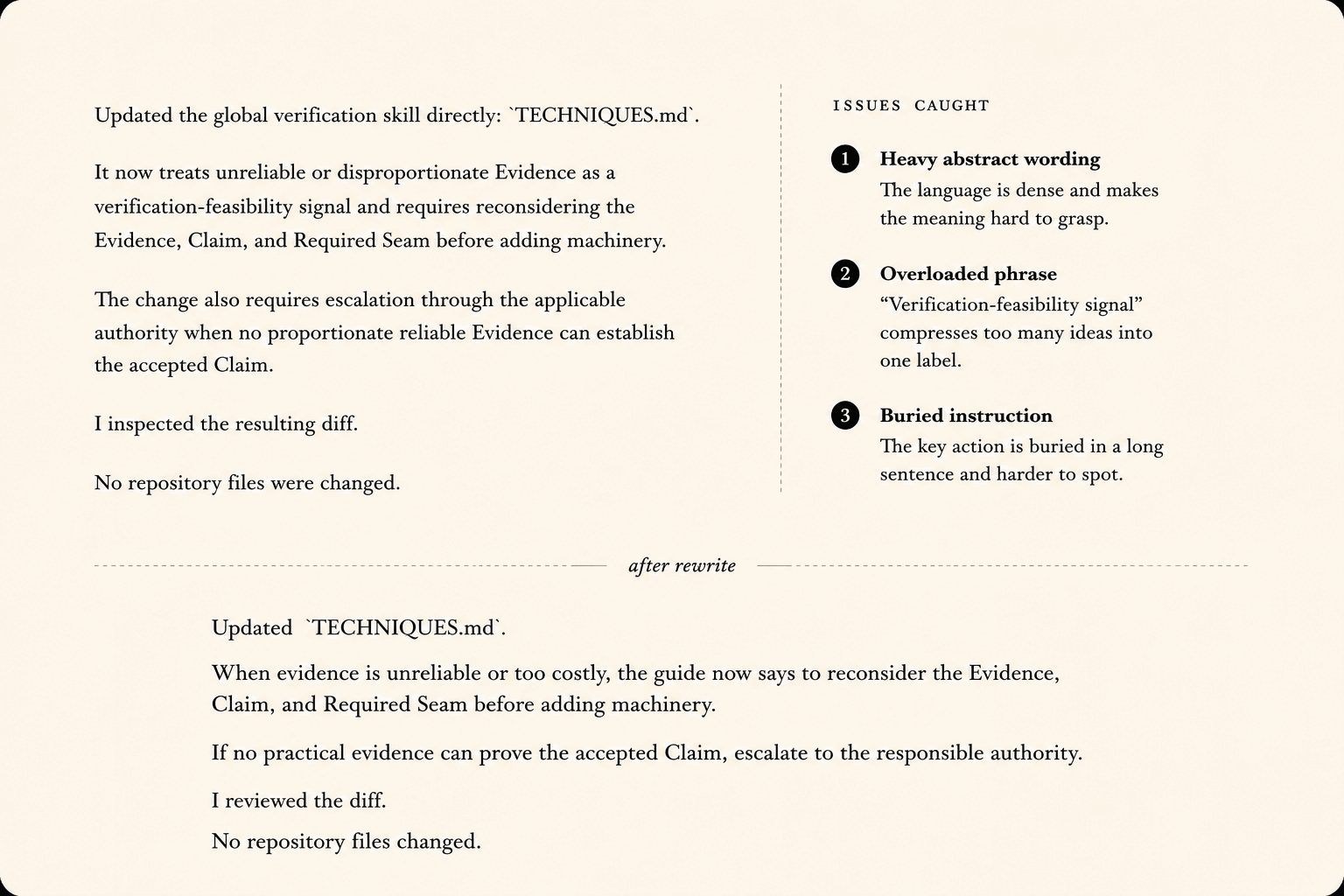
- ## See it in action
- 
- Currently supported: Pi, Claude Code, Codex
- ## Use nopus
- To use nopus, install Node.js 22 or newer and make sure the `node` command is available.
- <details>
- <summary>Pi</summary>
- Install nopus from npm:
- ```sh
- pi install npm:@syzom/nopus
- ```
- You can install the GitHub repository instead:
- ```sh
- pi install git:github.com/Vistyy/nopus
- ```
- Start Pi normally after installation.
- The extension checks each completed response.
- When it requests a rewrite, it hides the rejected response from the terminal transcript by default.
- The response remains in the Pi session and model history.
- Because nopus evaluates completed responses, the response remains visible while it streams and disappears only after nopus requests a rewrite.
- Use these commands while working:
- ```text
- /nopus status
- /nopus check
- /nopus on
- /nopus off
- /nopus extra-simple on
- /nopus extra-simple off
- /nopus hide-original on
- /nopus hide-original off
- ```
- </details>
- <details>
- <summary>Claude Code</summary>
- Add the marketplace from GitHub and install the plugin:
- ```text
- /plugin marketplace add Vistyy/nopus
- /plugin install nopus@nopus
- ```
- The plugin uses a Stop hook to request one clearer response.
- The identifier follows the `plugin@marketplace` format, so this plugin is `nopus@nopus`.
- </details>
- <details>
- <summary>Codex</summary>
- Add the marketplace from GitHub and install the plugin:
- ```sh
- codex plugin marketplace add Vistyy/nopus
- codex plugin add nopus@nopus
- ```
- Start a new Codex session after installation so the plugin and its skills load.
- The Codex plugin uses the same bounded Stop hook.
- The identifier follows the `plugin@marketplace` format, so this plugin is `nopus@nopus`.
- </details>
- ## How it works
- nopus examines the prose when a coding agent completes a response.
- Its measurements are deterministic, so the same prose and sensitivity produce the same decision.
- It measures these characteristics:
- - **Uncommon wording** - Words that are rare in ordinary conversation.
- - *Example:* “Commence the task” instead of “Start the task.”
- - **Very uncommon wording** - Words that are rare in both conversation and broad written English.
- - *Example:* “Ameliorate the problem” instead of “Fix the problem.”
- - **Abstract vocabulary** - Concepts and qualities used without concrete people, objects, or actions.
- - *Example:* “capability, strategy, governance, and ownership.”
- - **Abstract sentences** - Abstract wording that fills one sentence and continues across several sentences.
- - *Example:* “The strategy establishes capability ownership through governance transformation.”
- - **Noun and modifier stacks** - Three or more nouns or modifiers compressed into one phrase.
- - *Example:* “repository state mutation verification strategy.”
- - **Phrase load** - Dense phrases that appear frequently for the amount of prose.
- - *Example:* A short answer containing both “deployment policy validation process” and “repository state mutation strategy.”
- - **Formulaic style cues** - Literal phrases that add inflated framing or filler.
- - *Example:* “Here’s where it gets interesting.”
- Word rarity comes from packaged conversational and broad-web frequency data.
- Abstractness comes from human-rated word concreteness, and technical exceptions come from a packaged computing glossary.
- The style matcher uses only a small allowlist of literal cues rather than trying to classify arbitrary writing habits.
- nopus then looks for combinations that make a response materially harder to read.
- For example, uncommon words become more significant when they appear with sustained abstraction and dense phrase stacks.
- Several abstract sentences become more significant when loaded phrases recur throughout them.
- ### How nopus avoids unnecessary rewrites
- - It removes code blocks, inline code, URLs, file paths, and table rows before measuring prose.
- - It excludes obvious identifiers and reduces the weight of established computing terms.
- - It uses proportions and phrase density, so a long response is not penalized merely for being long.
- - Most decision paths require several measurements to cross their thresholds together.
- - A single rare word or dense phrase does not normally trigger a rewrite.
- - Style cues require either two distinct cues or one cue supported by enough uncommon wording.
- - It requests at most one automatic rewrite, so it cannot create a retry loop.
- Necessary technical terms, commands, identifiers, conditions, and qualifications remain part of the requested answer.
- `InteractiveSessionHost` stays `InteractiveSessionHost`; nopus targets the difficult prose around it.
- When nopus requests a rewrite, the host displays this message:
- ```text
- nopus requested a clearer rewrite.
- ```
- ### What the agent receives
- For the response used in the example below, the default rewrite request gives the agent focused guidance and examples from its own response:
- ```text
- Rewrite the response for clarity and directness.
- Keep its meaning and necessary detail.
- Return only the revised response.
- Focus on these areas:
- - Replace formulaic framing with plain statements.
- Examples from the response:
- - "here's where it gets interesting": lecture-hall framing.
- - "paradigm shift": tired.
- ```
- Turning rewrite evidence off removes the `Examples from the response` block.
- The agent still receives the rewrite instructions and focus areas.
- Extra-simple rewriting is off by default.
- When enabled, nopus requests a short initial answer that keeps the main conclusion, immediate action, and conditions or warnings that could change that action.
- It leaves supporting rationale, examples, alternatives, future considerations, and lower-priority implementation details for follow-up.
- ## Choose how sensitive it should be
- Sensitivity controls how often nopus intervenes, and the default is `medium`.
- | Sensitivity | What to expect | Observed rewrite rate | Best fit |
- |---|---|---:|---|
- | `low` | Uses the strictest thresholds to target clear cases where abstraction, uncommon wording, or dense phrasing accumulates strongly. | 5.3% | You want intervention only for the most difficult responses. |
- | `medium` | Catches difficulty sustained across several sentences or supported by multiple characteristics without treating isolated wording as a problem. | 9.9% | You want a balanced default for regular use. |
- | `high` | Uses lower thresholds so shorter runs of abstraction and borderline combinations can request a rewrite sooner. | 18.6% | You consistently prefer plain language and accept more interventions. |
- The [observed rates](evaluation/README.md) come from 5,337 completed Pi responses and provide only a rough comparison because results vary by agent and task.
- ## Configure automatic rewrites
- `nopus-configure` changes the settings used by the automatic integrations.
- It does not rewrite a response.
- | Action | Pi | Claude Code | Codex |
- |---|---|---|---|
- | Set medium sensitivity | `/skill:nopus-configure medium` | `/nopus:nopus-configure medium` | `$nopus-configure medium` |
- | Disable rewrite evidence | `/skill:nopus-configure evidence off` | `/nopus:nopus-configure evidence off` | `$nopus-configure evidence off` |
- | Enable extra-simple rewrites | `/skill:nopus-configure extra-simple on` | `/nopus:nopus-configure extra-simple on` | `$nopus-configure extra-simple on` |
- | Show rejected Pi responses | `/skill:nopus-configure hide-original off` | - | - |
- <details>
- <summary>Configuration file and environment variables</summary>
- The configuration skill writes `$XDG_CONFIG_HOME/nopus/config.json`, or the platform user-configuration equivalent.
- ```json
- {
- "complexitySensitivity": "medium",
- "includeEvidence": true,
- "extraSimple": false,
- "pi": {
- "hideOriginalResponse": true
- }
- }
- ```
- Rewrite evidence and Pi response hiding are enabled by default.
- Extra-simple rewriting is disabled by default.
- `NOPUS_COMPLEXITY_SENSITIVITY`, `NOPUS_INCLUDE_EVIDENCE`, `NOPUS_EXTRA_SIMPLE`, and `NOPUS_PI_HIDE_ORIGINAL_RESPONSE` override the configuration file for automation.
- </details>
- ## Simplify a response manually
- `nopus-simplify` is the manual counterpart to the automatic rewrite.
- Use it when nopus does not trigger but you still find the preceding response too complex.
- Invoking the skill requests a rewrite immediately instead of applying the selected sensitivity threshold.
- It uses the same clarity goals as the automatic rewrite and preserves meaning, necessary detail, technical terms, commands, identifiers, conditions, and qualifications.
- It does not change nopus configuration.
- | Pi | Claude Code | Codex |
- |---|---|---|
- | `/skill:nopus-simplify` | `/nopus:nopus-simplify` | `$nopus-simplify` |
- ## Development
- Install dependencies and run all checks:
- ```sh
- pnpm install
- pnpm check
- ```
- Update the normalized datasets from their checksum-pinned upstream sources:
- ```sh
- pnpm import:data
- ```
- See [`evaluation/README.md`](evaluation/README.md) for the private-corpus calibration and regression workflow.
- Normal analysis and verification do not download runtime data.
- <details>
- <summary>Data sources and attribution</summary>
- nopus retains normalized JSON rather than the original upstream formats.
- The SHA-256 values below identify the exact upstream copies used to produce the normalized datasets.
- ### Claudisms
- `data/ai-style-cues.json` is derived from <https://claudisms.ai/claudisms.md>.
- The source describes itself as a living list of AI-writing habits that is free to copy and adapt.
- The copy was retrieved on 2026-08-14 and has SHA-256 `f4a09fa849b61712838d3e56c854ddf37a59417823acb348a330721615f73b2b`.
- ### SUBTLEX-US word frequencies
- `data/conversational-word-frequencies.json` is derived from `subtlex-word-frequencies@2.0.0`, available at <https://github.com/words/subtlex-word-frequencies>.
- The package derives its data from SUBTLEX-US by Marc Brysbaert and Boris New.
- The source paper is “Moving beyond Kučera and Francis: A Critical Evaluation of Current Word Frequency Norms and the Introduction of a New and Improved Word Frequency Measure for American English,” DOI <https://doi.org/10.3758/BRM.41.4.977>.
- The source copy has SHA-256 `271c5a5fbf332f60762cfa34b11394427c220099d96c589751b6bc77e5b32c1a`.
- The npm package declares the ISC license, which is preserved at `data/licenses/conversational-word-frequencies-ISC.txt`.
- ### Norvig web word counts
- `data/broad-web-word-counts.json` is derived from <https://norvig.com/ngrams/count_1w.txt>.
- Peter Norvig publishes the file as part of the data described at <https://norvig.com/ngrams/>.
- The counts derive from the Google Web Trillion Word Corpus described by Thorsten Brants and Alex Franz and distributed by the Linguistic Data Consortium.
- The source copy has SHA-256 `51df159fd3de12b20e403c108f526e96dbd723d9cabdd5f17955cdc16059e690`.
- ### Brysbaert concreteness ratings
- `data/concreteness-ratings.json` is derived from the ArtsEngine mirror at <https://github.com/ArtsEngine/concreteness>.
- The data accompanies Marc Brysbaert, Amy Beth Warriner, and Victor Kuperman, “Concreteness ratings for 40 thousand generally known English word lemmas,” DOI <https://doi.org/10.3758/s13428-013-0403-5>.
- The source copy has SHA-256 `0b4082dbd38585b0ee1fd258145b7a50592f8d0d98e5fc6b6844ceef3cd8ecc8`.
- ### Carpentries Glosario
- `data/technical-terms.json` is derived from The Carpentries `glosario` repository at revision `a4a774b6dea3881a7794d63aee10fbb5d34321d1`.
- The source repository is <https://github.com/carpentries/glosario>, and its archived releases are available under DOI <https://doi.org/10.5281/zenodo.13589476>.
- The source copy has SHA-256 `93a6371add7275d643cacb060ae0b65749d1ffdff329064feeaeaf7152c3715f`.
- The data is licensed under Creative Commons Attribution 4.0 International, and the license is preserved at `data/licenses/computing-glossary-CC-BY-4.0.md`.
- The Carpentries does not endorse nopus.
- </details>
Ratings and comments
Sign in to rate this skill.
Sign inFree to use. If it’s helped, pass it on.