foreman
A Boris-style agentic orchestrator TUI that supervises headless Claude Code agents through a gated software-delivery pipeline — pointed at any repository.
Safety scan
A static text scan, not a guarantee. Select the badge to see what was scanned and every finding.
Badge for your README

Markdown
[](/listings/visionforge-ou--foreman)HTML
<a href="/listings/visionforge-ou--foreman"><img src="/api/listings/visionforge-ou--foreman/badge.svg" alt="findsafeskills safety rating" /></a>Install
Install instructions from the README
As written by the repo's author. findsafeskills has not verified these steps.
# 1. Install (exposes a single `foreman` command)
pipx install .            # or:  uv tool install .

# 2. Point it at any repo
cd /path/to/your/repo
foreman init              # scaffolds .foreman/ and installs the foreman-* skills
                          #   into .claude/skills/

# 3. See the whole thing work end-to-end with NO tokens spent
foreman demo              # runs the full pipeline against a throwaway sample repo
                          #   using a mocked agent backend (canned stream-json)

# 4. Launch the TUI for real work
foreman                   # (same as `foreman tui`)
foreman --demo # launch the TUI against a throwaway sample repo<details> <summary><b>Other CLI commands</b></summary>
foreman status            # show vendored-skill + agent status + features for the repo
foreman init --force      # re-create config and reinstall the foreman-* skills/agents
foreman build             # resume/continue the autonomous build of a feature
foreman retro             # cluster recurring failures → gated skill/prompt patch drafts
foreman bench             # replay the eval set; report success-rate/cost/turn deltas
foreman --version
</details>
Requirements
- Python 3.11+ - The `claude` CLI installed and authenticated (`claude --version`) - `git` - Linux / WSL2 (developed and tested on Ubuntu under WSL2)
---
What was scanned
The files the safety scan read, as written by the repository's author and shown as plain text. Lines with a finding are marked.
README.md · README · 524 lines
View this file on GitHub (read at the repository's current version: the scan did not record which commit it read)
- <div align="center">
- # Foreman
- **A Boris-style agentic orchestrator TUI that supervises headless [Claude Code](https://claude.com/claude-code) agents through a _gated_ software-delivery pipeline — pointed at any repository.**
- `plan → ADR/PRD → issues → TDD build → e2e`
- [](https://github.com/VisionForge-OU/foreman/actions/workflows/ci.yml)
- [](https://codecov.io/gh/VisionForge-OU/foreman)
- [](https://pypi.org/project/foreman-orchestrator/)
- [](https://pypi.org/project/foreman-orchestrator/)
- [](https://pypi.org/project/foreman-orchestrator/)
- [](./LICENSE)
- [](https://textual.textualize.io/)
- [](#contributing)
- [Why Foreman?](#why-foreman) · [Demo](#demo) · [Quickstart](#5-minute-quickstart) · [Guide](#guide--driving-the-tui) · [How it works](#how-it-works) · [Roadmap](#roadmap) · [Contributing](#contributing)
- </div>
- > _"I don't prompt Claude anymore; I have loops that prompt Claude."_
- Foreman spawns the locally-installed `claude` CLI in headless stream-json mode,
- parses its event stream, enforces budgets, and drives your delivery workflow with
- a human-in-the-loop review gate for the design phases and guardrailed autonomy for
- the build. **All state is human-readable files committed inside the target repo** —
- no database; kill it and restart and it fully recovers from disk.
- ---
- ## Table of contents
- - [Why Foreman?](#why-foreman)
- - [Demo](#demo)
- - [5-minute quickstart](#5-minute-quickstart)
- - [Guide — driving the TUI](#guide--driving-the-tui)
- - [How it works](#how-it-works)
- - [Roadmap](#roadmap)
- - [File layout](#file-layout)
- - [Configuration](#configuration-foremanconfigyaml)
- - [The vendored skills](#the-vendored-skills)
- - [Development](#development)
- - [Contributing](#contributing)
- - [FAQ](#faq)
- - [Acknowledgements](#acknowledgements)
- - [License](#license)
- ---
- ## Why Foreman?
- Running a coding agent in a `while` loop is easy. Running one you can **trust to
- merge** is not. Foreman is the supervisor in between: it keeps a human at the design
- gates, then hands the build to agents that are **boxed in by the orchestrator, not
- by their own good behaviour**.
- - 🚦 **Gated pipeline** — `plan → ADR/PRD → issues → TDD build → e2e`, with human review gates on every design phase and a hash-sealed approval that auto-reverts if a doc changes.
- - 🤖 **Real headless agents** — spawns the locally-installed `claude` CLI in stream-json mode, parses its events, and enforces per-run turn/cost/time budgets.
- - 💾 **No database** — all state is human-readable files committed inside the target repo. Crash-safe: kill it mid-build and it recovers from disk.
- - ⌨️ **Keyboard-driven TUI** — drive the entire workflow from a Textual terminal UI ([full keymap below](#guide--driving-the-tui)).
- - 🧰 **Worktree isolation** — parallel workers each run in their own git worktree, footprint-gated by a declared `touches` set so they never collide.
- - 🛡️ **Guardrails Foreman enforces (not the agent)** — per-run caps, a daily cost ceiling with a hard stop, and a `PreToolUse` deny hook that blocks workers from writing their own verification.
- - 🔁 **Evals flywheel** — every run is outcome-labelled; `foreman retro` clusters failures into gated skill/prompt patches that must pass `foreman bench` before they can land.
- ---
- ## Demo
- ```bash
- foreman --demo # launch the full TUI against a throwaway sample repo,
- # driven by a mocked agent backend — ZERO tokens spent
- ```
- `foreman demo` (non-interactive) and `foreman --demo` (the live TUI) run the entire
- `plan → … → e2e` pipeline on canned stream-json, so you can explore every gate and
- screen before spending a cent.
- <!-- Tip: drop a real terminal recording or screenshot here, e.g. an asciinema cast or a docs/demo.gif -->
- Dashboard at a glance _(illustrative layout — run `foreman --demo` to see it live)_:
- ```
- ┌ Foreman ─────────────────────────────────── agentic delivery orchestrator ──┐
- │ Features (n) │ daily-plan — phase: building cost: $0.41 ●2 wk │
- │ ▸ daily-plan │ Press b to (re)start · w workers · x attention │
- │ backlog-aging │ │
- │ │ Issue board │
- │ Vendored skills │ queued in_progress done merged │
- │ ✓ foreman-tdd v4 │ ISS-004 ISS-002 ISS-001 ISS-003 │
- │ ✓ foreman-grill… v3 │ ISS-005 │
- │ Read-only agents │ │
- │ ✓ foreman-evaluator │ [ global activity log … ] │
- ├─────────────────────────┴────────────────────────────────────────────────┤
- │ ⠹ ACTIVE ISS-002 worker · turn 12/30 · $0.18 · running pytest │
- │ n New p Plan g Grill s Slice c Confirm b Build v Review w Workers … │
- └────────────────────────────────────────────────────────────────────────────┘
- ```
- ---
- ## 5-minute quickstart
- ```bash
- # 1. Install (exposes a single `foreman` command)
- pipx install . # or: uv tool install .
- # 2. Point it at any repo
- cd /path/to/your/repo
- foreman init # scaffolds .foreman/ and installs the foreman-* skills
- # into .claude/skills/
- # 3. See the whole thing work end-to-end with NO tokens spent
- foreman demo # runs the full pipeline against a throwaway sample repo
- # using a mocked agent backend (canned stream-json)
- # 4. Launch the TUI for real work
- foreman # (same as `foreman tui`)
- foreman --demo # launch the TUI against a throwaway sample repo
- ```
- <details>
- <summary><b>Other CLI commands</b></summary>
- ```bash
- foreman status # show vendored-skill + agent status + features for the repo
- foreman init --force # re-create config and reinstall the foreman-* skills/agents
- foreman build # resume/continue the autonomous build of a feature
- foreman retro # cluster recurring failures → gated skill/prompt patch drafts
- foreman bench # replay the eval set; report success-rate/cost/turn deltas
- foreman --version
- ```
- </details>
- ### Requirements
- - Python 3.11+
- - The `claude` CLI installed and authenticated (`claude --version`)
- - `git`
- - Linux / WSL2 (developed and tested on Ubuntu under WSL2)
- ---
- ## Guide — driving the TUI
- Foreman is **fully keyboard-driven**. Launch it with `foreman` (or `foreman --demo`
- to try it with a mocked backend and zero token spend). Every screen also shows its
- keys in the footer; the reference below is the complete map.
- <details>
- <summary><b>📖 Click to expand the full TUI guide</b></summary>
- ### The shape of a session
- You spend almost all of your time on the **Dashboard**. It lists your features on
- the left, shows the selected feature's current phase + cost + a live issue board on
- the right, and tells you the single next key to press in its hint line. The other
- screens (Review, Workers, Attention, Metrics, Retro, Settings) are pushed on top
- with a single key and dismissed with <kbd>Esc</kbd>.
- A feature moves through phases; the Dashboard hint tells you what to press at each:
- | Phase | Hint shown | You press |
- |-------|------------|-----------|
- | `request` | Run the planner | <kbd>p</kbd> |
- | `plan_review` | Review the plan (a=approve, r=request changes) | <kbd>v</kbd> |
- | `grilling` | Run the grill (ADR + PRD) | <kbd>g</kbd> |
- | `doc_review` | Review ADR / PRD | <kbd>v</kbd> |
- | `slicing` | Run the slicer | <kbd>s</kbd> |
- | `queue_review` | Confirm the queue, then build | <kbd>c</kbd> then <kbd>b</kbd> |
- | `building` | (Re)start the build · workers · attention | <kbd>b</kbd> · <kbd>w</kbd> · <kbd>x</kbd> |
- | `done` | Feature complete 🎉 — see `report.md` | — |
- ### Dashboard — global keys
- The home screen. Select a feature with the arrow keys, then act on it.
- | Key | Action |
- |-----|--------|
- | <kbd>↑</kbd> / <kbd>↓</kbd> | Select a feature in the list |
- | <kbd>n</kbd> | **New** feature (opens the create modal) |
- | <kbd>p</kbd> | Run the **planner** → `plan.md` |
- | <kbd>g</kbd> | Run the **grill** → ADR + PRD |
- | <kbd>s</kbd> | Run the **slicer** → issue files |
- | <kbd>c</kbd> | **Confirm** the queue (final gate before build) |
- | <kbd>b</kbd> | Start / resume the **build** loop |
- | <kbd>v</kbd> | Open the **Review** screen (plan / ADR / PRD) |
- | <kbd>w</kbd> | Open the **Worker** view (live agent logs) |
- | <kbd>x</kbd> | Open the **Attention** queue (escalations) |
- | <kbd>m</kbd> | Open the **Metrics** pane |
- | <kbd>t</kbd> | Open the **Retro** patch gate |
- | <kbd>,</kbd> | Open **Settings** (read-only config view) |
- | <kbd>q</kbd> | Quit |
- ### New-feature modal (<kbd>n</kbd>)
- A small form: type a **title**, <kbd>Tab</kbd> into the **request** box (description
- + product requirements), then click **Create** (or **Cancel**). Submitting writes
- `request.md` and selects the new feature.
- ### Review screen (<kbd>v</kbd>) — the design gate
- Where you approve or push back on the `plan`, `adr`, and `prd` drafts. The top of
- the screen surfaces the grill's **"decisions made on your behalf"** digest and any
- **open questions**; the body renders the document; a comment box at the bottom is
- used as your **answers** to those open questions.
- | Key | Action |
- |-----|--------|
- | <kbd>a</kbd> | **Approve** the current doc |
- | <kbd>r</kbd> | **Request changes** — uses the comment box as answers / change requests |
- | <kbd>Tab</kbd> | Cycle to the next doc (`plan` → `adr` → `prd`) |
- | <kbd>Esc</kbd> | Back to the dashboard |
- - A draft with **open questions cannot be approved** — answer them via a
- request-changes comment first, then re-run the grill/planner to revise.
- - **Approval is hash-sealed**: editing an approved doc's body auto-invalidates its
- approval (a SHA-256 of the body is re-checked on every load).
- - Requesting changes on a PRD **amendment** can spin off concrete fix issues — the
- notification tells you how many and to press <kbd>b</kbd> to build them.
- ### Worker view (<kbd>w</kbd>) — watch the build
- A sidebar of running workers (`id [status] $cost turns`) and a live, scrolling log
- of the selected worker's raw agent output, with a budget bar on top.
- | Key | Action |
- |-----|--------|
- | <kbd>↑</kbd> / <kbd>↓</kbd> | Select a worker (log follows the highlight) |
- | <kbd>Tab</kbd> | Jump to the next worker |
- | <kbd>k</kbd> | **Kill** the selected worker |
- | <kbd>Esc</kbd> | Back to the dashboard |
- ### Attention queue (<kbd>x</kbd>) — rescue escalations
- When a worker escalates (uncertainty, repeated evaluator disagreement, …) it lands
- here and the terminal bells. Select an escalation, read its detail, type your answer,
- and resume the worker — which picks up your answer in a fresh context.
- | Key | Action |
- |-----|--------|
- | <kbd>↑</kbd> / <kbd>↓</kbd> | Select an escalation |
- | <kbd>Ctrl</kbd>+<kbd>N</kbd> | Next escalation |
- | <kbd>Enter</kbd> | Newline **inside** the answer box (does _not_ submit) |
- | <kbd>Ctrl</kbd>+<kbd>S</kbd> | **Submit your answer & resume** the worker |
- | <kbd>Esc</kbd> | Back to the dashboard |
- > Submit is <kbd>Ctrl</kbd>+<kbd>S</kbd>, not <kbd>Enter</kbd>, so <kbd>Enter</kbd> stays free for
- > multi-line answers. The submit binding fires even while the answer box has focus.
- ### Metrics pane (<kbd>m</kbd>)
- Success rate, mean retries/issue, cost/issue, an escalation histogram, and trends
- across runs for the selected feature. <kbd>Esc</kbd> returns to the dashboard.
- ### Retro patch gate (<kbd>t</kbd>) — the human side of the flywheel
- Lists the gated skill/prompt patch proposals in `.foreman/retro/`. Select one to see
- its diff + rationale + attached bench delta. **A patch lands only with both your
- approval and a `foreman bench` report** — the gate is enforced here.
- | Key | Action |
- |-----|--------|
- | <kbd>↑</kbd> / <kbd>↓</kbd> | Select a proposal |
- | <kbd>Tab</kbd> | Next proposal |
- | <kbd>a</kbd> | **Approve** the proposal |
- | <kbd>r</kbd> | **Reject** the proposal |
- | <kbd>l</kbd> | **Land** it (requires approval **and** a bench report) |
- | <kbd>Esc</kbd> | Back to the dashboard |
- > Generating proposals (`foreman retro`) and benchmarking them (`foreman bench`) are
- > long, token-spending agent runs and stay on the CLI; only the review/approve/
- > reject/land gate lives in the TUI.
- ### Settings (<kbd>,</kbd>)
- A read-only render of the active configuration. Edit `.foreman/config.yaml`
- directly — it is validated on load. <kbd>Esc</kbd> returns to the dashboard.
- ### Cheat-sheet
- | Screen | Keys |
- |--------|------|
- | **Dashboard** | <kbd>n</kbd> new · <kbd>p</kbd> plan · <kbd>g</kbd> grill · <kbd>s</kbd> slice · <kbd>c</kbd> confirm · <kbd>b</kbd> build · <kbd>v</kbd> review · <kbd>w</kbd> workers · <kbd>x</kbd> attention · <kbd>m</kbd> metrics · <kbd>t</kbd> retro · <kbd>,</kbd> settings · <kbd>q</kbd> quit |
- | **Review** | <kbd>a</kbd> approve · <kbd>r</kbd> request changes · <kbd>Tab</kbd> next doc · <kbd>Esc</kbd> back |
- | **Workers** | <kbd>k</kbd> kill · <kbd>Tab</kbd> next · <kbd>↑</kbd>/<kbd>↓</kbd> select · <kbd>Esc</kbd> back |
- | **Attention** | <kbd>Ctrl</kbd>+<kbd>S</kbd> answer & resume · <kbd>Ctrl</kbd>+<kbd>N</kbd> next · <kbd>Esc</kbd> back |
- | **Retro** | <kbd>a</kbd> approve · <kbd>r</kbd> reject · <kbd>l</kbd> land · <kbd>Tab</kbd> next · <kbd>Esc</kbd> back |
- | **Metrics / Settings** | <kbd>Esc</kbd> back |
- </details>
- ---
- ## How it works
- ### Phase A — the gated pipeline (human in the loop)
- 1. **Create a feature** in the TUI (title + description + product requirements) →
- `request.md`.
- 2. **Plan** — a high-reasoning planner agent (`--effort` from config) turns the
- request into a deep implementation plan → `plan.md` (status `in_review`).
- 3. **Grill** — the vendored `foreman-grill-docs` skill challenges the *approved*
- plan against the codebase and domain model and writes an **ADR** and a **PRD**.
- Because there is no live user, it self-answers everything it can and surfaces
- the rest under an **"Open questions for reviewer"** block.
- 4. **Review** — you review each draft in the TUI: **a** approve, **r** request
- changes (your comments answer the open questions), **tab** to switch docs.
- A draft with open questions **cannot** be approved. Editing an approved doc
- automatically invalidates its approval (a SHA-256 of the body is checked on
- every load).
- 5. **Slice** — once the ADR and PRD are both approved, `foreman-to-issues` breaks
- the PRD into small, dependency-ordered, vertically-sliced issue files with PRD
- traceability.
- 6. **Confirm the queue** — the final gate. The queue view shows each issue's
- runnable `acceptance_check`, `touches`, `prd_refs`, dependencies, and conflict
- graph. Nothing downstream runs until you confirm.
- ### Phase B — the autonomous build loop ("Boris loop")
- A one-time **initializer** writes `init.sh` + `feature-state.md`. Then, for each
- ready issue (queued + dependencies done) whose declared **`touches`** footprint
- doesn't overlap a running one, up to `max_parallel` workers run concurrently, each
- in its **own git worktree**:
- - A `foreman-tdd` worker implements the slice (red-green-refactor), runs tests via
- the installed **`foreman-test`** wrapper, saves **evidence** under
- `runs/<id>/evidence/`, updates **`progress.md`**, and emits a `FOREMAN-SUMMARY`.
- - The **merge gate** (Foreman runs it itself, never trusting the agent) requires:
- the worker's **evidence** is real, the issue's runnable **`acceptance_check`**
- passes, the full **test/lint/typecheck** pass, and the **regression ratchet** is
- green (no previously-passing test now fails — bounces name the regressed tests).
- - A read-only **evaluator** (a separate `--agent`, fresh context) then grades the
- diff on a 1–5 rubric; objections **bounce to a fresh worker** (with a distilled
- failure report), uncertainty/repeated disagreement **escalate**. Two further
- opt-in read-only graders — **code-review** and **security-review** — can run on
- the committed slice and bounce/escalate on a blocking verdict.
- - Pass → Foreman flips the issue's entry in `verification.json` (workers are
- **hook-blocked** from writing it), commits + merges. After every N merges a
- **janitor** pass (dedup / conventions / docs) runs through the same gate.
- - When all issues land, an **e2e** agent runs, then a read-only **auditor** walks
- the PRD requirement-by-requirement; a divergence drafts a **PRD amendment** that
- re-enters the hash-sealed review gate.
- ### Guardrails (enforced by Foreman, not the agent)
- Per-run `max_turns`, `max_cost_usd`, `timeout_min`; per-issue `max_retries`;
- global `max_parallel` and a daily cost ceiling with a hard stop. Workers can't
- write `verification.json` / issue files (a `PreToolUse` deny hook, proven to hold
- under `acceptEdits`); crash-safe per-issue **locks** with heartbeat reclaim prevent
- double-claiming. Every enforcement event is logged and surfaced.
- ### The evals flywheel
- Every run is **outcome-labelled** (`success_first_try | success_after_retry(n) |
- evaluator_bounce | escalated(reason) | …`); the TUI metrics pane (press **m**)
- renders success rate, mean retries/issue, cost/issue, and an escalation histogram.
- `foreman retro` clusters recurring failures and drafts patches to the vendored
- skills / rubric / prompts — drafts that pass the **same hash-sealed review gate** as
- a PRD; **no patch lands without a `foreman bench` report** showing it doesn't
- regress the eval set.
- ---
- ## Roadmap
- Foreman ships **Phase 1 + Phase 2** today. Phase 3 is planned, not yet implemented.
- - ✅ **Phase 1 — the gated pipeline.** `plan → ADR/PRD → issues → TDD → e2e`,
- worktree-isolated parallel build, Foreman-owned merge gate + regression ratchet,
- read-only evaluator/auditor, crash-safe file state, and the full Textual TUI.
- - ✅ **Phase 2 — the evals flywheel.** Run outcome taxonomy, the metrics pane,
- `foreman retro` / `foreman bench`, and hash-sealed skill/prompt patch landing.
- _(0.6.0 adds opt-in code-review & security-review gate agents — see [`CHANGELOG.md`](./CHANGELOG.md).)_
- - 🚧 **Phase 3 — hardening (planned).** Training-data exporter, worker sandboxing,
- CLI-contract probes, and a chaos suite.
- ---
- ## File layout
- <details>
- <summary>What <code>foreman init</code> creates inside your repo</summary>
- ```
- .foreman/
- schema_version # on-disk schema version (2); Phase-1 trees migrate additively
- config.yaml daily_cost.json SKILL_CHANGELOG.md
- retro/ # gated skill/prompt patch proposals + bench reports
- features/<slug>/
- request.md plan.md adr.md prd.md report.md
- feature-state.md init.sh # initializer outputs (WS3)
- verification.json baseline.json # Foreman-owned structural-done + ratchet baseline
- reviews/ plan-v1-review.md prd-v1-body.md ...
- issues/ ISS-001.md ISS-001.check/ ... # each issue ships a runnable acceptance check
- escalations/ISS-001.md ...
- runs/<timestamp>-ISS-001/{transcript.jsonl, summary.md, usage.json,
- progress.md, verdict.json, evidence/}
- .claude/skills/ foreman-grill-docs/ foreman-to-prd/ foreman-to-issues/ foreman-tdd/
- .claude/agents/ foreman-evaluator.md foreman-auditor.md foreman-retro.md
- ```
- Document statuses: `drafting → in_review → changes_requested → approved`
- (approval auto-reverts if the body changes). Issue statuses:
- `queued | in_progress | tests_failing | awaiting_evaluation | needs_human | done | merged`.
- </details>
- ## Configuration (`.foreman/config.yaml`)
- See `config.sample.yaml` for the annotated template. Key fields: `model_planner`,
- `model_worker`, `model_evaluator`, `model_auditor`, `effort`, `required_skills`,
- `required_agents`, `commands` (test/lint/typecheck/e2e), `git`, `limits`,
- `run_budget`, `evaluator_*`, `auditor_enabled`, `notify_command`, `retry_strategy`
- (`fresh`|`resume`), `janitor_enabled`/`janitor_every`/`janitor_kinds`,
- `bench_eval_set`/`bench_cost_ceiling_usd`, `e2e_enabled`, `permission_mode`.
- ## The vendored skills
- Foreman ships forked, namespaced copies of skills from
- [mattpocock/skills](https://github.com/mattpocock/skills),
- [obra/superpowers](https://github.com/obra/superpowers), and Anthropic — e.g.
- `foreman-grill-docs`, `foreman-to-prd`, `foreman-to-issues`, `foreman-tdd`,
- `foreman-debug`, `foreman-verify` — rewritten for headless, non-interactive
- orchestration with a local (non-GitHub) issue layer. The pipeline references
- **only** these names, so it never resolves to a user-installed upstream copy; your
- other installed skills remain available to workers. See [`NOTICE`](./NOTICE) for
- attribution and [`DECISIONS.md`](./DECISIONS.md) §8 for the per-skill changelog.
- ## Development
- ```bash
- uv venv && uv pip install -e ".[dev]"
- pytest -q # full suite (uses mocked agents + real git/pytest)
- ```
- The whole system is exercised offline via a mocked agent backend
- (`foreman demo` / the test suite) so the state machine and TUI are testable without
- burning tokens. The single seam is `AgentBackend` (`backend.py`): `ClaudeBackend`
- spawns the real CLI; `MockBackend` replays canned stream-json.
- Design rationale lives in [`DECISIONS.md`](./DECISIONS.md); release history in
- [`CHANGELOG.md`](./CHANGELOG.md).
- ## Contributing
- Contributions are welcome. Foreman is developed in the open at
- [`n1arash/foreman`](https://github.com/n1arash/foreman).
- 1. **Open an issue** for a bug or proposal:
- [github.com/n1arash/foreman/issues](https://github.com/n1arash/foreman/issues).
- 2. **Set up the dev env** (see [Development](#development)) and branch off `main`.
- 3. **Keep the suite green** — `pytest -q` runs fully offline on the mocked backend,
- so no tokens are spent in CI or locally. Add tests for new behaviour.
- 4. **Follow the conventions** — state lives in human-readable files; the only seam
- to the real agent is `AgentBackend`; gates are enforced by Foreman, never trusted
- to the agent. New cross-cutting decisions get an entry in [`DECISIONS.md`](./DECISIONS.md).
- 5. **Open a PR** against `main` with a clear description and a `CHANGELOG.md` note.
- ## FAQ
- <details>
- <summary><b>Does trying it cost tokens?</b></summary>
- No. `foreman demo` and `foreman --demo` run the entire pipeline on a **mocked**
- agent backend (canned stream-json), so you can explore every gate and screen with
- zero token spend. Only real feature work against your repo spawns the `claude` CLI.
- </details>
- <details>
- <summary><b>Do I need a database or a server?</b></summary>
- No. Every bit of state is a human-readable file committed inside your target repo
- under `.foreman/`. There is no daemon and no database — kill Foreman mid-build and
- restart, and it recovers from disk.
- </details>
- <details>
- <summary><b>Which models does it use?</b></summary>
- Whatever you configure per role in `.foreman/config.yaml` — `model_planner`,
- `model_worker`, `model_evaluator`, `model_auditor` — plus an `effort` knob for the
- planner. Different stages can run different models.
- </details>
- <details>
- <summary><b>Is my repo safe from a runaway agent?</b></summary>
- Workers run in **isolated git worktrees** under per-run turn/cost/time caps and a
- daily cost ceiling with a hard stop, and are **hook-blocked** from writing their own
- verification. For unsupervised runs, use the strictest `permission_mode` (and ideally
- a container). Foreman never trusts the agent's self-report — it re-runs the gates.
- </details>
- <details>
- <summary><b>Does it work outside Linux?</b></summary>
- It's developed and tested on Linux / WSL2 (Ubuntu). It should run anywhere the
- `claude` CLI, `git`, and Python 3.11+ are available, but Linux/WSL2 is the tested path.
- </details>
- ## Star History
- [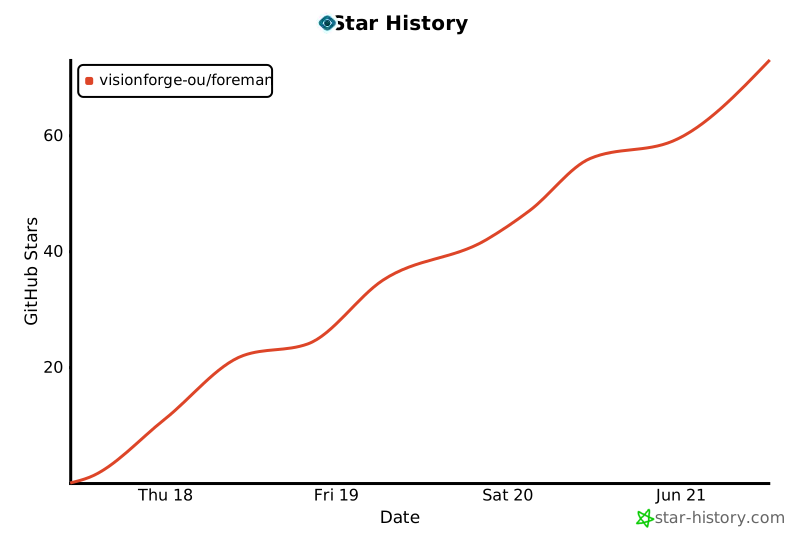](https://www.star-history.com/?repos=VisionForge-OU%2Fforeman&type=date&legend=top-left)
- ## Acknowledgements
- - Built on [Textual](https://textual.textualize.io/) for the TUI and the
- [Claude Code](https://claude.com/claude-code) CLI for the agents.
- - Vendored, headless-rewritten skills are forked from
- [mattpocock/skills](https://github.com/mattpocock/skills) (MIT),
- [obra/superpowers](https://github.com/obra/superpowers) (MIT), and Anthropic's
- skills — see [`NOTICE`](./NOTICE) for full attribution.
- ## License
- [MIT](./LICENSE). Portions derived from [mattpocock/skills](https://github.com/mattpocock/skills)
- and others (MIT) — see [`LICENSE`](./LICENSE) and [`NOTICE`](./NOTICE) for attribution.
Ratings and comments
Sign in to rate this skill.
Sign inFree to use. If it’s helped, pass it on.