dsh-agent-team-gui
Persistent multi-model workflow teams for DeepSeek Harness — dynamic lead planning, bounded DAGs, per-agent model/tools, Run Center and Token insights.
Safety scan
A static text scan, not a guarantee. Select the badge to see what was scanned and every finding.
Badge for your README

Markdown
[](/listings/toolclub--dsh-agent-team-gui)HTML
<a href="/listings/toolclub--dsh-agent-team-gui"><img src="/api/listings/toolclub--dsh-agent-team-gui/badge.svg" alt="findsafeskills safety rating" /></a>Install
Install instructions from the README
As written by the repo's author. findsafeskills has not verified these steps.
| Plugin release | DSH target | Upgrade guidance | | --- | --- | --- | | **1.3.0** | `>=0.1.5-rc.1 <0.1.6-0` | Recommended; selectable on-demand delegation and consistent mode boundaries | | 1.2.0 | `>=0.1.5-rc.1 <0.1.6-0` | Failure diagnosis and bounded lead-driven continuation | | 1.1.1 | `>=0.1.5-rc.1 <0.1.6-0` | Earlier workflow fixes; retries still replay the assignment | | 1.1.0 | `>=0.1.5-rc.1 <0.1.6-0` | Initial 0.1.5 compatibility; upgrade the plugin to 1.3.0 | | 1.0.1 | Verified with `0.1.1-rc.2` | Previous integration; upgrade both DSH and the plugin together |
The walkthrough has [English subtitles](https://github.com/toolclub/dsh-agent-team-gui/blob/main/docs/promotion/demo-captions.en.srt) and [Chinese subtitles](https://github.com/toolclub/dsh-agent-team-gui/blob/main/docs/promotion/demo-captions.zh-CN.srt). Load the SRT alongside the existing video in a compatible player; GitHub does not attach it automatically.
Upgrading DSH from 0.1.1? Use plugin **v1.3.0** for DSH **0.1.5**. This release fixes `source.subscribe` during plugin loading, migrates reconnect and Session APIs, and keeps the existing team definitions and run store. Restart DSH and refresh the browser after upgrading. The CLI may report `0.1.5-rc.1` while its compatible internal packages resolve to `0.1.5-rc.2`.
Requirements: a working DeepSeek Harness **Web** profile, at least one configured provider/model, Node.js `>=22.19.0 <23` or `>=24.0.0`, and pnpm. Declared DSH compatibility is `>=0.1.5-rc.1 <0.1.6-0`; the v1.3.0 release was verified against DSH `0.1.5-rc.1`.
**Recommended: install the compiled release package.** It includes the built Host and client files, so installation does not run this plugin's Git `prepare` build or require its `allowBuilds` entry.
dsh plugin --profile web add https://github.com/toolclub/dsh-agent-team-gui/releases/download/v1.3.0/dsh-agent-team-gui-1.3.0.tgz
dsh --profile web
Stop and restart an already-running DSH Web process after installing or upgrading. Then open **Settings → Teams**. If a plugin marketplace chooses Git installation and fails, use the direct release command above; see [installation troubleshooting](docs/first-team.md#installation-troubleshooting).
DSH `0.1.7-rc.2` is outside this release's declared host range; its installer rejects v1.3.0's peer ranges and rolls back the installation (reproduced on macOS arm64, Node 26.5.0, pnpm 12.6.0). Do not treat a change of installation source as runtime support. The Node engine range is not a claim that every newer Node/DSH combination has been tested.
For DSH Plugin Hub, use version **1.5.2** or later with a refreshed catalog. Hub 1.4.8 does not have the release-package channel. If the catalog still selects Git, use the direct command above. Hub caches the catalog for one hour and can reuse stale data when a refresh fails.
[Release notes and checksum](https://github.com/toolclub/dsh-agent-team-gui/releases/tag/v1.3.0) · [Git/source installation](#git-source-installation)
> [!TIP] > If `dsh` is not on `PATH`, use the launcher that starts your working Harness installation. > With npm, replace `dsh` with `npx @deepseek-ai/dsh@0.1.5-rc.1`; from a source checkout, replace > it with `pnpm --dir /absolute/path/to/deepseek-harness dsh`. Keep the same launcher for installation > and startup. New to Harness? Start with its [official setup guide](https://github.com/deepseek-ai/deepseek-harness#run).
Verify that both the `dsh-agent-team-gui` bundle and the `agent-team-gui` configuration row are present:
dsh --profile web --dump-config
What was scanned
The files the safety scan read, as written by the repository's author and shown as plain text. Lines with a finding are marked.
README.md · README · 487 lines
View this file on GitHub (read at the repository's current version: the scan did not record which commit it read)
- # dsh-agent-team-gui
- [English](README.md) | [简体中文](README-zh.md)
- [](https://github.com/toolclub/dsh-agent-team-gui/actions/workflows/ci.yml)
- [](https://github.com/toolclub/dsh-agent-team-gui/releases)
- [](https://github.com/toolclub/dsh-agent-team-gui/stargazers)
- [](LICENSE)
- **Give DeepSeek Harness a reusable team: one Agent plans, another implements, and a third reviews.**
- Save the team once, choose a model for each member, and reuse it across projects and conversations.
- Follow the plan, member outputs, retries, and provider-reported Token usage in one Run Center.
- This is an unofficial community plugin for the **DeepSeek Harness Web profile**.
- [Watch the 80-second UI guide](https://github.com/toolclub/dsh-agent-team-gui/blob/main/assets/promotion-walkthrough-zh.mp4) · [Install v1.3.0](#install) · [Run your first team](docs/first-team.md) ·
- [Example recipe](examples/full-stack-delivery.recipe.json) ·
- [Share a workflow](https://github.com/toolclub/dsh-agent-team-gui/discussions/1)
- [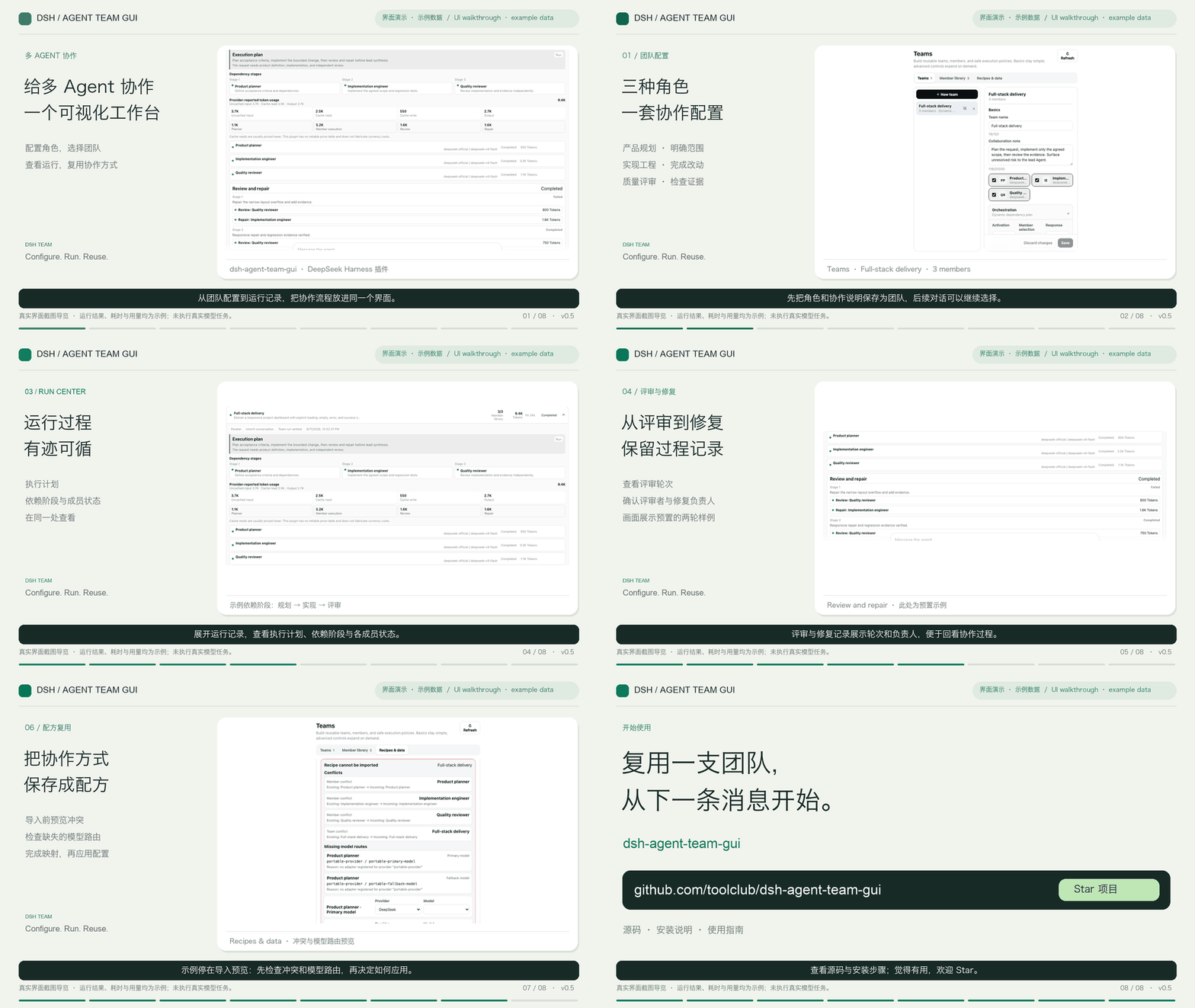](https://github.com/toolclub/dsh-agent-team-gui/blob/main/assets/promotion-walkthrough-zh.mp4)
- *Screenshot-based UI guide with example data and Chinese synthetic narration. Displayed task results, timings, and Tokens are not a live-run benchmark. [Sources and captions](docs/promotion/demo-guide.md).*
- If this is useful for your DSH workflow, [give the project a Star](https://github.com/toolclub/dsh-agent-team-gui)
- and help another developer discover it.
- ## Why this plugin
- A team is a reusable product object, not a one-off dispatch form. Create it once in **Settings →
- Teams**, then use it across projects and conversations.
- | Capability | User outcome |
- | --- | --- |
- | One model and tool policy per member | Combine a planner, implementer, reviewer, or specialist without forcing one route on everyone |
- | Dynamic workflow planning by default | The active conversation's model assigns focused work and dependencies from the current request |
- | Team / Solo / Inherited modes | Choose a durable conversation override, a project default, or a one-message exception without ambiguous switches |
- | Bounded DAG, retries, quality gate, background work | Long work is observable, cancellable, finite, and restart-safe |
- | Official provider Token usage | See input, cache-read, cache-write, and output Tokens with full/partial/unavailable coverage—never invented prices |
- | Versions, recipes, and definition backup | Reproduce a team, share it without credentials, preview impact, and remap model routes before applying |
- ## Install
- | Plugin release | DSH target | Upgrade guidance |
- | --- | --- | --- |
- | **1.3.0** | `>=0.1.5-rc.1 <0.1.6-0` | Recommended; selectable on-demand delegation and consistent mode boundaries |
- | 1.2.0 | `>=0.1.5-rc.1 <0.1.6-0` | Failure diagnosis and bounded lead-driven continuation |
- | 1.1.1 | `>=0.1.5-rc.1 <0.1.6-0` | Earlier workflow fixes; retries still replay the assignment |
- | 1.1.0 | `>=0.1.5-rc.1 <0.1.6-0` | Initial 0.1.5 compatibility; upgrade the plugin to 1.3.0 |
- | 1.0.1 | Verified with `0.1.1-rc.2` | Previous integration; upgrade both DSH and the plugin together |
- The walkthrough has [English subtitles](https://github.com/toolclub/dsh-agent-team-gui/blob/main/docs/promotion/demo-captions.en.srt)
- and [Chinese subtitles](https://github.com/toolclub/dsh-agent-team-gui/blob/main/docs/promotion/demo-captions.zh-CN.srt).
- Load the SRT alongside the existing video in a compatible player; GitHub does not attach it automatically.
- Upgrading DSH from 0.1.1? Use plugin **v1.3.0** for DSH **0.1.5**. This release fixes
- `source.subscribe` during plugin loading, migrates reconnect and Session APIs, and keeps the existing
- team definitions and run store. Restart DSH and refresh the browser after upgrading. The CLI may
- report `0.1.5-rc.1` while its compatible internal packages resolve to `0.1.5-rc.2`.
- Requirements: a working DeepSeek Harness **Web** profile, at least one configured provider/model,
- Node.js `>=22.19.0 <23` or `>=24.0.0`, and pnpm. Declared DSH compatibility is
- `>=0.1.5-rc.1 <0.1.6-0`; the v1.3.0 release was verified against DSH `0.1.5-rc.1`.
- **Recommended: install the compiled release package.** It includes the built Host and client files,
- so installation does not run this plugin's Git `prepare` build or require its `allowBuilds` entry.
- ```sh
- dsh plugin --profile web add https://github.com/toolclub/dsh-agent-team-gui/releases/download/v1.3.0/dsh-agent-team-gui-1.3.0.tgz
- dsh --profile web
- ```
- Stop and restart an already-running DSH Web process after installing or upgrading. Then open
- **Settings → Teams**. If a plugin marketplace chooses Git installation and fails, use the direct
- release command above; see [installation troubleshooting](docs/first-team.md#installation-troubleshooting).
- DSH `0.1.7-rc.2` is outside this release's declared host range; its installer rejects v1.3.0's peer ranges and rolls back the installation (reproduced on macOS arm64, Node 26.5.0, pnpm 12.6.0). Do not treat a change of installation source as runtime support. The Node engine range is not a claim that every newer Node/DSH combination has been tested.
- For DSH Plugin Hub, use version **1.5.2** or later with a refreshed catalog. Hub 1.4.8 does not have the release-package channel. If the catalog still selects Git, use the direct command above. Hub caches the catalog for one hour and can reuse stale data when a refresh fails.
- [Release notes and checksum](https://github.com/toolclub/dsh-agent-team-gui/releases/tag/v1.3.0) ·
- [Git/source installation](#git-source-installation)
- > [!TIP]
- > If `dsh` is not on `PATH`, use the launcher that starts your working Harness installation.
- > With npm, replace `dsh` with `npx @deepseek-ai/dsh@0.1.5-rc.1`; from a source checkout, replace
- > it with `pnpm --dir /absolute/path/to/deepseek-harness dsh`. Keep the same launcher for installation
- > and startup. New to Harness? Start with its [official setup guide](https://github.com/deepseek-ai/deepseek-harness#run).
- Verify that both the `dsh-agent-team-gui` bundle and the `agent-team-gui` configuration row are present:
- ```sh
- dsh --profile web --dump-config
- ```
- ## Run your first team
- Use the included [full-stack delivery recipe](examples/full-stack-delivery.recipe.json), with a
- planner, implementation engineer, and reviewer. You can bind all three to the same working model
- for the first run; multiple providers are optional.
- 1. Download the recipe JSON. Open **Settings → Teams → Recipes & data** and choose **Choose recipe file**.
- 2. Map the placeholder routes to your configured provider/model routes, review the preview, and choose
- **Create a copy → Import reviewed recipe**. In **Member library**, confirm each member's exact model and tool access.
- 3. For this first walkthrough, set **Team usage → Host dispatches first**, **Dispatch policy → Run assigned work**, and member selection to
- **All members**, then save. The supplied recipe otherwise uses Smart/adaptive selection.
- 4. Select an empty scratch project, choose the imported team beside the composer, select **Select team for this conversation**, and send the
- [ready-to-copy task](docs/first-team.md#try-a-small-development-task): build and test a small to-do list.
- 5. Open **Team runs** to inspect the plan, outputs, review, and actual Token coverage. Check the delivered
- files and test results before treating the task as complete.
- [Full walkthrough, expected results, and troubleshooting →](docs/first-team.md)
- ## Create your own team
- In **Settings → Teams → Member library**, save each member's role, model, optional fallback, and tool policy.
- In **Settings → Teams**, add those members and choose activation, member selection, and execution options.
- Leave **Fixed order** off for dynamic planning, or enable it for a fixed serial sequence.
- Choose **Team**, **Solo**, or **Inherited** beside the composer to control the current conversation.
- 
- *UI example with demonstration data.*
- ## How orchestration works
- ```mermaid
- flowchart TD
- U[User message] --> M{Effective mode and one-shot choice}
- M -->|Solo or Manual| L[Lead handles request directly]
- M -->|On demand| J{Lead decides whether delegation helps}
- J -->|No| L
- J -->|Missing information| A[Ask user]
- J -->|Yes: dispatch_to_squad| D[Validate and admit one initial dispatch]
- M -->|Host dispatch or Force Team next| D
- D --> P[Use explicit plan or invoke bounded planner]
- P -->|Smart skip| L
- P --> W[Dependency-ready members, failure policy, optional quality gate]
- W --> R[Persist results, diagnosis and reported usage]
- R --> L
- R -->|Lead reviews unfinished work| C[Bounded continue_squad_run]
- C -->|Reuse successes, shared budget, one continuation| W
- ```
- New editor drafts and built-in templates default to **Lead decides when to delegate**.
- Selecting a team makes it available; simple answers create no planning child or team run.
- Saved/imported choices and legacy missing-field defaults remain unchanged.
- [Full flow and edge-case contract](docs/on-demand-flow.md). Host background runs finish in Run Center;
- model-initiated tool dispatch waits for its result.
- After dispatch, when no explicit assignments/order are supplied and no fixed order exists, the plugin uses the active conversation's provider/model route in a bounded,
- tool-free planner child. It receives the member roles and returns structured assignments plus an
- acyclic dependency graph. It does not turn one member into a replacement for the whole team. A
- bad, cyclic, or unavailable plan falls back to deterministic role-scoped assignments.
- Ready DAG nodes run up to `maxConcurrency`. Dependants receive only bounded structured handoffs;
- full member output remains in durable run history. A fixed member order is an explicit serial
- override and bypasses DAG planning.
- ### Activation and selection
- - **Run assigned work** requires execution once dispatch has been chosen; it does not force on-demand delegation.
- - **Smart** lets the bounded planner skip unsuitable/trivial work.
- - **Manual** blocks ordinary automatic/model dispatch; explicitly choose Force Team next or a manual Run Center action.
- - **All members** assigns each configured member exactly once.
- - **Adaptive** lets Smart planning select the smallest useful non-empty subset.
- ### Conversation modes
- - **Team** is an explicit durable team selection for this conversation.
- - **Solo** is an explicit durable opt-out, even when the project has a default team.
- - **Inherited** removes the conversation override and follows the project default when one exists.
- - **Next message** is a separate crash-safe one-shot Team or Solo choice, consumed exactly once.
- These states remain interactive after page refresh, cold Host startup, and live reconnect. An empty
- or temporarily unavailable catalog never silently deletes a saved selection.
- ### Safety bounds
- - Planner, member, reviewer, and repair prompts put the exclusive role and no-delegation contract
- before a bounded excerpt of user content.
- - Delegated sessions cannot dispatch another team. Detected DSH subagent tools—including renamed
- registrations—are denied inside team children.
- - One durable claim binds automatic and model-tool dispatch to the latest human message, so repeated
- tool calls cannot create hundreds of duplicate teams.
- - Member timeout, concurrency, retry-once, soft team Token budget, and quality rounds are finite.
- - A retry creates a linked immutable run and replays the original normalized assignments, order,
- and DAG; it does not silently ask the model to invent a different workflow.
- ## Run Center and Token usage
- 
- Every execution is written before planning starts. The Run Center exposes foreground/background
- state, live phase, elapsed time, child IDs, complete outputs, bounded handoffs, stop, linked whole
- or member retry, export, filters, and retention-safe clear.
- If a DSH child settles with `stopReason: "error"` after delivering non-empty plain text, the member
- counts as **Completed** instead of losing a valid long-form deliverable. The stop reason remains
- recorded and Run Center shows a protocol-delivery warning. Empty output, rejected runs, cleanup
- failures, timeouts, and other non-completed reasons such as `max-tokens` remain failures.
- Each member handoff summary keeps up to 16,000 characters by default. A team may set
- `handoffSummaryMaxChars` from 1,000 to 32,000. Complete raw output remains durable in Run Center;
- dependency and lead prompts retain separate aggregate bounds so one long artifact cannot make model
- context unbounded.
- The plugin reuses DSH's official `tokenUsage` projection and keeps four buckets:
- - uncached input;
- - cache read;
- - cache write;
- - output.
- Planner, member, review, and repair usage remain separately attributable. Coverage is explicitly
- **full**, **partial**, or **unavailable** at run and retry-attempt level. Before a provider reports a
- sample, the UI says **Metering…** instead of showing a false zero. Tokens are not money; the plugin
- does not guess prices that Harness providers do not publish through a stable pricing contract.
- 
- ## Quality gate and background runs
- An optional quality gate names one reviewer, one repair owner, explicit criteria, and `0..2` repair
- rounds. A rejection can rerun only that repair owner, followed by the named reviewer. It cannot
- create arbitrary agents or recurse.
- Foreground runs finish before the lead Agent synthesizes bounded handoffs. Background runs return a
- short acknowledgement and stay visible in the plugin Run Center; when the official DSH Jobs service
- is present, the same run is also registered there with a shared cancel hook. Without that optional
- service, the plugin falls back to process-local background execution; a Host restart then reconciles
- unfinished durable state as **Interrupted** rather than pretending it completed.
- ## Versions, recipes, and definition backup
- 
- - Each saved team version includes immutable snapshots of all referenced member definitions.
- - Restore is preview-first and warns when a shared member would change another team.
- - Recipes contain one team and its members, never provider credentials. Import supports **Copy** or
- **Merge**, conflict preview, and separate primary/fallback route remapping.
- - Definition backup exports agents and teams. Import is preview-first with **Merge** or **Replace**;
- replace reports deletions, dangling mode/default cleanup, and affected teams before confirmation.
- - Multi-table writes are serialized and use compensating rollback on validation, cancellation, or
- storage failure. Readers see either the previous or committed definition graph, not a half-import.
- - Remote recipe URLs are disabled in v0.5. Import a reviewed local JSON file; this intentionally
- avoids exposing an unprotected server-side fetch/SSRF surface.
- Start with the credential-free
- [full-stack delivery recipe](examples/full-stack-delivery.recipe.json), preview it, and remap its
- `your-provider / your-model` placeholders to routes configured in your own DSH profile.
- Definition exports include member system prompts and model route names. Run exports additionally
- include the user task and member outputs. Review those files before sharing them.
- ## Settings reference
- ### Member
- | Field | Meaning |
- | --- | --- |
- | Name and role prompt | Durable identity and exclusive instructions for this member |
- | Primary provider/model | Existing DSH route; credentials stay in DSH |
- | Fallback provider/model | Optional paired route for retry-once |
- | `maxTokens` | Hard per-attempt output ceiling sent to the provider |
- | Tool allow/deny | Least-privilege visibility for registered DSH tools; recursive team/subagent tools remain denied |
- ### Team
- | Field | Meaning |
- | --- | --- |
- | Members and collaboration note | Reusable member definitions plus team-level coordination guidance |
- | Fixed order | Complete serial permutation; leave off for dynamic assignments and DAG dependencies |
- | Execution/context | Serial or bounded parallel; `spawn`, `fork`, or serial-only `chain` |
- | Activation/selection | Always, Smart, or Manual; all members or adaptive subset |
- | Response | Foreground synthesis or observable background run |
- | Planner | Current/recent/full context and a bounded planner Token ceiling |
- | Resilience | Continue, stop, or retry-once; member timeout and fallback route |
- | Limits | Maximum concurrency and a soft provider-reported team Token budget |
- | Handoff summary | Per-member summary ceiling in characters; blank uses 16,000, configurable from 1,000–32,000 |
- | Quality | Named reviewer, repair owner, criteria, and at most two repair rounds |
- 
- ## Host configuration
- The Web bundle inserts one unique Host row; it relies on the Web profile's existing storage,
- Connection RPC, models, sessions, and browser module services.
- ```yaml
- - id: agent-team-gui
- name: dsh-agent-team-gui
- config:
- defaultProvider: spawn
- defaultExecutionMode: serial
- defaultContextMode: spawn
- historyMaxRuns: 0
- historyMaxAgeDays: 0
- versionMaxPerSquad: 0
- ```
- | Field | Default | Meaning |
- | --- | --- | --- |
- | `defaultProvider` | `spawn` | Registered DSH subagent provider |
- | `defaultExecutionMode` | `serial` | Effective mode when a team omits it |
- | `defaultContextMode` | `spawn` | Effective context when a team omits it |
- | `historyMaxRuns` | `0` | Count retention; `0` disables automatic run deletion |
- | `historyMaxAgeDays` | `0` | Age retention in days; `0` disables automatic run deletion |
- | `versionMaxPerSquad` | `0` | Version retention per team; `0` disables automatic version deletion |
- If you override the row in a profile patch, restate every needed field: DSH patch rows replace the
- complete `config` object rather than deep-merging it. `chain` is valid only for serial execution.
- Retention is deliberately opt-in: upgrading to v0.5 does not silently delete existing run history
- or team versions. Set a positive limit only when automatic cleanup is the behavior you want.
- ## Other installation paths
- ### Git source installation
- Use this alternative when you intend to build from source:
- ```sh
- dsh plugin --profile web add -w github:toolclub/dsh-agent-team-gui#v1.3.0
- ```
- Git dependencies run this repository's `prepare` build. On pnpm 10+, authorize only the exact
- package key pnpm prints under `allowBuilds` in the profile's `pnpm-workspace.yaml`, then repeat the
- same pinned command. The key can include the resolved revision; copy the actual key from the error.
- This grants that dependency permission to execute build scripts. The compiled release path above
- avoids this step.
- ### Exact commit
- Resolve and review a full commit SHA, then use the same `allowBuilds` rule as the tagged Git install:
- ```sh
- dsh plugin --profile web add -w github:toolclub/dsh-agent-team-gui#<full-commit-sha>
- ```
- This is the most reproducible source install. The release CI performs the same fresh-profile check
- against the exact pushed revision.
- ### Local checkout
- From this repository:
- ```sh
- pnpm install --frozen-lockfile
- pnpm run preflight
- dsh plugin --profile web add -w .
- ```
- `preflight` type-checks Host, Client, and tests; runs Host/rendered Client suites; builds from a clean
- output directory; audits the tarball and secrets; and boots an isolated temporary DSH Web profile.
- ### Compiled tarball
- ```sh
- mkdir -p dist
- pnpm pack --pack-destination dist
- dsh plugin --profile web add -w ./dist/dsh-agent-team-gui-1.3.0.tgz
- ```
- The package audit verifies runtime/declaration closure, examples, governance files, screenshots,
- source maps, external dependency declarations, no absolute paths, no symlinks, and no known
- credential patterns.
- ### Ask a terminal-capable Agent
- You can send this single instruction inside DeepSeek Harness:
- > Follow the installation and security notes in
- > https://github.com/toolclub/dsh-agent-team-gui. Install the compiled v1.3.0 Release tarball into
- > the Web profile, restart Web, verify the composed configuration, and report the installed version
- > and installation source.
- ## Model tool and public service
- `dispatch_to_squad` remains available for explicit/manual model-driven use. It accepts a team ID or
- unique case-insensitive name, a task, optional assignments/order, and execution/context overrides
- where the saved team permits them. Its model-facing result is bounded; the complete canonical run is
- durable and available through the Run Center/export.
- The package also exports `AgentTeamService`, record/result types, Zod schemas, and the in-process
- definition/dispatch/version/recipe/run APIs. Treat those APIs as developer-preview surfaces while
- DSH itself is pre-stable.
- ## Security and privacy
- - Plugin RPC uses `/api/agentTeamGui` behind DSH's browser-session cookie authentication and
- Host/Origin checks. Requests and results are validated; there is no separate unauthenticated channel.
- - Provider credentials are never copied into plugin records, recipes, examples, logs, or exports.
- - Durable local storage does contain team role prompts, selected route names, conversation/project
- identifiers, user tasks, run outputs, errors, and Token usage. Protect the DSH home directory.
- - Use least-privilege member tools. A model may perform any action that its allowed DSH tools permit.
- - URL recipe fetching is disabled. Installation scripts are the only extra machine-code authority;
- review and pin Git dependencies or use a compiled tarball.
- - Report vulnerabilities privately using [SECURITY.md](SECURITY.md), not a public issue containing
- credentials or private prompts.
- ## Compatibility and limitations
- Dependency and repair chains have a separate 12,000-character serialized JSON budget; quality
- review chains have 32,000 characters. These are independent of the per-member stored summary limit.
- Chains reserve member identities, share space across deliveries, and report `chainTruncated` and
- `omittedHandoffs`. Full outputs remain in Run Center. Review rounds use the reviewer's configured
- `maxTokens`, with 2,048 only as the default when unset.
- `retry-once` now diagnoses failures before retrying. Explicit billing exhaustion, cancellation,
- or an exhausted configured budget stops recovery. A tool-free system coordinator on the lead's
- model route assesses failure evidence and prior progress. Only a supported transient failure is
- retried in place; structural changes are proposed to the lead, not silently executed.
- The lead can call `continue_squad_run` after a failed/partial run settles, referencing its run id
- and chain revision. The first release allows **one continuation per execution chain**. It reuses
- independent successful tasks and reruns affected descendants, retains both plans/results, and
- shares the original configured soft Token budget. Duplicate submissions return the accepted
- result; changed wording does not reset admission. Same-message initial dispatch remains limited
- to one. Run Center manual retry remains a separate explicit replay initiated by the user.
- Continuation keeps one task node per existing member. Split remaining work into ordered steps;
- adding multiple independent nodes for the same member or a new team is not supported yet.
- See [execution chains and recovery](docs/execution-chains.md) for the contract and limits.
- For DSH 0.1.5, global deny entries are filtered against the global registry while scoped allows
- remain intact. An execution guard also blocks recognized delegation tools and explicit member
- denies on marked in-process children. DSH has no universal delegation capability tag: custom tools
- with unrelated schemas and arbitrary external programs are not an OS-level sandbox boundary.
- - Web profile only; there is no headless Settings UI. The exported Host service can still be used by
- another in-process plugin that supplies the required services.
- - Declared compatibility is DSH `>=0.1.5-rc.1 <0.1.6-0`; CI currently verifies DSH `0.1.5-rc.1`. DSH and this
- plugin are both pre-stable, so pin versions.
- - Old v0.4 durable definitions and v1 exports remain readable/importable. Editing them must satisfy
- the safer v0.5 new-write limits. A legacy run without a stored plan cannot be faithfully retried
- and is rejected with an explanation.
- - Provider Token projections are optional. Partial/unavailable coverage is expected and explicit.
- - A soft team Token budget prevents later scheduling; it cannot stop an already-running provider at
- the exact threshold. Per-member `maxTokens` is the hard provider bound.
- - DSH currently offers no supported registration seam for custom durable `squad/*` Session event
- types. The plugin uses its durable run store, standard child sessions/tool events, Jobs, and logs.
- - Model-tool trigger mode is best-effort because DSH exposes no `toolChoice` control. Guaranteed
- normal-send mode is Host-driven and durable-message-idempotent.
- ## Verification and project health
- ```sh
- pnpm run typecheck
- pnpm run test
- pnpm run build
- pnpm run audit:pack
- pnpm run smoke:install
- pnpm run smoke:browser
- ```
- CI runs Node 22.19 and Node 24, a fresh DSH `0.1.5-rc.1` Web profile, browser keyboard/accessibility/reconnect
- journeys, exact Git revision installation, and the community plugin doctor. The detailed product
- contract and evidence matrix live in [docs/v0.5-product-spec.md](docs/v0.5-product-spec.md) and
- [docs/v0.5-acceptance.md](docs/v0.5-acceptance.md).
- ## Contributing
- Read [CONTRIBUTING.md](CONTRIBUTING.md), the [Code of Conduct](CODE_OF_CONDUCT.md), and
- [SECURITY.md](SECURITY.md). The concise Chinese tutorial
- [从零开发一个 DeepSeek Harness 插件](docs/developing-a-deepseek-harness-plugin.zh-CN.md) explains
- `apply`, Service plugins, profile/bundle wiring, local verification, and GitHub installation using
- official Harness references.
- Issues should include the exact DSH/plugin versions and a sanitized minimal reproduction. Pull
- requests should add focused regression evidence and keep compatibility, bounded execution,
- accessibility, privacy, and package closure in scope.
- If this workflow helps, a [GitHub Star](https://github.com/toolclub/dsh-agent-team-gui) makes it
- easier for other DSH users to discover. Real recipes, screenshots, and honest bug reports help even
- more.
- ## Uninstall
- ```sh
- dsh plugin --profile web remove dsh-agent-team-gui
- ```
- Removing the package does not automatically delete durable plugin tables in the configured DSH
- storage backend.
- ## License
- Released under the [MIT License](LICENSE).
Ratings and comments
Sign in to rate this skill.
Sign inFree to use. If it’s helped, pass it on.