agentdescent
Safety scan
A static text scan, not a guarantee. Select the badge to see what was scanned and every finding.
Check it deeper on your machine
It has changed since its scan on 13 Nov 2026.
As a Claude Code plugin, install it and then ask Claude Code:
/plugin marketplace add keithmackay/mackayi/plugin install scanskillsafety@mackayiDo a deep scan of https://github.com/ThinkFlowLab/agentdescent with scanskillsafety
Or from a terminal, clone it and run it:
git clone https://github.com/keithmackay/scanskillsafety-skill ~/.claude/skills/scanskillsafetynode ~/.claude/skills/scanskillsafety/cli.cjs --deep 'https://github.com/ThinkFlowLab/agentdescent'
It checks the exact commit: every file, its packages against OSV (api.osv.dev), how it compares with this page's scan (findsafeskills.com receives the repository's address), and, if you agree, Claude reading every file with your own Claude subscription. It never runs the code.
Badge for your README

Markdown
[](/listings/thinkflowlab--agentdescent)HTML
<a href="/listings/thinkflowlab--agentdescent"><img src="/api/listings/thinkflowlab--agentdescent/badge.svg" alt="findsafeskills safety rating" /></a>Install
Install instructions from the README
As written by the repo's author. findsafeskills has not verified these steps.
pip install "agentdescent[mcp]>=0.10.0"
agentdescent demo                         # a complete evolution, offline, no API key, ~10 s
agentdescent doctor                       # which agent CLIs and provider keys this machine has
Host / MCP default loop is **Path A** (`doctor` → `plan` → `start` → `apply`); advanced MCP tools need `agentdescent mcp --advanced` — see [docs/mcp-path-a.md](docs/mcp-path-a.md).
`[mcp]` adds the agent-facing MCP server and needs Python ≥ 3.10; the library itself supports 3.9, where you drop `[mcp]` and drive it with the CLI. Research examples are outside the wheel: to run `python -m examples.run_demo` or any algorithm port, clone the repo and follow [install and first run](docs/install.md#source-examples):
git clone https://github.com/ThinkFlowLab/agentdescent && cd agentdescent
pip install -e ".[dev,mcp]"
`agentdescent demo` builds a skill whose rules name the wrong CSV column, twelve cases with known totals and a local program as the agent, then runs the real loop — only the model is replaced — and ends with:
held-out reward: 1.000 outcomes: {'committed': 1}
what it learned: rules.md -> 'COLUMN: amount'What was scanned
The files the safety scan read, as written by the repository's author and shown as plain text. Lines with a finding are marked.
.claude-plugin/marketplace.json · Manifest · 17 lines
- {
- "name": "agentdescent",
- "owner": {
- "name": "Birfy"
- },
- "metadata": {
- "description": "AgentDescent: evolve your skills, agents and plugins."
- },
- "plugins": [
- {
- "name": "agentdescent",
- "source": "./integrations/claude-code",
- "description": "Evolve skills, agents, prompts, code and plugins against examples with a parallel, merge-based optimiser.",
- "version": "0.10.0"
- }
- ]
- }
README.md · README · 279 lines
- # AgentDescent
- **[Website & interactive demo](https://thinkflowlab.github.io/agentdescent/)** ·
- [Get started](https://thinkflowlab.github.io/agentdescent/install/) ·
- [Documentation](https://thinkflowlab.github.io/agentdescent/docs/)
- > **Gradient descent — but the parameters are agents.** AgentDescent evolves
- > prompts, skills, agent directories, agent code and host plugins against your
- > own examples. *N* workers propose edits **in parallel**, one aggregator merges
- > them into a version-controlled artifact, and a held-out gate decides what is
- > kept. Use it from Python with one `evolve()` call, from the CLI, or from inside
- > Claude Code, Codex, OpenCode, DeepSeek Harness or Grok Bot — and swap in any of
- > the named algorithms or twenty-three published-method ports on the same engine.
- [](https://pypi.org/project/agentdescent/)
- [](https://github.com/ThinkFlowLab/agentdescent/actions/workflows/tests.yml)
- [](https://thinkflowlab.github.io/agentdescent/)
- [](https://www.python.org/)
- [](https://github.com/ThinkFlowLab/agentdescent/blob/main/LICENSE)
- ## Install
- ```bash
- pip install "agentdescent[mcp]>=0.10.0"
- agentdescent demo # a complete evolution, offline, no API key, ~10 s
- agentdescent doctor # which agent CLIs and provider keys this machine has
- ```
- Host / MCP default loop is **Path A** (`doctor` → `plan` → `start` → `apply`); advanced MCP tools need `agentdescent mcp --advanced` — see [docs/mcp-path-a.md](docs/mcp-path-a.md).
- `[mcp]` adds the agent-facing MCP server and needs Python ≥ 3.10; the library
- itself supports 3.9, where you drop `[mcp]` and drive it with the CLI. Research examples are outside the wheel: to run
- `python -m examples.run_demo` or any algorithm port, clone the repo and follow
- [install and first run](docs/install.md#source-examples):
- ```bash
- git clone https://github.com/ThinkFlowLab/agentdescent && cd agentdescent
- pip install -e ".[dev,mcp]"
- ```
- `agentdescent demo` builds a skill whose rules name the wrong CSV column, twelve
- cases with known totals and a local program as the agent, then runs the real
- loop — only the model is replaced — and ends with:
- ```
- held-out reward: 1.000 outcomes: {'committed': 1}
- what it learned: rules.md -> 'COLUMN: amount'
- ```
- ## 60-second quickstart
- Runnable as-is — no API key, no dependencies. Three functions are the whole
- contract: how to run a task, how to score it, and what to propose on a failure.
- ```python
- from agentdescent import Task, evolve
- tasks = [Task(id=f"t{i}", prompt=f"item {i}") for i in range(12)]
- def reward(task, output): # must return [0, 1]
- return 1.0 if "2026" in output else 0.0
- def run(rendered, task): # your solver
- return "answer" + (" 2026" if "year" in rendered else "")
- def propose(rendered, task, output, reward): # what to add on a failure
- return "always state the year"
- result = evolve(tasks, reward, run=run, propose=propose,
- rounds=6, n_workers=3, max_concurrency=3)
- print(result.rendered, result.final_reward, result.error)
- ```
- ### With a real model and a real dataset
- Credentials are read from the environment at call time — never from code — and
- the base URL picks the provider
- ([every provider →](https://thinkflowlab.github.io/agentdescent/agents/#configuring-your-provider-and-key)):
- ```bash
- export OPENAI_BASE_URL=https://api.deepseek.com # or GLM, Ark, a local vLLM, OpenAI itself
- export OPENAI_API_KEY=sk-... # your key for *that* endpoint
- ```
- ```python
- from agentdescent import SingleSlot, evolve, openai_compatible, reflector, scorer, tasks_from
- from agentdescent.dataloader import hf_rows
- rows = hf_rows("hotpotqa/hotpot_qa", "validation", config="distractor", limit=40)
- model = openai_compatible(model="deepseek-v4-flash")
- tasks = tasks_from(rows, prompt="question", gold="answer") # rows -> Task objects
- run = lambda instruction, task: model(f"{instruction}\n\n{task.prompt}")
- result = evolve(tasks, scorer("exact"), run=run, propose=reflector(model),
- strategy=SingleSlot(initial_value="You are a helpful assistant."),
- rounds=8, n_workers=8, max_concurrency=8, held_out_frac=0.3,
- patience=3, target_reward=0.98)
- print(result.rendered) # the instruction it learned
- print(result.final_reward) # held-out reward
- print(result.outcomes()) # why it went that way
- ```
- On 40 HotpotQA items (12 held out) this took held-out exact match from **0.167
- to 0.583**, learning *"Respond with only the requested answer, omitting any extra
- explanation or restatement."* That evolves an **instruction** (`SingleSlot`), not
- an Agent Skill folder — for a library run `agentdescent demo --kind skill_library`.
- Pass `agent=LLMAgent(claude_code())` (or any
- [agent or LLM](https://thinkflowlab.github.io/agentdescent/agents/)) instead of
- `run`/`propose` to evolve against a tool-using CLI agent.
- [Quickstart — dataset to skill →](https://thinkflowlab.github.io/agentdescent/quickstart-skill/)
- ### From the CLI, on a file or directory
- ```bash
- agentdescent init ./my-skill --data cases.jsonl --out spec.json # cases: {"prompt": ..., "gold": ...} per line
- agentdescent plan spec.json # validates and prices it; runs nothing
- agentdescent evolve spec.json --detach
- agentdescent status # then: show <run_id>, apply <run_id> --dry-run, apply <run_id>
- ```
- Nothing is written back until `apply`, which backs up first.
- ## Call any algorithm
- Every named algorithm is a set of defaults over the same engine, selectable by
- name from the CLI, a spec, MCP, or the host plugins:
- ```bash
- agentdescent algorithms list # ace, archive_selection, dgm, evoskill, gepa, rrsi, skillopt, …
- agentdescent algorithms show gepa # what it changes, its parameters
- agentdescent algorithms run gepa ./prompt.txt cases.jsonl --rounds 1 --workers 1 # writes a spec and plans it
- agentdescent demo --algorithm archive_selection # watch one run offline
- ```
- In a spec it is one field — `"algorithm": "gepa"` or
- `{"name": "gepa", "params": {...}}` — and every explicit field still wins.
- [The catalog →](https://thinkflowlab.github.io/agentdescent/algorithms/)
- **Cards vs ports:** Path A names **cards** (wheel mechanism slices). The
- **twenty-three research ports** are source-only under `examples/` — same slug is
- not the same fidelity; never read a card run as paper numbers
- ([decision tree](https://thinkflowlab.github.io/agentdescent/algorithm-decision-tree/), #384).
- Ports run from a checkout, each with a `--dry-run` that needs no API key:
- * **Benchmark-faithful (8):** ACE · GEPA · EvoSkill · SkillOpt · ADAS · DGM ·
- OpenEvolve · ERA
- * **Microports and analogues (15):** PromptBreeder · AFlow · Self-Refine ·
- Reflexion · SICA · Gödel Agent · Voyager · SkillWeaver · Absolute Zero ·
- R-Zero · Agent0 · gskill · TextGrad · Dynamic Cheatsheet · Genesis
- ```bash
- python -m examples.gepa.gepa_prompt_evolution --dry-run
- python -m examples.ace.ace_context_evolution --model claude-haiku-4-5 --async # barrier-free
- ```
- Fidelity is declared per port and follows each project's *released code*;
- analogues are not benchmark reproductions.
- [All twenty-three, with measured results →](https://thinkflowlab.github.io/agentdescent/self-evolution-examples/)
- ## Add an algorithm
- * **A named card, in one PR** — a `build(ctx, params) -> Overrides` that fills
- [policy slots](https://thinkflowlab.github.io/agentdescent/policy-guide/) and
- `evolve()` knobs. Copy `agentdescent/algorithms/_TEMPLATE.py`, register it, and
- regenerate the catalog with `python -m tools.gen_algorithms_docs`.
- [Register a named Algorithm card →](https://thinkflowlab.github.io/agentdescent/algorithm-authoring/)
- * **From your own package** — no fork needed; expose it as an entry point and
- `agentdescent algorithms list` picks it up:
- ```toml
- [project.entry-points."agentdescent.algorithms"]
- my_method = "my_pkg:ALGORITHM"
- ```
- * **A full research port** — [porting checklist](docs/porting-checklist.md)
- (benchmark-faithful) or [MethodPolicy checklist](docs/porting-methodpolicy.md)
- (microports).
- ## Use it from your agent
- The same engine as a **plugin**: a shared skill teaches the host when to reach
- for it, an MCP server exposes `doctor / plan / start / status / show / apply /
- cancel / resume` (and the algorithm, audit and archive tools), and the CLI
- mirrors them, so a run started from an agent can be inspected from a shell.
- | host | install | then |
- |---|---|---|
- | Claude Code | `agentdescent install claude-code` | `claude --plugin-dir ~/.agentdescent/plugins/claude-code` |
- | Codex | `codex plugin marketplace add ThinkFlowLab/agentdescent && codex plugin add agentdescent@agentdescent` | `codex mcp list` |
- | OpenCode | `agentdescent install opencode` | `opencode mcp list` |
- | DeepSeek Harness | `agentdescent install dsh` | `dsh --profile web --dump-config \| grep agentdescent` |
- | Grok Bot | `agentdescent install grok-bot` (a scaffold, not one-click) | read `HOST.md`; MCP via `agentdescent mcp --transport streamable-http` behind an HTTPS tunnel |
- From a checkout, `bash scripts/setup-hosts.sh` installs AgentDescent and wires
- every agent CLI it finds. Then say *"improve this prompt against these
- examples"* inside the agent: it runs `doctor`, writes a spec, **quotes the call
- count before starting**, waits for your yes, runs detached, and asks again
- before it writes anything back. No cases yet is not a blocker — it drafts 8–20
- for you to check first.
- `kind` is `text`, `skill_dir`, `skill_library` (multi-file `*/SKILL.md` tree),
- `agent_dir`, `agent_code`, `policy_slot` — or **`plugin`**: the host plugins
- themselves are evolvable, each rollout in an isolated copy of the host with
- hooks and permissions frozen and a recursion guard. Flagship library demo:
- `agentdescent demo --kind skill_library`.
- [The plugin, step by step →](https://thinkflowlab.github.io/agentdescent/plugin-quickstart/)
- · [set it up and test it →](https://thinkflowlab.github.io/agentdescent/testing-guide/)
- ## How it works
- 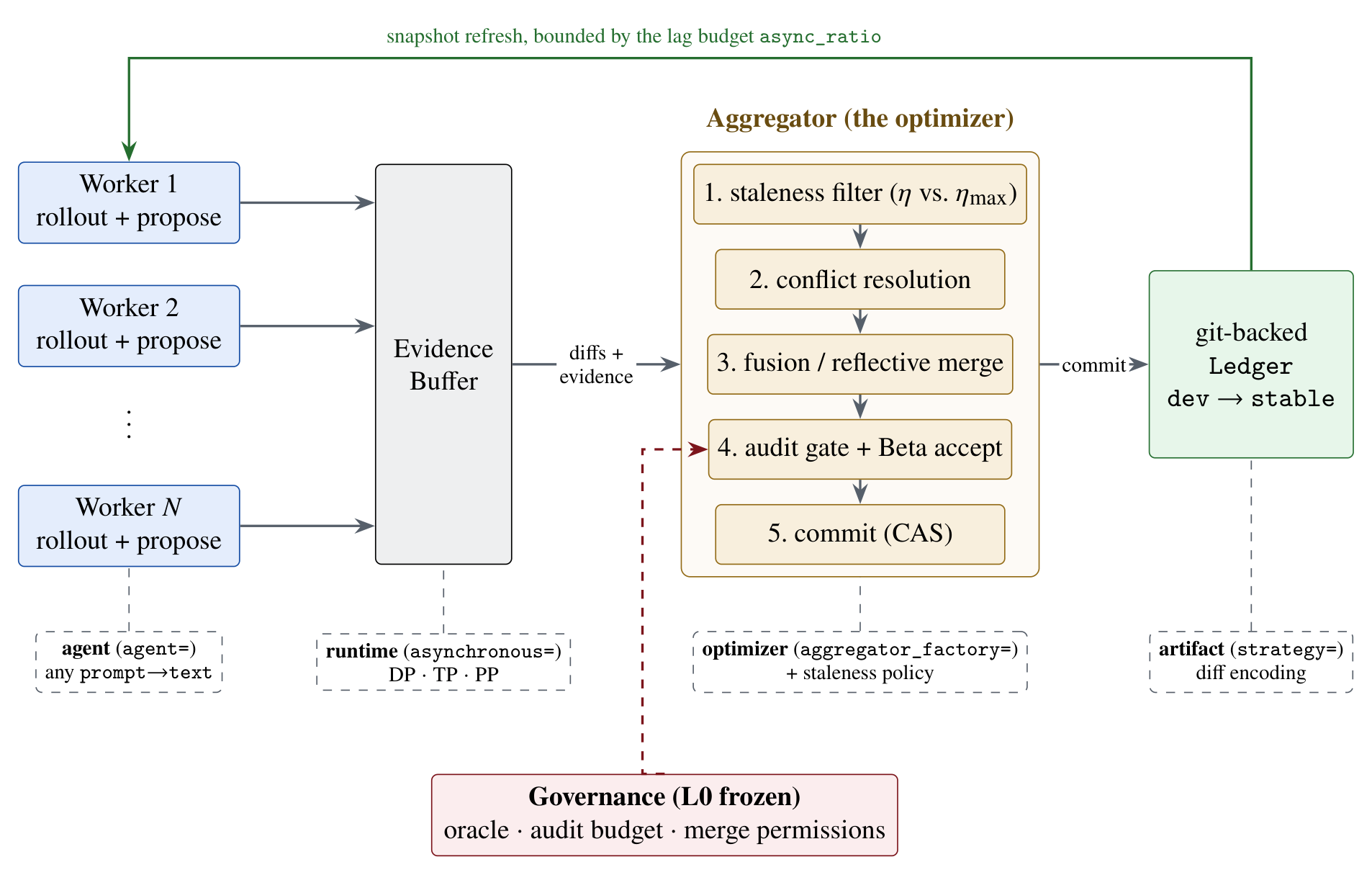
- Serial self-improvement is bounded at one accepted change per iteration;
- merging concurrent edits is the attempt to lift that bound. The analogy breaks
- exactly where the design lives: **gradients add, diffs do not**, so aggregation
- is conflict resolution, fusion, statistical acceptance and a transactional
- commit rather than averaging. The governance layer (red) is deliberately *not* a
- seam — a self-modifying system must not be able to replace its own evaluator.
- The figure is regenerated from TikZ by
- [`tools/gen_architecture_figure.py`](tools/gen_architecture_figure.py).
- **What you can replace.** Two `typing.Protocol` seams carry the algorithm:
- * **the strategy — what evolves.** `AppendRules` (lessons; proposals almost
- always fuse), `KeyedRules` (one entry per category), `FileTree` (a directory,
- one key per path), `SingleSlot` (one value; proposals always contradict), or
- your own three-method class. Its key space decides whether concurrent edits
- can fuse at all.
- * **eight policy slots — the rules of evolution:** `selection`,
- `task_sampler`, `proposal`, `staleness`, `conflict`, `fusion`, `acceptance`,
- `promotion`. Each defaults to the shipped rule; a driver *refuses* a field it
- cannot honour rather than ignoring it. Mechanisms that need state the
- pipeline does not keep take the `aggregator_factory` exit.
- [How to fill a slot →](https://thinkflowlab.github.io/agentdescent/policy-guide/)
- ## What it measures
- Every row names the setting that produced it; [the results
- page](https://thinkflowlab.github.io/agentdescent/results/) also reports the
- runs where there was nothing left to learn.
- | | measured | setting |
- |---|---|---|
- | An artifact held in **one key**, where a keyed union can never fuse | keyed union fuses **0 of 48** merges · reflective merge **42 of 48** | BBH `dyck_languages`, `GLM-5.2`, *N*=4, 4 seeds |
- | What that costs, at a pinned rollout budget | **40% fewer model calls** (95% CI 27–54%, same direction on every seed) | the same runs |
- | Wall-clock against a *faithful* serial control | median **6.8×** (three seeds, 3.1–9.5×) | GEPA on HotpotQA, *N*=4, 16 rollouts pinned |
- | The one-call path, end to end | held-out exact match **0.167 → 0.583** | 40 HotpotQA items, 12 held out |
- Quality is claimed only where the design can support it: intervals rather than
- *p*-values where a comparison cannot reach significance, and it says so.
- ## Documentation
- Full docs: **[thinkflowlab.github.io/agentdescent](https://thinkflowlab.github.io/agentdescent/)**.
- | | |
- |---|---|
- | **Start** | [Install](https://thinkflowlab.github.io/agentdescent/install/) · [The plugin, step by step](https://thinkflowlab.github.io/agentdescent/plugin-quickstart/) · [Quickstart — dataset to skill](https://thinkflowlab.github.io/agentdescent/quickstart-skill/) · [Evolve a directory](https://thinkflowlab.github.io/agentdescent/quickstart-directory/) · [Evolve agent code](https://thinkflowlab.github.io/agentdescent/quickstart-agent-code/) |
- | **Agents** | [Use it from your agent](https://thinkflowlab.github.io/agentdescent/plugins/) · [Set it up and test it](https://thinkflowlab.github.io/agentdescent/testing-guide/) · [Agents & LLMs](https://thinkflowlab.github.io/agentdescent/agents/) |
- | **Algorithms** | [Named algorithms](https://thinkflowlab.github.io/agentdescent/algorithms/) · [Register a card](https://thinkflowlab.github.io/agentdescent/algorithm-authoring/) · [Twenty-three ports](https://thinkflowlab.github.io/agentdescent/self-evolution-examples/) · [Port fidelity](https://thinkflowlab.github.io/agentdescent/port-fidelity/) |
- | **Engine** | [The `evolve()` method](https://thinkflowlab.github.io/agentdescent/evolution/) · [Strategies](https://thinkflowlab.github.io/agentdescent/strategies/) · [Policies](https://thinkflowlab.github.io/agentdescent/policies/) · [Architecture](https://thinkflowlab.github.io/agentdescent/architecture/) · [Concepts](https://thinkflowlab.github.io/agentdescent/concepts/) · [API reference](https://thinkflowlab.github.io/agentdescent/api/) |
- | **Results** | [Measured results](https://thinkflowlab.github.io/agentdescent/results/) · [Efficiency](https://thinkflowlab.github.io/agentdescent/efficiency/) · [Runtime matrix](https://thinkflowlab.github.io/agentdescent/matrix-overview/) |
- ## Citing, scope and contributing
- Use GitHub's **Cite this repository** button ([`CITATION.cff`](CITATION.cff));
- per-result raw data is in [`bench/results/`](bench/results/).
- A **research reference implementation**, not a production system. The novelty is
- a narrow engineering synthesis — concurrent, staleness-bounded,
- conflict-resolved diff-level merge over a git-backed versioned ledger — and its
- throughput premise is a testable hypothesis rather than community consensus.
- Contributions welcome: [CONTRIBUTING.md](CONTRIBUTING.md). The suite is offline
- and deterministic, so `pytest -q` needs no API key.
Ratings and comments
Sign in to rate this skill.
Sign inFree to use. If it’s helped, pass it on.