orbi
Open-source (AGPL-3.0), self-hostable lights-out software factory for the agent era: label a GitHub Issue, get an independently reviewed, merged PR and a tagged release.
Safety scan
A static text scan, not a guarantee. Select the badge to see what was scanned and every finding.
Check it deeper on your machine
It has changed since its scan on 11 Nov 2026.
As a Claude Code plugin, install it and then ask Claude Code:
/plugin marketplace add keithmackay/mackayi/plugin install scanskillsafety@mackayiDo a deep scan of https://github.com/orbi-build/orbi with scanskillsafety
Or from a terminal, clone it and run it:
git clone https://github.com/keithmackay/scanskillsafety-skill ~/.claude/skills/scanskillsafetynode ~/.claude/skills/scanskillsafety/cli.cjs --deep 'https://github.com/orbi-build/orbi'
It checks the exact commit: every file, its packages against OSV (api.osv.dev), how it compares with this page's scan (findsafeskills.com receives the repository's address), and, if you agree, Claude reading every file with your own Claude subscription. It never runs the code.
Badge for your README

Markdown
[](/listings/orbi-build--orbi)HTML
<a href="/listings/orbi-build--orbi"><img src="/api/listings/orbi-build--orbi/badge.svg" alt="findsafeskills safety rating" /></a>Install
Install instructions from the README
As written by the repo's author. findsafeskills has not verified these steps.
git clone https://github.com/orbi-build/orbi.git && cd orbi
uv tool install --force --reinstall --editable --python python3 .  # compatible system Python (>= 3.14, e.g. Fedora 43 / current Arch); older (e.g. Ubuntu 24.04's 3.12): --python 3.14 so uv provisions it
Want just the CLI? It's on PyPI as [`orbi-cli`](https://pypi.org/project/orbi-cli/) (requires Python ≥ 3.14; the command stays `orbi`): `uv tool install orbi-cli` (older system Python: add `--python 3.14` so uv provisions one) or `pip install orbi-cli` in a Python ≥ 3.14 environment; verify with `orbi --version` → `orbi <version>`, uninstall with `uv tool uninstall orbi-cli`. To run Orbi itself, use the one-line installer at the top of [Getting started](docs/getting-started.mdx) — it creates the editable install Orbi's deployment drives.
Ready check (before setup)
- `uv`: `uv --version`; Pi and its provider: `pi --version`, then `pi --print "reply with the single word: ok"` - GitHub CLI ≥ 2.94 ([official repository](https://github.com/cli/cli/blob/trunk/docs/install_linux.md) — Ubuntu 24.04's package 2.45.0 is too old): run `gh auth login` once, then verify `gh auth status` - Linux — systemd user session: `systemctl --user status` - macOS — launchd GUI session: `launchctl print gui/$(id -u)` (not yet verified on real hardware; reports welcome)
Choose the mode in [Getting started](docs/getting-started.mdx): bootstrap uses this checkout as `repo_dir`; [External single-repo mode](docs/getting-started.mdx#external-single-repo-mode-deploy_home) uses it as `deploy_home` and a foreign repository as `repo_dir`.
cp src/orbi/example_config.toml orbi.toml
orbi setup --config orbi.toml  # 4. run one-time setup (checks prior gh auth, labels, scheduler units (systemd/launchd), and checkout; idempotent)
PYTHONPATH=src python3 -m orbi.runner --config orbi.toml  # 5. manually run one tick (for initial verification; the timer schedules normal runs)
orbi doctor --config orbi.toml  # 6. verify deployment health
What was scanned
The files the safety scan read, as written by the repository's author and shown as plain text. Lines with a finding are marked.
README.md · README · 110 lines
View this file on GitHub (read at the repository's current version: the scan did not record which commit it read)
This file has changed since it was scanned, so this is not exactly the text that was scanned, and no line is marked. The findings are listed with the safety scan above.
- English | [简体中文](README.zh-CN.md)
- # Orbi
- **Label a GitHub Issue. Get back a reviewed, merged PR. Release when you decide.**
- [Try Orbi Cloud — 3 merged deliveries free](https://orbi.build/?ref=gh-readme) · no server, no credit card required
- [](https://youtu.be/zvPnE2whb08)
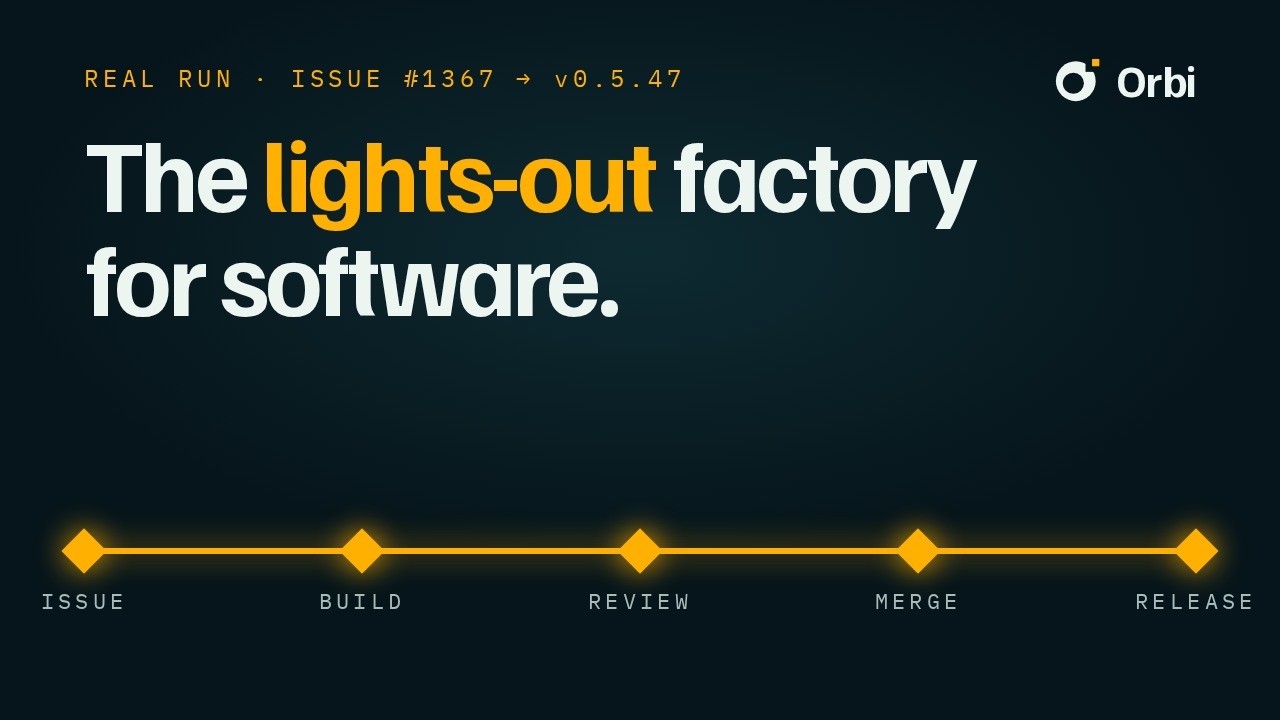
- **See one real loop:** [Issue #1367](https://github.com/orbi-build/orbi/issues/1367) → [PR #1370](https://github.com/orbi-build/orbi/pull/1370) → [Release v0.5.47](https://github.com/orbi-build/orbi/releases/tag/v0.5.47)
- Orbi is an open-source **software dark factory**: a software delivery system for GitHub. You define the goal and acceptance criteria in an Issue and label it `ai-ready`; Orbi implements it in an isolated worktree, runs tests, opens a PR, and takes it through independent review, fixes, and merge. When you request a release, Orbi runs the release gates and publishes the tag and release notes. GitHub Issues are the only state store—no database, queue, or daemon.
- **Ledger:** [merged PRs](https://github.com/orbi-build/orbi/pulls?q=is:merged) · [closed Issues](https://github.com/orbi-build/orbi/issues?q=is:closed) · [tagged releases](https://github.com/orbi-build/orbi/releases) — the repository is the record.
- Website [orbi.build](https://orbi.build/?ref=gh-readme-links) | Documentation <https://docs.orbi.build/> | [Discussions](https://github.com/orbi-build/orbi/discussions) | Docker [GHCR](https://ghcr.io/orbi-build/orbi) · [Docker Hub](https://hub.docker.com/r/orbibuild/orbi)
- **Prefer to run it yourself?** Follow the Quick start below. Cloud founding members get 50% off forever with the code `FOUNDING50` at checkout (6 places).
- ## Quick start
- ```bash
- git clone https://github.com/orbi-build/orbi.git && cd orbi
- uv tool install --force --reinstall --editable --python python3 . # compatible system Python (>= 3.14, e.g. Fedora 43 / current Arch); older (e.g. Ubuntu 24.04's 3.12): --python 3.14 so uv provisions it
- ```
- Want just the CLI? It's on PyPI as [`orbi-cli`](https://pypi.org/project/orbi-cli/) (requires Python ≥ 3.14; the command stays `orbi`): `uv tool install orbi-cli` (older system Python: add `--python 3.14` so uv provisions one) or `pip install orbi-cli` in a Python ≥ 3.14 environment; verify with `orbi --version` → `orbi <version>`, uninstall with `uv tool uninstall orbi-cli`. To run Orbi itself, use the one-line installer at the top of [Getting started](docs/getting-started.mdx) — it creates the editable install Orbi's deployment drives.
- ### Ready check (before setup)
- - `uv`: `uv --version`; Pi and its provider: `pi --version`, then `pi --print "reply with the single word: ok"`
- - GitHub CLI ≥ 2.94 ([official repository](https://github.com/cli/cli/blob/trunk/docs/install_linux.md) — Ubuntu 24.04's package 2.45.0 is too old): run `gh auth login` once, then verify `gh auth status`
- - Linux — systemd user session: `systemctl --user status`
- - macOS — launchd GUI session: `launchctl print gui/$(id -u)` (not yet verified on real hardware; reports welcome)
- Choose the mode in [Getting started](docs/getting-started.mdx): bootstrap uses this checkout as `repo_dir`; [External single-repo mode](docs/getting-started.mdx#external-single-repo-mode-deploy_home) uses it as `deploy_home` and a foreign repository as `repo_dir`.
- ```bash
- cp src/orbi/example_config.toml orbi.toml
- # edit orbi.toml: set source_repos = ["OWNER/REPO"] (the repository whose Issues Orbi delivers)
- orbi setup --config orbi.toml # 4. run one-time setup (checks prior gh auth, labels, scheduler units (systemd/launchd), and checkout; idempotent)
- PYTHONPATH=src python3 -m orbi.runner --config orbi.toml # 5. manually run one tick (for initial verification; the timer schedules normal runs)
- orbi doctor --config orbi.toml # 6. verify deployment health
- ```
- ## The loop, in 35 seconds
- Another real delivery, recorded from the live GitHub pages — including the review that rejected the first attempt:
- <video src="https://github.com/user-attachments/assets/1f0d3a62-5fc9-44ae-bf68-b312a6a55f85" controls muted></video>
- 1. **An issue** — a bug, labelled `ai-ready`
- 2. **It writes the code** — PR #1023, on a recorded base SHA
- 3. **The review says no** — one Major finding, naming `src/orbi/release.py:2377` and the fix
- 4. **It fixes itself** — more commits, until the checks go green
- 5. **It merges** — 9 commits, +427/−43, only after the review passed
- 6. **A tagged release** — v0.5.17, with the Issue and PR in the notes
- ## Why Orbi
- - **GitHub Issues are the task pool**: the `ai-ready` label dispatches work, and the delivery record (comments, PRs, and CI) is complete by default, with no second task system;
- - **Fully automated**: a user scheduler timer (systemd on Linux, launchd on macOS) triggers a tick every 5 minutes. Normal operation needs no status command, polling, or supervision;
- - **Independent review + merge gates**: after a PR opens, an independent review session reviews it and fixes findings in the same session. Reviewed code is what merges, and only with CI green on the latest base: if the base moved after the review, the Runner merges it into the delivery itself when there is no conflict and waits for CI on the new head before merging; conflicts or an outside push go back to review. AI never merges or pushes protected branches;
- - **Fail fast**: command errors fail immediately and leave the evidence in the logs. The Issue is marked `ai-blocked` for a human decision, with no silent fallback;
- - **Observable end to end**: every journal log and GitHub progress comment carries the same `run_id`, so the complete timeline can be reconstructed with one grep.
- ## What it does
- ```text
- GitHub Issue (ai-ready)
- → Claim: create a feature branch + isolated worktree (from the frozen origin/main SHA)
- → Pi development: plan → implement → test → verify
- → Commit delivery (the Agent stops at the commit)
- → Runner closeout: sync the latest base, push, and create a PR (body includes Fixes #N)
- → Independent review (fixes in the same session) → merge gate → merge
- ```
- - Each task gets its own run: the branch, worktree, logs, and PR are all associated with the same `run_id`; retries create a new run and preserve the old evidence unchanged;
- - Failures are classified clearly: recoverable failures return to the same PR for continued fixes, while unrecoverable failures mark the Issue `ai-blocked` for a human;
- - Supports `orbi add` for dispatching work, `status` for viewing the queue, `session` for following the Pi session, `install-units` for idempotently installing the scheduler units (systemd on Linux, launchd on macOS), and `doctor` for read-only diagnostics.
- ## Documentation
- | Topic | Entry point |
- |---|---|
- | Documentation home | <https://docs.orbi.build/> |
- | Getting started (prerequisites, configuration, first run, smoke test) | [Getting started](docs/getting-started.mdx) |
- | One-time setup (labels, units, transport migration) | [One-time setup](docs/setup.mdx) |
- | Workflow (state chain, labels, P0, Epic, Release) | [Workflow](docs/workflow.mdx) |
- | Operations (timer, journal, unit drift, recovery) | [Operations](docs/operations.mdx) |
- | Public contracts (interface inventory, status and progress formats) | [Public contracts](docs/public-contracts.mdx) |
- | Testing, coverage gates, and remote CI | [Testing](docs/testing.mdx) |
- | Contributing (Issue granularity, KISS/LEAN, PR flow) | [Contributing](docs/contributing.mdx) |
- | Chinese documentation | [docs/zh/](docs/zh/) |
- ## Development and contribution
- See the development contract in [AGENTS.md](AGENTS.md), and [Contributing](docs/contributing.mdx) for dispatching Issues, reporting bugs, and submitting PRs. Runtime code lives in the `src/orbi/` package (Issue #168 src layout; the editable finder maps the whole package, so new modules need no reinstall). The checkout root has no `orbi.py` (it would shadow the installed package); the compatibility entry point is `python3 -m orbi.cli`, not the formal usage path.
- ## License
- Orbi is **open source under the [GNU AGPL-3.0](LICENSE)**, with the **[Sustainable Use License](docs/licenses/sustainable-use-license.md)** (v1.0) as an alternative. Pick either license.
- In practice:
- - **Run Orbi on your own repositories for free forever**—personal or internal company use, at any scale, under either license. Modify it, self-host it, run it across a thousand repositories; no authorization needed.
- - **You may share it**—free of charge for non-commercial purposes under the SUL; under AGPL-3.0, offering a modified Orbi as a network service means publishing your changes.
- - **Commercial authorization is needed only to sell Orbi itself**—hosting it as a service for customers or embedding it in a paid product (SUL); AGPL-3.0 has no such restriction.
- Unsure which side your use falls on? Ask in [Discussions](https://github.com/orbi-build/orbi/discussions).
Ratings and comments
Sign in to rate this skill.
Sign inFree to use. If it’s helped, pass it on.