Back to search
code-reader-skills
SkillGitHub
🧠 Cognitive science-based Claude Skills for deep code understanding | 基于认知科学的源代码深度理解工具
Safety scan
A static text scan, not a guarantee. Select the badge to see what was scanned and every finding.
Checked today
Badge for your README
Markdown
[](/listings/notlate-cn--code-reader-skills)HTML
<a href="/listings/notlate-cn--code-reader-skills"><img src="/api/listings/notlate-cn--code-reader-skills/badge.svg" alt="findsafeskills safety rating" /></a>Install
i
Install instructions from the README
As written by the repo's author. findsafeskills has not verified these steps.
**方式一:复制到 Claude 目录(推荐)**
# 中文版
mkdir -p ~/.claude/skills
cp -r code-reader-zh ~/.claude/skills

# 英文版
mkdir -p ~/.claude/skills
cp -r code-reader-en ~/.claude/skills
**方式二:直接在对话中使用**
# 在分析代码前,直接粘贴 skill 内容
cat code-reader-zh/SKILL.md | pbcopy  # macOS
# 或者在对话中输入 @文件路径
**方式三:使用 API 的开发者**
如果你通过 Claude API 调用,可以将 skill 内容作为 System Prompt:
import anthropic

# 读取 skill 内容(中文版)
with open('code-reader-zh/SKILL.md', 'r', encoding='utf-8') as f:
    skill_content = f.read()

client = anthropic.Anthropic()
message = client.messages.create(
    model="claude-sonnet-4-20250514",  # 或使用最新可用模型
    system=skill_content,  # 将 skill 作为系统提示
    messages=[
        {"role": "user", "content": "深入分析这段代码:\n\n[你的代码]"}
    ]
)What was scanned
The files the safety scan read, as written by the repository's author and shown as plain text. Lines with a finding are marked.
README.md · README · 629 lines
View this file on GitHub (read at the repository's current version: the scan did not record which commit it read)
- # 🧠 Code Deep Understanding Analyzer
- <div align="center">
- **基于认知科学的源代码深度理解工具 | Cognitive Science-Based Code Analysis Tool**
- [](LICENSE)
- [](https://github.com/notlate-cn/code-reader-skills/releases)
- [](https://claude.ai)
- [](#)
- [English](#english) | [中文](#中文)
- </div>
- ---
- ## 中文
- ### 📖 项目简介
- 这是一套专业的 Claude Skills,帮助开发者**真正理解**源代码,而不只是"看懂"。基于认知科学研究,融合精细询问法、自我解释测试和应用迁移验证,确保深度学习而非产生流畅幻觉。
- **核心理念:** 理解为什么 (WHY) > 知道是什么 (WHAT)
- ### ✨ 核心特性
- - 🎯 **精细询问法** - 每个概念强制回答 3 个 WHY
- - 🧪 **自我解释测试** - 验证真实理解程度
- - 🔗 **概念网络构建** - 建立知识连接,而非孤立记忆
- - 🚀 **应用迁移测试** - 检验能否在不同场景应用
- - 📚 **学术研究支撑** - 基于 Dunlosky, Chi, Karpicke 等认知科学研究
- - ⚡ **三种模式** - Quick/Standard/Deep 满足不同需求
- - 🤖 **智能并行** - Deep Mode 大型项目自动使用并行处理
- ### 📦 文件结构
- ```
- code-reader-skills/
- ├── code-reader-zh/ # 中文版 🇨🇳
- │ ├── SKILL.md # Skill 源文件
- │ └── code-reader-zh.skill # Skill 包
- │
- ├── code-reader-en/ # 英文版 🇺🇸
- │ ├── SKILL.md # Skill source file
- │ └── code-reader-en.skill # Skill package
- │
- ├── README.md # 项目说明(本文件)
- └── LICENSE # 开源许可证
- ```
- ### 🚀 快速开始
- #### 1. 下载 Skill 文件
- ```bash
- # 克隆仓库
- git clone https://github.com/notlate-cn/code-reader-skills.git
- cd code-reader-skills
- ```
- #### 2. 三种分析模式
- 支持三种分析深度,根据场景自动选择:
- | 模式 | 耗时 | 适用场景 | 触发词示例 |
- |------|------|---------|-----------|
- | **Quick** | 5-10 分钟 | 快速浏览、代码审查 | "快速看一下"、"这段代码干嘛的" |
- | **Standard** | 15-20 分钟 | 学习理解、技术调研 ⭐ | "分析一下"、"帮我理解"、"解释一下" |
- | **Deep** | 30+ 分钟 | 深度掌握、大型项目 🚀 | "彻底分析"、"完全掌握"、"深入研究" |
- **默认使用 Standard Mode**
- **🚀 Deep Mode 内部智能策略:代码 ≤ 2000 行使用渐进式生成,代码 > 2000 行自动启用并行处理。**
- #### 3. 安装 Skill
- **方式一:复制到 Claude 目录(推荐)**
- ```bash
- # 中文版
- mkdir -p ~/.claude/skills
- cp -r code-reader-zh ~/.claude/skills
- # 英文版
- mkdir -p ~/.claude/skills
- cp -r code-reader-en ~/.claude/skills
- ```
- **方式二:直接在对话中使用**
- ```bash
- # 在分析代码前,直接粘贴 skill 内容
- cat code-reader-zh/SKILL.md | pbcopy # macOS
- # 或者在对话中输入 @文件路径
- ```
- **方式三:使用 API 的开发者**
- 如果你通过 Claude API 调用,可以将 skill 内容作为 System Prompt:
- ```python
- import anthropic
- # 读取 skill 内容(中文版)
- with open('code-reader-zh/SKILL.md', 'r', encoding='utf-8') as f:
- skill_content = f.read()
- client = anthropic.Anthropic()
- message = client.messages.create(
- model="claude-sonnet-4-20250514", # 或使用最新可用模型
- system=skill_content, # 将 skill 作为系统提示
- messages=[
- {"role": "user", "content": "深入分析这段代码:\n\n[你的代码]"}
- ]
- )
- ```
- #### 4. 开始使用
- **Quick Mode 触发示例:**
- ```
- 你:/code-reader-v2-cn 快速分析这段代码
- [上传或粘贴代码]
- ```
- **Standard Mode 触发示例:**
- ```
- 你:/code-reader-v2-cn 深入分析这段代码,我想理解它的设计原理
- [上传或粘贴代码]
- ```
- **Deep Mode 触发示例:**
- ```
- 你:/code-reader-v2-cn 我需要彻底掌握这个算法,准备面试用
- [上传或粘贴代码]
- ```
- **大型项目自动触发并行处理:**
- ```
- 你:/code-reader-v2-cn 彻底分析这个项目
- [上传或粘贴代码,系统检测到 >2000 行时自动使用并行处理]
- ```
- ### 📊 输出结构
- #### Quick Mode(快速概览)
- 1. 👀 快速概览
- 2. 📝 功能说明
- 3. 📐 核心算法/设计
- 4. 💻 关键代码段
- 5. 📦 依赖关系
- 6. 🎯 快速使用示例
- #### Standard Mode(标准理解)⭐
- 1. 🧪 理解验证状态
- 2. 👀 快速概览
- 3. 🎯 背景与动机(精细询问)
- 4. 📌 核心概念说明
- 5. 📐 算法与理论
- 6. 🏗️ 设计模式
- 7. 💻 关键代码深度解析(6A 核心片段识别 + 6B 六节深度解读)
- 8. 📦 依赖与使用示例
- #### Deep Mode(完全掌握)🚀
- [包含 Standard Mode 所有内容,加上]
- - 🔗 概念网络图
- - 🔍 **核心片段识别**(6A):从大型代码中筛选 3-7 个最值得深读的片段
- - 💻 **六节深度解读**(6B):每片段按「整体作用 → 核心逻辑 → 逐行解析 → 设计点 → 三组示例 → 改进建议」解读
- - 🧪 **测试用例分析**(如有测试,选 3-5 个典型用例说明代码功能)
- - 🚀 应用迁移场景(至少 2 个)
- - ✅ 质量验证清单
- - 🤖 **智能策略选择**:代码 ≤ 2000 行使用渐进式生成,代码 > 2000 行自动启用并行处理
- - 并行处理时:主协调 Agent + 并行子 Agents + 自动汇总
- - 确保每个章节都有充分深度
- ### 💡 使用示例
- #### 示例 1:学习 JWT 认证(Standard Mode)
- <details>
- <summary>点击查看完整示例</summary>
- **输入:**
- ```python
- def authenticate_user(username, password):
- user = db.find_user(username)
- if not user:
- return None
- if verify_password(password, user.password_hash):
- return generate_token(user.id)
- return None
- ```
- **输出(节选):**
- ```markdown
- ## 背景与动机分析
- **WHY 需要这段代码?**
- - 系统需要验证用户身份,保护未授权访问
- **WHY 选择 JWT 方案?**
- - 无状态认证,服务器不需要存储 Session
- **WHY 不用 Session?**
- - Session 需要服务器存储,不利于水平扩展
- ```
- </details>
- ### 🔬 研究基础
- 基于以下认知科学研究:
- - **[Dunlosky et al. (2013)](https://www.aft.org/ae/fall2013/dunlosky)** - 精细询问法显著优于被动阅读
- - **[Chi et al. (1994)](https://onlinelibrary.wiley.com/doi/10.1207/s15516709cog1803_3)** - 自我解释者获得正确心智模型的概率更高
- - **[Karpicke & Roediger (2008)](https://science.sciencemag.org/content/319/5865/966)** - 检索练习优于重复阅读 250%
- ### 🤝 贡献指南
- 欢迎贡献!以下是参与方式:
- 1. **报告问题** - 通过 [Issues](https://github.com/notlate-cn/code-reader-skills/issues) 反馈
- 2. **提出建议** - 分享你的使用体验和改进想法
- 3. **提交 PR** - 改进文档或添加新功能
- 4. **分享案例** - 展示你的使用案例
- ### ❓ 常见问题
- <details>
- <summary><strong>Q: 三种模式有什么区别?</strong></summary>
- **A:**
- - **Quick**:快速了解代码结构和功能,5-10 分钟
- - **Standard**:理解 WHY 和设计思路,15-20 分钟(推荐)
- - **Deep**:应用迁移测试 + 质量验证,30+ 分钟
- </details>
- <details>
- <summary><strong>Q: 支持哪些编程语言?</strong></summary>
- **A:** 支持所有主流语言:
- - Python, JavaScript, TypeScript, Java, C++, Go, Rust
- - 以及各种框架和库
- </details>
- <details>
- <summary><strong>Q: 如何判断我真正理解了?</strong></summary>
- **A:** 使用 Deep Mode 的"四能"测试:
- 1. ✅ 能否不看代码解释设计思路?
- 2. ✅ 能否独立实现类似功能?
- 3. ✅ 能否应用到不同场景?
- 4. ✅ 能否向他人清晰解释?
- </details>
- ### 📝 更新日志
- #### v2.4.0 (2026-03-10)
- **新增功能:**
- - 🔍 **核心片段识别(6A)**:大型项目先按优先级筛选 3-7 个最值得深读的片段,避免"全部浅析"
- - 💻 **六节深度解读模板(6B)**:每个核心片段按「整体作用 / 核心逻辑 / 逐行解析 / 设计点 / 三组对比示例 / 改进建议」结构化解读
- - 🤖 **子 Agent 两阶段指令**:关键代码解析子 Agent 强制执行片段识别 → 深度解读工作流
- **重构:**
- - 📦 SKILL.md 从 2371 行精简至 688 行(精简 71%),删除冗余示例和重复结构,保留全部执行逻辑
- - 🌐 中英文版同步更新,结构完全一致
- #### v2.3.0 (2026-02-07)
- **重构优化:**
- - 🔄 合并 Parallel Deep Mode 到 Deep Mode,作为内部策略
- - ⚡ 优化触发词系统,丰富各模式触发词
- - 🤖 Deep Mode 内部智能选择:≤2000 行渐进式,>2000 行自动并行
- - 📖 简化为三种模式:Quick/Standard/Deep
- - 🧪 新增测试用例反向理解功能(Step 6.5)
- **改进:**
- - 🎯 用户体验更友好,无需手动选择并行模式
- - 📝 更新中英文 SKILL.md 和 README 文档
- - 🔬 支持通过测试用例反向验证和深化理解
- - 🛠️ 支持 C++、MLIR/LLVM 等多种语言测试格式
- **解决问题:**
- - ✅ 解决模式过于冗余的问题
- - ✅ 自动策略选择降低使用门槛
- - ✅ 通过测试发现代码中隐藏的行为和边界条件
- #### v2.2.0 (2026-02-04)
- **新增功能:**
- - ✨ 场景化注释风格(场景 N / 步骤 N)
- - ✨ Token 优化策略(直接写入文件)
- - ✨ 渐进式生成(Deep Mode 专用)
- - ✨ 多语言注释支持规范
- **改进:**
- - 📦 优化文档结构,删除重复内容
- - 📖 统一章节深度自检标准
- - 🎯 完善执行流示例格式
- **优化:**
- - 🔧 文件大小:1500 → 1342 行 (-10.5%)
- - ⚡ 删除子 Agent 使用规范
- - 📝 合并重复的模式选择说明
- #### v2.1.0 (2026-01-31)
- **新增功能:**
- - ✨ Quick/Standard/Deep 三种分析模式
- - ✨ 智能模式选择机制
- - ✨ 优化输出结构
- **改进:**
- - 📦 独立中英文目录结构
- - 📖 更新 README 说明
- - 🎯 精简触发词
- ### 📄 许可证
- 本项目采用 [MIT License](LICENSE) 开源。
- ### 🌟 Star History
- 如果这个项目对你有帮助,请给个 Star ⭐
- [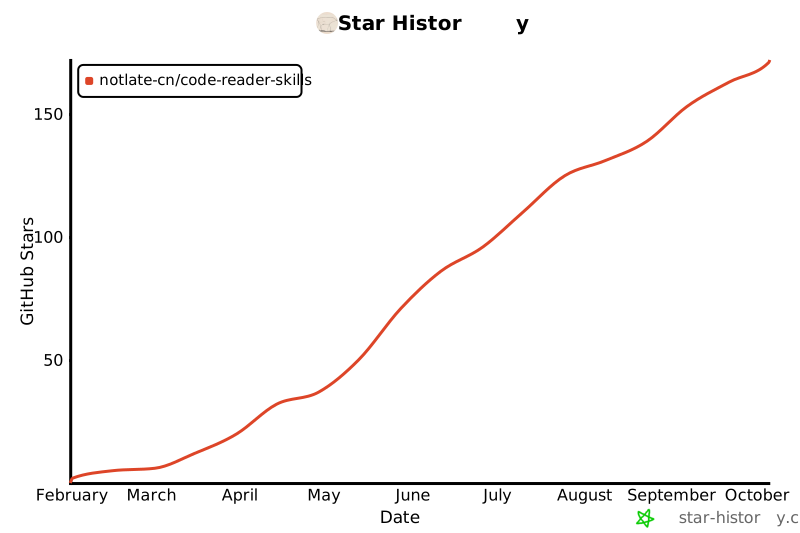](https://star-history.com/#notlate-cn/code-reader-skills&Date)
- ### 📧 联系方式
- - 问题反馈:[GitHub Issues](https://github.com/notlate-cn/code-reader-skills/issues)
- - 讨论交流:[GitHub Discussions](https://github.com/notlate-cn/code-reader-skills/discussions)
- ---
- ## English
- ### 📖 Project Introduction
- A professional Claude Skills set that helps developers **truly understand** source code, not just "get it." Based on cognitive science research, integrating elaborative interrogation, self-explanation testing, and application transfer verification to ensure deep learning rather than fluency illusion.
- **Core Philosophy:** Understanding WHY > Knowing WHAT
- ### ✨ Key Features
- - 🎯 **Elaborative Interrogation** - Force answering 3 WHYs for each concept
- - 🧪 **Self-Explanation Test** - Verify true understanding
- - 🔗 **Concept Network Construction** - Build knowledge connections, not isolated memories
- - 🚀 **Application Transfer Test** - Examine if applicable in different scenarios
- - 📚 **Academic Research Support** - Based on Dunlosky, Chi, Karpicke's cognitive science research
- - 🌐 **Bilingual Support** - Complete Chinese and English versions
- - ⚡ **Four Modes** - Quick/Standard/Deep/Parallel Deep for different needs
- - 🤖 **Parallel Analysis** - Sub-agents process chapters in parallel, ensuring depth for large projects
- ### 📦 File Structure
- ```
- code-reader-skills/
- ├── code-reader-zh/ # Chinese version 🇨🇳
- │ ├── SKILL.md # Skill source file
- │ └── code-reader-zh.skill # Skill package
- │
- ├── code-reader-en/ # English version 🇺🇸
- │ ├── SKILL.md # Skill source file
- │ └── code-reader-en.skill # Skill package
- │
- ├── README.md # Project documentation (this file)
- └── LICENSE # Open source license
- ```
- ### 🚀 Quick Start
- #### 1. Download Skill Files
- ```bash
- # Clone repository
- git clone https://github.com/notlate-cn/code-reader-skills.git
- cd code-reader-skills
- ```
- #### 2. Three Analysis Modes
- | Mode | Duration | Use Case | Trigger Examples |
- |------|----------|----------|------------------|
- | **Quick** | 5-10 min | Quick browse, code review | "quick look", "what does this do" |
- | **Standard** | 15-20 min | Learning, research ⭐ | "analyze", "help me understand", "explain" |
- | **Deep** | 30+ min | Deep mastery, large projects 🚀 | "thoroughly analyze", "completely master", "in-depth research" |
- **Default: Standard Mode**
- **🚀 Deep Mode internal smart strategy: Code ≤ 2000 lines uses progressive generation, code > 2000 lines auto-enables parallel processing.**
- #### 3. Install Skill
- **Method 1: Copy to Claude directory (Recommended)**
- ```bash
- # English version
- mkdir -p ~/.claude/skills
- cp -r code-reader-en ~/.claude/skills
- # Chinese version
- mkdir -p ~/.claude/skills
- cp -r code-reader-zh ~/.claude/skills
- ```
- **Method 2: Use directly in conversation**
- ```bash
- # Paste skill content before analyzing code
- cat code-reader-en/SKILL.md | pbcopy # macOS
- # Or use @file-path in conversation
- ```
- **Method 3: For API Users**
- If you're using Claude API, pass skill content as System Prompt:
- ```python
- import anthropic
- # Read skill content (English version)
- with open('code-reader-en/SKILL.md', 'r', encoding='utf-8') as f:
- skill_content = f.read()
- client = anthropic.Anthropic()
- message = client.messages.create(
- model="claude-sonnet-4-20250514",
- system=skill_content, # Use skill as system prompt
- messages=[
- {"role": "user", "content": "Deeply analyze this code:\n\n[Your code]"}
- ]
- )
- ```
- #### 4. Getting Started
- **Quick Mode Trigger Example:**
- ```
- You: /code-reader-v2-en Quickly analyze this code
- [Upload or paste code]
- ```
- **Standard Mode Trigger Example:**
- ```
- You: /code-reader-v2-en Deeply analyze this code, I want to understand its design principles
- [Upload or paste code]
- ```
- **Deep Mode Trigger Example:**
- ```
- You: /code-reader-v2-en I need to thoroughly master this algorithm for interview preparation
- [Upload or paste code]
- ```
- **Parallel Deep Mode Trigger Example:**
- ```
- You: /code-reader-v2-en Thoroughly analyze this large project
- [Upload or paste code, system will auto-use parallel processing when >2000 lines detected]
- ```
- ### 📊 Output Structure
- #### Quick Mode
- 1. Quick Overview
- 2. Functionality Description
- 3. Core Algorithm/Design
- 4. Key Code Segments
- 5. Dependencies
- 6. Quick Usage Example
- #### Standard Mode ⭐
- 1. Understanding Verification Status
- 2. Quick Overview
- 3. Background & Motivation (Elaborative Interrogation)
- 4. Core Concepts
- 5. Algorithm & Theory
- 6. Design Patterns
- 7. Key Code Deep Analysis (6A snippet identification + 6B six-section deep-dive)
- 8. Dependencies & Usage Examples
- #### Deep Mode 🚀
- [All Standard Mode content, plus]
- - Concept Network Diagram
- - **Core Snippet Identification (6A)**: Select 3-7 most important snippets from large codebases
- - **Six-Section Deep-Dive (6B)**: Each snippet analyzed as: Purpose → Logic → Line-by-line → Design points → 3 examples → Improvements
- - **Test Case Analysis** (if tests exist, select 3-5 typical test cases to illustrate functionality)
- - Application Transfer Scenarios (at least 2)
- - Quality Verification Checklist
- - **Smart Strategy Selection**: Code ≤ 2000 lines uses progressive, code > 2000 lines auto-enables parallel processing
- - Parallel processing: Master coordinator Agent + parallel sub-agents + auto-aggregation
- - Ensures sufficient depth for each chapter
- ### 🔬 Research Foundation
- Based on the following cognitive science research:
- - **[Dunlosky et al. (2013)](https://www.aft.org/ae/fall2013/dunlosky)** - Elaborative interrogation significantly outperforms passive reading
- - **[Chi et al. (1994)](https://onlinelibrary.wiley.com/doi/10.1207/s15516709cog1803_3)** - Self-explainers achieve correct mental models with higher probability
- - **[Karpicke & Roediger (2008)](https://science.sciencemag.org/content/319/5865/966)** - Retrieval practice outperforms re-reading by 250%
- ### 🤝 Contributing
- Contributions are welcome! Here's how to participate:
- 1. **Report Issues** - Provide feedback via [Issues](https://github.com/notlate-cn/code-reader-skills/issues)
- 2. **Suggest Improvements** - Share your experience and ideas
- 3. **Submit PRs** - Improve documentation or add new features
- 4. **Share Cases** - Showcase your use cases
- ### ❓ FAQ
- <details>
- <summary><strong>Q: What's the difference between three modes?</strong></summary>
- **A:**
- - **Quick**: Fast understanding of structure and functionality, 5-10 min
- - **Standard**: Understand WHY and design rationale, 15-20 min (Recommended)
- - **Deep**: Application transfer testing + quality verification, 30+ min. Auto-uses parallel processing for large projects (>2000 lines)
- </details>
- <details>
- <summary><strong>Q: Which programming languages are supported?</strong></summary>
- **A:** All mainstream languages:
- - Python, JavaScript, TypeScript, Java, C++, Go, Rust
- - And various frameworks and libraries
- </details>
- <details>
- <summary><strong>Q: How do I know if I truly understand?</strong></summary>
- **A:** Use Deep Mode's "four abilities" test:
- 1. ✅ Can you explain the design rationale without looking at code?
- 2. ✅ Can you independently implement similar functionality?
- 3. ✅ Can you apply it to different scenarios?
- 4. ✅ Can you clearly explain it to others?
- </details>
- ### 📝 Changelog
- #### v2.4.0 (2026-03-10)
- **New Features:**
- - 🔍 **Core Snippet Identification (6A)**: For large projects, prioritize and select 3-7 most important snippets before deep analysis
- - 💻 **Six-Section Deep-Dive Template (6B)**: Each snippet analyzed with: Purpose / Logic / Line-by-line / Design points / 3 comparison examples / Improvements
- - 🤖 **Two-phase sub-agent instruction**: Code analysis sub-agents enforce snippet identification → deep-dive workflow
- **Refactor:**
- - 📦 SKILL.md trimmed from 2371 to 688 lines (71% reduction), removing redundant examples and duplicate structures while preserving all execution logic
- - 🌐 Chinese and English versions synchronized with identical structure
- #### v2.3.0 (2026-02-07)
- **Refactor:**
- - 🔄 Merge Parallel Deep Mode into Deep Mode as internal strategy
- - ⚡ Optimize trigger word system, enrich trigger words for each mode
- - 🤖 Deep Mode smart selection: ≤2000 lines progressive, >2000 lines auto-parallel
- - 📖 Simplify to 3 modes: Quick/Standard/Deep
- - 🧪 Add test case reverse understanding feature (Step 6.5)
- **Improvements:**
- - 🎯 Better UX, no manual parallel mode selection needed
- - 📝 Updated Chinese/English SKILL.md and README
- - 🔬 Support reverse-understanding code through test cases
- - 🛠️ Support C++, MLIR/LLVM and other language test formats
- **Problems Solved:**
- - ✅ Fixed redundant modes issue
- - ✅ Auto strategy selection lowers usage barrier
- - ✅ Discover hidden behaviors and boundary conditions through tests
- #### v2.2.0 (2026-02-04)
- **New Features:**
- - ✨ Scenario-based comment style (Scenario N / Step N)
- - ✨ Token optimization strategy (direct file writing)
- - ✨ Progressive generation (Deep Mode only)
- - ✨ Multi-language comment support standards
- **Improvements:**
- - 📦 Optimized document structure, removed duplicates
- - 📖 Unified chapter depth self-check standards
- - 🎯 Enhanced execution flow example format
- **Optimizations:**
- - 🔧 File size: 1500 → 1342 lines (-10.5%)
- - ⚡ Removed Sub-Agent usage guidelines
- - 📝 Merged duplicate mode selection sections
- #### v2.1.0 (2026-01-31)
- **New Features:**
- - ✨ Quick/Standard/Deep analysis modes
- - ✨ Smart mode selection mechanism
- - ✨ Optimized output structure
- **Improvements:**
- - 📦 Separate Chinese/English directory structure
- - 📖 Updated README documentation
- - 🎯 Refined trigger words
- ### 📄 License
- This project is open-sourced under the [MIT License](LICENSE).
- ### 🌟 Star History
- If this project helps you, please give it a Star ⭐
- [](https://star-history.com/#notlate-cn/code-reader-skills&Date)
- ### 📧 Contact
- - Bug Reports: [GitHub Issues](https://github.com/notlate-cn/code-reader-skills/issues)
- - Discussions: [GitHub Discussions](https://github.com/notlate-cn/code-reader-skills/discussions)
- ---
- <div align="center">
- **Made with ❤️ and 🧠 for deeper code understanding**
- **基于 ❤️ 和 🧠 创建,助力深度理解代码**
- [⬆ Back to Top](#-code-deep-understanding-analyzer)
- </div>
Ratings and comments
Sign in to rate this skill.
Sign inFree to use. If it’s helped, pass it on.