skillgrade
"Unit tests" for your agent skills
Safety scan
A static text scan, not a guarantee. Select the badge to see what was scanned and every finding.
Badge for your README

Markdown
[](/listings/mgechev--skillgrade)HTML
<a href="/listings/mgechev--skillgrade"><img src="/api/listings/mgechev--skillgrade/badge.svg" alt="findsafeskills safety rating" /></a>Install
Install instructions from the README
As written by the repo's author. findsafeskills has not verified these steps.
**Prerequisites**: Node.js 20+, Docker
npm i -g skillgrade
**1. Initialize** — go to your skill directory (must have `SKILL.md`) and scaffold:
cd my-skill/
GEMINI_API_KEY=your-key skillgrade init    # or ANTHROPIC_API_KEY / OPENAI_API_KEY
# Use --force to overwrite an existing eval.yaml
Generates `eval.yaml` with AI-powered tasks and graders. Without an API key, creates a well-commented template.
**2. Edit** — customize `eval.yaml` for your skill (see [eval.yaml Reference](#evalyaml-reference)).
**3. Run**:
GEMINI_API_KEY=your-key skillgrade --smoke
The agent is auto-detected from your API key: `GEMINI_API_KEY` → Gemini, `ANTHROPIC_API_KEY` → Claude, `OPENAI_API_KEY` → Codex. Override with `--agent=claude`.
**4. Review**:
skillgrade preview          # CLI report
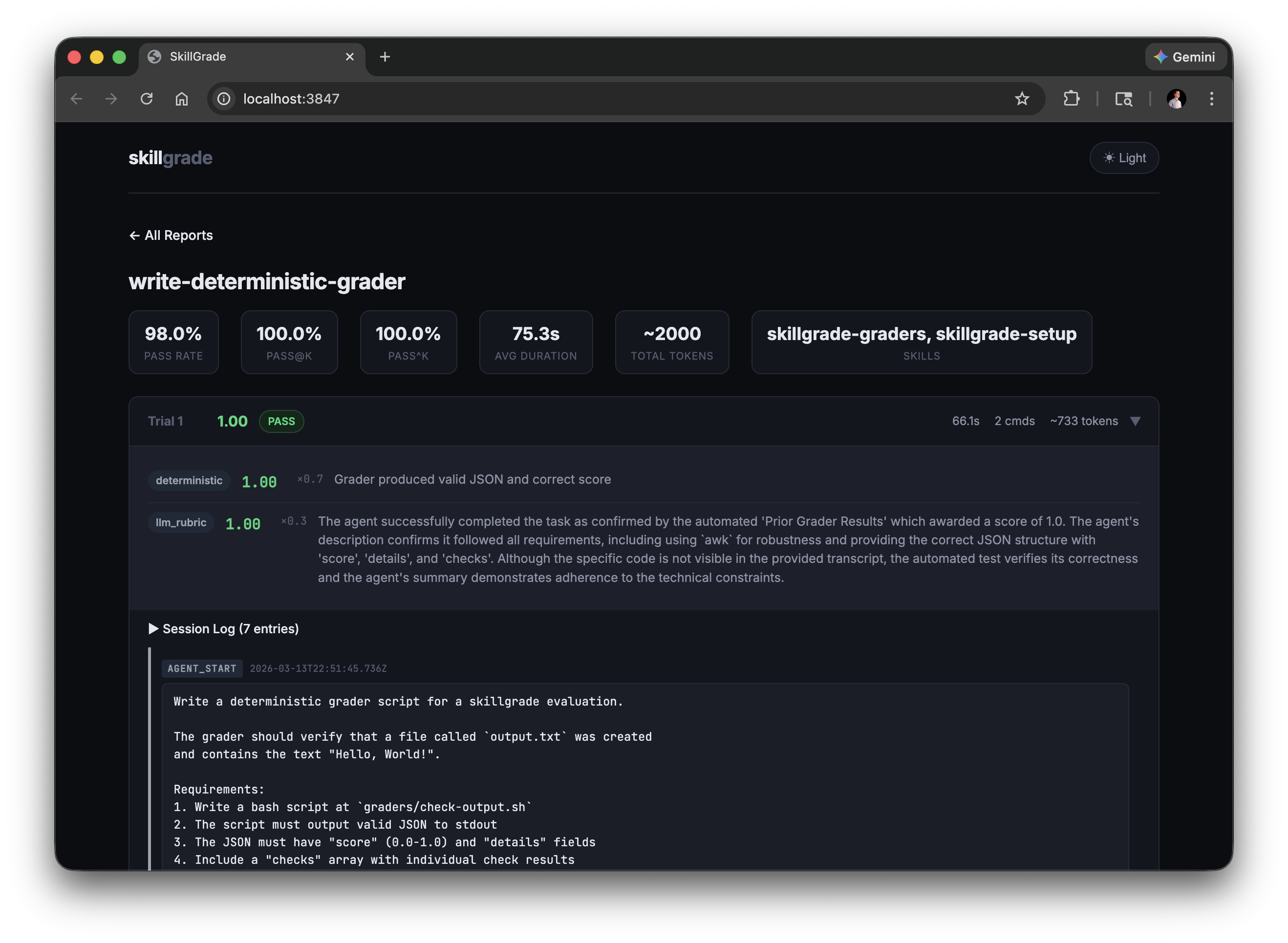
skillgrade preview browser  # web UI → http://localhost:3847
Reports are saved to `$TMPDIR/skillgrade/<skill-name>/results/`. Override with `--output=DIR`.
What was scanned
The files the safety scan read, as written by the repository's author and shown as plain text. Lines with a finding are marked.
README.md · README · 684 lines
View this file on GitHub (read at the repository's current version: the scan did not record which commit it read)
This file has changed since it was scanned, so this is not exactly the text that was scanned, and no line is marked. The findings are listed with the safety scan above.
- # Skillgrade
- An eval harness for AI coding agents. Define tasks, run any agent, score with deterministic scripts, LLM judges, or human reviewers.
- Works with Gemini CLI, Claude Code, Codex CLI, OpenCode, any [ACP](https://agentclientprotocol.com/)-compatible agent, or any command-line tool — with or without [Agent Skills](https://agentskills.io/home).
- See [examples/](examples/) — [superlint](examples/superlint/) (simple) and [angular-modern](examples/angular-modern/) (TypeScript grader).
- 
- ## Quick Start
- **Prerequisites**: Node.js 20+, Docker
- ```bash
- npm i -g skillgrade
- ```
- **1. Initialize** — scaffold an `eval.yaml` in any directory:
- ```bash
- cd my-evals/
- skillgrade init
- ```
- If a `SKILL.md` is present and an API key is set, `init` generates AI-powered tasks tailored to the skill. Otherwise, it creates a ready-to-edit template.
- **2. Edit** — define your tasks in `eval.yaml` (see [eval.yaml Reference](#evalyaml-reference)).
- **3. Run**:
- ```bash
- GEMINI_API_KEY=your-key skillgrade --smoke
- ```
- The agent is auto-detected from your API key: `GEMINI_API_KEY` → Gemini, `ANTHROPIC_API_KEY` → Claude, `OPENAI_API_KEY` → Codex. Override with `--agent=claude`.
- **4. Review**:
- ```bash
- skillgrade preview # CLI report
- skillgrade preview browser # web UI → http://localhost:3847
- ```
- Reports are saved to `$TMPDIR/skillgrade/<eval-name>/results/`. Override with `--output=DIR`.
- ## Presets
- | Flag | Trials | Use Case |
- |------|--------|----------|
- | `--smoke` | 5 | Quick capability check |
- | `--reliable` | 15 | Reliable pass rate estimate |
- | `--regression` | 30 | High-confidence regression detection |
- ## Options
- | Flag | Description |
- |------|-------------|
- | `--eval=NAME[,NAME]` | Run specific evals by name (comma-separated) |
- | `--grader=TYPE` | Run only graders of a type (`deterministic`, `llm_rubric`, or `human`) |
- | `--trials=N` | Override trial count |
- | `--parallel=N` | Run trials concurrently |
- | `--agent=gemini\|claude\|codex\|acp\|opencode\|command` | Override agent (default: auto-detect from API key) |
- | `--model=NAME` | Model the agent answers with (`gemini`, `claude`, `codex`, `opencode`). Default: whatever the agent CLI is configured to use |
- | `--provider=docker\|local` | Override provider |
- | `--acp-command=CMD` | ACP agent command (e.g., `gemini --acp`) |
- | `--command=CMD` | Command to run for the `command` agent (e.g., `node mycli.js`) |
- | `--opencode-agent=NAME` | OpenCode agent (build\|plan\|explore) |
- | `--opencode-model=MODEL` | OpenCode model (provider/model format) |
- | `--output=DIR` | Output directory (default: `$TMPDIR/skillgrade`) |
- | `--format=FORMAT` | Export results (`json`, `junit`, `csv`, `markdown` — comma-separate for multiple) |
- | `--validate` | Verify graders using reference solutions |
- | `--ci` | CI mode: exit non-zero if below threshold |
- | `--threshold=0.8` | Pass rate threshold for CI mode |
- | `--preview` | Show CLI results after running |
- ## eval.yaml Reference
- ```yaml
- version: "1"
- # Optional: path to a skill directory. Omit for non-skill evals.
- # skill: path/to/my-skill
- defaults:
- agent: gemini # gemini | claude | codex | acp | opencode | command
- model: claude-opus-5 # model the agent answers with (gemini, claude, codex, opencode)
- provider: docker # docker | local
- trials: 5
- timeout: 300 # seconds
- threshold: 0.8 # for --ci mode
- grader_model: gemini-3-flash-preview # default LLM grader model
- grader_provider: gemini # default LLM grader provider: gemini | anthropic | openai
- command: node mycli.js # command to run when agent is 'command' (see Custom Command Agent)
- acp: # ACP agent configuration (optional)
- command: gemini --acp # command to start ACP-compatible agent
- env: # optional environment variables
- DEBUG: "1"
- docker:
- base: node:20-slim
- setup: | # extra commands run during image build
- apt-get update && apt-get install -y jq
- environment: # container resource limits
- cpus: 2
- memory_mb: 2048
- tasks:
- - name: fix-linting-errors
- instruction: |
- Use the superlint tool to fix coding standard violations in app.js.
- workspace: # files copied into the container
- - src: fixtures/broken-app.js
- dest: app.js
- - src: bin/superlint
- dest: /usr/local/bin/superlint
- chmod: "+x"
- context: # reference material for the agent
- - src: specs/api-schema.yaml # (not scored — just gives the agent context)
- dest: api-schema.yaml
- graders:
- - type: deterministic
- setup: npm install typescript # grader-specific deps (optional)
- run: npx ts-node graders/check.ts
- weight: 0.7
- - type: llm_rubric
- rubric: |
- Did the agent follow the check → fix → verify workflow?
- provider: gemini # optional: gemini (default) | anthropic | openai
- model: gemini-3.5-flash # optional model override
- weight: 0.3
- # Per-task overrides (optional)
- agent: claude
- model: claude-sonnet-5 # override the model for this task only
- grader_provider: anthropic # override default LLM grader provider
- trials: 10
- timeout: 600
- ```
- String values (`instruction`, `rubric`, `run`) support **file references** — if the value is a valid file path, its contents are read automatically:
- ```yaml
- instruction: instructions/fix-linting.md
- rubric: rubrics/workflow-quality.md
- ```
- ### Workspace vs Context
- Both `workspace` and `context` copy files into the agent's working directory, but they serve different roles:
- - **`workspace`** — evaluation fixtures. These are the files the agent works on and graders check against (source code, configs, test inputs).
- - **`context`** — reference material. Docs, specs, or schemas that shape how the agent approaches the task but aren't directly graded.
- ```yaml
- tasks:
- - name: implement-api
- workspace:
- - src: fixtures/app.js # the file the agent edits
- dest: app.js
- context:
- - src: specs/openapi.yaml # reference the agent can read
- dest: openapi.yaml
- ```
- ### Multi-turn evals
- A task can define `turns` instead of a single `instruction`. Each turn has its own instruction and optional graders. The agent's workspace persists across turns — turn 2 sees everything turn 1 produced.
- ```yaml
- tasks:
- - name: plan-then-implement
- turns:
- - instruction: |
- Read the codebase and propose a refactoring plan. Write it to plan.md.
- graders:
- - type: llm_rubric
- rubric: Is the plan well-structured and comprehensive?
- weight: 0.3
- - instruction: |
- Implement the refactoring plan you wrote in plan.md.
- graders:
- - type: deterministic
- run: bash graders/check-refactor.sh
- weight: 0.7
- workspace:
- - src: fixtures/legacy-app/
- dest: .
- ```
- A task must have either `instruction` or `turns` — never both. Grader results from all turns are aggregated into the trial's final reward.
- Agents that implement the optional `runTurn()` method receive the turn index and all previous outputs for context. Agents without it fall back to the standard `run()` on each turn.
- ### Dataset / batch support
- Expand a single task template into many tasks by loading rows from a JSONL or CSV file:
- ```yaml
- tasks:
- - name: code-review
- dataset: datasets/review-cases.jsonl
- instruction: |
- Review this code and identify bugs:
- ```
- {{code}}
- ```
- graders:
- - type: deterministic
- run: node graders/check-review.mjs
- weight: 1.0
- ```
- `datasets/review-cases.jsonl`:
- ```json
- {"code": "if (x = 5) { ... }", "expected_issues": "assignment in condition"}
- {"code": "arr[arr.length]", "expected_issues": "off-by-one"}
- ```
- This expands to `code-review/0`, `code-review/1`, etc. Template variables use `{{key}}` syntax — each key in the row is interpolated into the instruction. Each row's full data becomes the task's `expected` field, so graders can access it via `SKILLGRADE_INPUT`.
- CSV files are also supported — the first row is treated as headers.
- ### Reference output and metadata
- A task can carry the row's answer key and a set of labels:
- ```yaml
- - name: easy--tooltip-token
- instruction: |
- Report the background colour token of the Tooltip's default variant.
- Write {"token": "..."} to answer.json.
- expected: # the answer key — graders only, never the agent
- token: Brand/100
- variants: [default, hover]
- metadata: # labels for --filter, recorded with the results
- tier: easy
- form: open
- tags: [smoke]
- graders:
- - type: deterministic
- run: node graders/check-token.mjs
- ```
- Both are optional: a task without `expected` is scored purely on what its
- graders measure, so golden-truth and metric-style tasks live in the same suite.
- skillgrade **delivers `expected`, it never interprets it** — comparison is the
- grader's job. A deterministic grader receives the task context as one JSON
- document in `SKILLGRADE_INPUT`, so `expected` keeps its structure:
- ```js
- // graders/check-token.mjs — one script for every token task
- const { task, trial, expected, metadata } = JSON.parse(process.env.SKILLGRADE_INPUT);
- const answer = JSON.parse(fs.readFileSync('answer.json', 'utf8')); // cwd is the workspace
- console.log(JSON.stringify({
- score: answer.token === expected.token ? 1 : 0,
- details: `${task}: want ${expected.token}, got ${answer.token ?? '(none)'}`,
- }));
- ```
- ```bash
- # or from a shell grader
- want=$(jq -r .expected.token <<< "$SKILLGRADE_INPUT")
- ```
- An `llm_rubric` grader gets `expected` as an `## Expected Output` section in its
- prompt. Both channels are built after the agent process has exited, and neither
- writes to the workspace — unlike `run:` and `rubric:`, which are staged into the
- agent's working directory before it starts, so keep answer keys out of those.
- ### Selecting which tasks to run
- `metadata` is what `--filter` selects on. Values are OR within a key and AND
- across keys; `--filter` and `--not-filter` are repeatable:
- ```bash
- skillgrade --filter=tier=easy,medium # easy OR medium
- skillgrade --filter=tier=hard --filter=form=refuse # hard AND refuse
- skillgrade --filter=tags=smoke --not-filter=tags=flaky
- skillgrade --filter-pattern='^easy--' # regex over task names
- skillgrade --filter=tier=easy --list # print the selection, run nothing
- ```
- A filter on a key that no task declares is an error rather than a silent
- match-everything — `--filter=teir=easy` should not quietly run the whole suite.
- Filters work the same whether the tasks are inline or imported.
- ### Splitting eval.yaml across files
- Any section can live in another file. `$import` takes a file, a directory (every
- `.yaml`/`.yml` inside it, sorted), a glob, or a list of those:
- ```yaml
- version: "1"
- defaults:
- $import: shared/defaults.yaml # merged in place — keys below win
- trials: 3
- tasks:
- - $import: evals/easy/*.yaml # one task per file, or a file holding a list
- - $import: evals/hard # a whole directory
- trials: 10 # applied to every task it imports
- - name: still-inline # inline tasks keep working
- instruction: ...
- graders: [...]
- ```
- Each imported file is a normal YAML document — a single task, a list of tasks, or
- an object for a section like `defaults`. Imported files may import further files;
- paths are relative to the file that contains the `$import`, and cycles are an error.
- A task keeps working when you move it into its own file: **its relative paths
- resolve against its own directory first, then the eval root.** So
- `evals/easy/one.yaml` can say `instruction: instruction.md` for the file next to it
- while still pointing `run: node graders/check.mjs` at the shared graders directory
- at the root.
- ## Graders
- Skillgrade ships with three grader types. Mix and weight them to score any dimension — correctness, code quality, workflow compliance, human judgment.
- ### Deterministic
- Runs a command and parses JSON from stdout:
- ```yaml
- - type: deterministic
- run: bash graders/check.sh
- weight: 0.7
- ```
- Output format:
- ```json
- {
- "score": 0.67,
- "details": "2/3 checks passed",
- "checks": [
- {"name": "file-created", "passed": true, "message": "Output file exists"},
- {"name": "content-correct", "passed": false, "message": "Missing expected output"}
- ]
- }
- ```
- `score` (0.0–1.0) and `details` are required. `checks` is optional.
- **Bash example:**
- ```bash
- #!/bin/bash
- passed=0; total=2
- c1_pass=false c1_msg="File missing"
- c2_pass=false c2_msg="Content wrong"
- if test -f output.txt; then
- passed=$((passed + 1)); c1_pass=true; c1_msg="File exists"
- fi
- if grep -q "expected" output.txt 2>/dev/null; then
- passed=$((passed + 1)); c2_pass=true; c2_msg="Content correct"
- fi
- score=$(awk "BEGIN {printf \"%.2f\", $passed/$total}")
- echo "{\"score\":$score,\"details\":\"$passed/$total passed\",\"checks\":[{\"name\":\"file\",\"passed\":$c1_pass,\"message\":\"$c1_msg\"},{\"name\":\"content\",\"passed\":$c2_pass,\"message\":\"$c2_msg\"}]}"
- ```
- > Use `awk` for arithmetic — `bc` is not available in `node:20-slim`.
- ### LLM Rubric
- Evaluates the agent's session transcript against qualitative criteria:
- ```yaml
- - type: llm_rubric
- rubric: |
- Workflow Compliance (0-0.5):
- - Did the agent follow the mandatory 3-step workflow?
- Efficiency (0-0.5):
- - Completed in ≤5 commands?
- weight: 0.3
- provider: gemini # gemini (default) | anthropic | openai
- model: gemini-2.0-flash # optional, auto-detected from API key
- ```
- The `provider` field selects which LLM API to call:
- | Provider | API Key Env Var | Base URL Env Var (optional) | Default Model |
- |------------|---------------------|-----------------------------|----------------------------|
- | `gemini` | `GEMINI_API_KEY` | - | Dynamically resolved latest Flash model (via API) |
- | `anthropic`| `ANTHROPIC_API_KEY` | `ANTHROPIC_BASE_URL` | Dynamically resolved latest Haiku model (via API) |
- | `openai` | `OPENAI_API_KEY` | `OPENAI_BASE_URL` | Dynamically resolved latest Mini/Flash model (via API) |
- `ANTHROPIC_BASE_URL` and `OPENAI_BASE_URL` enable custom/self-hosted endpoints (Ollama, vLLM, etc.). They apply to both LLM grading and `skillgrade init`.
- ### Human
- Pauses the eval for manual review. The grader writes a context file with the agent's output and waits for a reviewer to score it:
- ```yaml
- - type: human
- prompt: |
- Does the generated UI match the design spec?
- Check layout, colors, and responsive behavior.
- weight: 0.5
- ```
- When a human grader runs, it:
- 1. Writes the instruction, agent output, and commands to `<workspace>/.review/<task>-<trial>.json`
- 2. Prints a banner with the file path and scoring instructions
- 3. Polls for `<workspace>/.review/<task>-<trial>.result.json`
- The reviewer writes a standard grader result:
- ```json
- {"score": 0.8, "details": "Layout matches, colors are off on mobile"}
- ```
- Useful for evaluating subjective quality — design fidelity, UX, documentation clarity — that automated checks can't reliably measure.
- ### Combining Graders
- ```yaml
- graders:
- - type: deterministic
- run: bash graders/check.sh
- weight: 0.7 # 70% — did it work?
- - type: llm_rubric
- rubric: rubrics/quality.md
- weight: 0.2 # 20% — was the approach good?
- - type: human
- prompt: Is the output production-ready?
- weight: 0.1 # 10% — human sign-off
- ```
- Final reward = `Σ (grader_score × weight) / Σ weight`
- ## Extending Skillgrade
- All four extension points use the same registry pattern — register a factory function, use it by name:
- ```typescript
- import {
- registerGrader, registerAgent, registerProvider, registerReporter,
- Grader, Reporter
- } from 'skillgrade';
- // Custom grader
- class MyGrader implements Grader {
- async grade(workspace, provider, config, taskPath, sessionLog) {
- return { grader_type: 'my_grader', score: 0.9, weight: config.weight, details: 'Passed' };
- }
- }
- registerGrader('my_grader', () => new MyGrader());
- // Custom agent
- registerAgent('my-agent', (config) => new MyAgent(config));
- // Custom provider (e.g., SSH, E2B, cloud VMs)
- registerProvider('ssh', (config) => new SSHProvider(config));
- // Custom reporter
- class DashboardReporter implements Reporter {
- async report(results, outputDir) {
- // push to your dashboard
- return path.join(outputDir, 'dashboard.json');
- }
- }
- registerReporter('dashboard', () => new DashboardReporter());
- ```
- ## Report Formats
- Export results in multiple formats — use one or combine them:
- ```bash
- skillgrade --smoke --format=json # JSON summary
- skillgrade --smoke --format=junit # JUnit XML for CI dashboards
- skillgrade --smoke --format=csv # CSV for spreadsheets
- skillgrade --smoke --format=markdown # Markdown report
- skillgrade --smoke --format=json,junit,markdown # all three at once
- ```
- | Format | Output File | Use Case |
- |--------|-------------|----------|
- | `json` | `summary.json` | Dashboards, trend tracking, programmatic access |
- | `junit` | `junit.xml` | CI systems (GitHub Actions, Jenkins, CircleCI) |
- | `csv` | `results.csv` | Spreadsheet analysis, data pipelines |
- | `markdown` | `report.md` | Documentation, PR comments, Slack posts |
- ## CI Integration
- Use `--provider=local` in CI — the runner is already an ephemeral sandbox, so Docker adds overhead without benefit.
- ```yaml
- # .github/workflows/skillgrade.yml
- - run: |
- npm i -g skillgrade
- cd evals/
- GEMINI_API_KEY=${{ secrets.GEMINI_API_KEY }} skillgrade --regression --ci --provider=local
- ```
- Exits with code 1 if pass rate falls below `--threshold` (default: 0.8).
- > **Tip**: Use `docker` (the default) for local development to protect your machine. In CI, `local` is faster and simpler.
- ## Environment Variables
- | Variable | Used by |
- |----------|---------|
- | `GEMINI_API_KEY` | Agent execution, LLM grading (`provider: gemini`), `skillgrade init` |
- | `ANTHROPIC_API_KEY` | Agent execution, LLM grading (`provider: anthropic`), `skillgrade init` |
- | `OPENAI_API_KEY` | Agent execution (Codex), LLM grading (`provider: openai`), `skillgrade init` |
- | `ANTHROPIC_BASE_URL` | LLM grading (`provider: anthropic`), `skillgrade init` — custom Anthropic-compatible endpoint |
- | `OPENAI_BASE_URL` | LLM grading (`provider: openai`), `skillgrade init` — custom OpenAI-compatible endpoint (Ollama, vLLM, etc.) |
- | `GEMINI_MODEL` | Override the default model used for Gemini LLM grading (defaults to dynamic API lookup; throws if resolution fails) |
- | `INIT_GEMINI_MODEL` | Override the model used for Gemini in `skillgrade init` (defaults to `GEMINI_MODEL` or dynamic API lookup; throws if resolution fails) |
- | `ANTHROPIC_MODEL` | Override the default model used for Anthropic LLM grading (defaults to dynamic API lookup; throws if resolution fails) |
- | `INIT_ANTHROPIC_MODEL` | Override the model used for Anthropic in `skillgrade init` (defaults to `ANTHROPIC_MODEL` or dynamic API lookup; throws if resolution fails) |
- | `OPENAI_MODEL` | Override the default model used for OpenAI LLM grading (defaults to dynamic API lookup; throws if resolution fails) |
- | `INIT_OPENAI_MODEL` | Override the model used for OpenAI in `skillgrade init` (defaults to `OPENAI_MODEL` or dynamic API lookup; throws if resolution fails) |
- Variables are also loaded from `.env` in the working directory. Shell values override `.env`. All values are **redacted** from persisted session logs.
- ## Custom Command Agent
- Point skillgrade at **any command** — a custom script, an orchestrator over the Claude/OpenAI SDKs, or any CLI tool — without forking the package or implementing an ACP server.
- ### Quick Start
- ```bash
- skillgrade --agent=command --command="node mycli.js"
- ```
- Or in `eval.yaml`:
- ```yaml
- defaults:
- agent: command
- command: "node mycli.js"
- provider: local # run on the host; or use docker + docker.setup to install your CLI
- ```
- `command` can also be set per task to override the default.
- ### How the instruction reaches your command
- The task instruction is **piped to your command's stdin** (skillgrade writes it to `/tmp/.prompt.md`, then runs `cat /tmp/.prompt.md | <command>` inside the workspace directory). If your CLI takes the prompt as an argument instead, wrap it in a one-line script that reads stdin.
- Your command runs in the workspace and is free to read/edit files there — graders score the resulting workspace state (and any live checks), not your command's stdout, so any agent slots in cleanly.
- ### Docker vs local
- - **`provider: local`** is the simplest fit for a custom agent: your command runs on the host with your tools already installed.
- - **`provider: docker`** still works — skillgrade does **not** auto-install anything for the `command` agent, so install your CLI and dependencies via `docker.setup`:
- ```yaml
- defaults:
- agent: command
- command: "mycli run"
- docker:
- base: node:20-slim
- setup: "npm install -g my-cli-package"
- ```
- ## OpenCode Agent
- [OpenCode](https://opencode.ai/) is an AI coding agent that supports multiple AI models and specialized subagents.
- ### Quick Start
- ```bash
- # Use OpenCode with default agent and model
- skillgrade --agent=opencode
- # Specify OpenCode agent (build|plan|explore)
- skillgrade --agent=opencode --opencode-agent=build
- # Specify both agent and model (provider/model format)
- skillgrade --agent=opencode --opencode-agent=build --opencode-model=anthropic/claude-sonnet-4-20250514
- ```
- ### OpenCode Agents
- | Agent | Description |
- |-------|-------------|
- | `build` | Default primary agent with full tool access |
- | `plan` | Read-only planning/analysis agent |
- | `explore` | Fast codebase exploration agent |
- ### OpenCode Models
- Models are specified in `provider/model` format:
- | Model | Format |
- |-------|--------|
- | Claude Sonnet 4 | `anthropic/claude-sonnet-4-20250514` |
- | GPT 5.1 Codex | `opencode/gpt-5.1-codex` |
- ### CLI Options
- | Flag | Description |
- |------|-------------|
- | `--agent=opencode` | Use OpenCode agent |
- | `--opencode-agent=NAME` | OpenCode agent (build\|plan\|explore) |
- | `--opencode-model=MODEL` | OpenCode model (provider/model format) |
- ### How It Works
- 1. skillgrade invokes OpenCode CLI with `opencode run`
- 2. Passes instruction via temp file to avoid shell escaping issues
- 3. Supports both agent and model specification
- 4. Works with `--provider=docker` or `--provider=local`
- ## ACP Agent
- [Agent Client Protocol (ACP)](https://agentclientprotocol.com/) is an open protocol that standardizes communication between AI coding agents and clients. Using an ACP-compatible agent allows you to evaluate agents without managing API keys directly.
- ### Quick Start
- ```bash
- # Use Gemini CLI in ACP mode (requires gemini CLI installed)
- skillgrade --agent=acp --acp-command="gemini --acp"
- # Or configure in eval.yaml
- ```
- ```yaml
- defaults:
- agent: acp
- acp:
- command: gemini --acp
- ```
- ### ACP-Compatible Agents
- Any agent that supports the ACP protocol can be used:
- | Agent | Command |
- |-------|---------|
- | Gemini CLI | `gemini --acp` |
- | Other ACP agents | Check agent documentation |
- ### How It Works
- 1. skillgrade starts the ACP agent as a subprocess
- 2. Communication happens via JSON-RPC 2.0 over stdio
- 3. No API key required — authentication is handled by the ACP agent
- 4. Works best with `--provider=local` since the ACP agent needs to be available in your environment
- ### CLI Options
- | Flag | Description |
- |------|-------------|
- | `--agent=acp` | Use ACP-compatible agent |
- | `--acp-command=CMD` | Command to start the ACP agent |
- The `--acp-command` can also be set in `eval.yaml` under `defaults.acp.command`.
- ## Best Practices
- - **Grade outcomes, not steps.** Check that the file was fixed, not that the agent ran a specific command.
- - **Instructions must name output files.** If the grader checks for `output.html`, the instruction must tell the agent to save as `output.html`.
- - **Validate graders first.** Use `--validate` with a reference solution before running real evals.
- - **Start small.** 3–5 well-designed tasks beat 50 noisy ones.
- - **Combine grader types.** Deterministic for correctness, LLM for quality, human for subjective judgment — weight each to match what matters.
- For a comprehensive guide on writing high-quality skills, check out [skills-best-practices](https://github.com/mgechev/skills-best-practices/). You can also install the skill creator skill to help author skills:
- ```bash
- npx skills add mgechev/skills-best-practices
- ```
- ## License
- MIT
- ---
- *Inspired by [SkillsBench](https://arxiv.org/html/2602.12670v1) and [Demystifying Evals for AI Agents](https://www.anthropic.com/engineering/demystifying-evals-for-ai-agents).*
Ratings and comments
Sign in to rate this skill.
Sign inFree to use. If it’s helped, pass it on.