img2-interior
Builds image-led interiors through Blender/Python, PBR, render-and-repair, bake/export and an interactive Three.js viewer; verifies native/runtime/portable delivery with img2.
Safety scan
A static text scan, not a guarantee. Select the badge to see what was scanned and every finding.
Badge for your README

Markdown
[](/listings/img2threejs--plugin-interior)HTML
<a href="/listings/img2threejs--plugin-interior"><img src="/api/listings/img2threejs--plugin-interior/badge.svg" alt="findsafeskills safety rating" /></a>Install
Install instructions from the README
As written by the repo's author. findsafeskills has not verified these steps.
Before you start
| Component | Requirement | | --- | --- | | Agent | Image-capable Claude Code, Codex or OpenCode, configured through img2; command execution and browser/image inspection tools | | Harness | img2 ≥0.4.0, core API 1 | | CLI / viewer | Git, npm and Node.js 18, 20 or ≥22; prefer a supported LTS release | | Audit / workspace tools | Python ≥3.10 | | Native authoring | Separate Python 3.11 environment with `bpy==4.3.0` and `numpy==1.26.4` | | Image tools / preview | Separate environment from `requirements-surfaces.txt`; a WebGL-capable browser |
The harness registers the skill; it does not install bpy or create the finished app. The agent follows the bundled [environment setup](reference/production-runbook.md#2-prepare-project-local-environments) and preflight before authoring. Compatible Blender wheels must exist for your platform. Installation and use are free under the [license](LICENSE), including commercial project work; commercializing the tool itself requires prior written permission.
Public npm install (preferred)
Install `@img2threejs/img2interior@0.3.1` from the public npm registry into a dedicated, persistent prefix, then register it with the official img2 harness via `add --link`. `npm install` is the real distribution and tracking event; `add --link` is the host registration step. The package has no lifecycle scripts, so `npm install` performs only a fetch and a directory copy.
npm install --prefix "$HOME/.local/share/img2interior" @img2threejs/img2interior@0.3.1
npx --yes @img2threejs/img2@0.4.0 install --yes
npx --yes @img2threejs/img2@0.4.0 add --link "$HOME/.local/share/img2interior/node_modules/@img2threejs/img2interior" --yes
npx --yes @img2threejs/img2@0.4.0 doctor --json
npx --yes @img2threejs/img2@0.4.0 sync --check
Skip the `install --yes` step if a compatible harness already exists on this host; the `add --link` flow alone is sufficient then. Keep the dedicated prefix in place at `$HOME/.local/share/img2interior` — future `npm install --prefix "$HOME/.local/share/img2interior" @img2threejs/img2interior@<version>` commands update the live link without moving it. Do not pass `--force`, do not run a global install, and do not delete the prefix while a host link still points inside it.
Restart the agent session, open your project and use the prompt above. The registry ID is **`interior`**; the agent-facing skill is **`img2-interior`**. To install from a Git clone or supplied source archive (pre-publication, an exact commit, or working without npm connectivity), follow [install from public source](reference/installation.md#install-from-public-source-or-supplied-archive). To remove and update, see [installation and removal](reference/installation.md).
> **Why this two-step path?** The img2 0.4.0 harness `add npm:@img2threejs/img2interior@<version> --yes` flow expects `npm view` to return a nested `info.dist.integrity`, but npm 10/11 return a flat `dist.integrity`; `add` therefore refuses the package rather than registering it. Real consumers use `npm install` to fetch the public package into a dedicated prefix, then `add --link` that installed copy. The `add npm:` transport bug lives in the img2 harness, not in this package; until the harness ships a fix, the documented supported install path is the two-step flow above.
Package and download metrics
- **Package:** [`@img2threejs/img2interior`](https://www.npmjs.com/package/@img2threejs/img2interior), version `0.3.1`, published with `--access public`. - **Download counts** (last month, daily series, custom date ranges) and **package metadata** come from the documented public npm registry API — see [download metrics](reference/installation.md#download-metrics) for the exact endpoints and their limits. The version + downloads badges at the top of this README resolve through that same API; they reflect real registry values, not local instrumentation, and lag the registry by roughly one day.
What was scanned
The files the safety scan read, as written by the repository's author and shown as plain text. Lines with a finding are marked.
SKILL.md · Manifest · 99 lines
View this file on GitHub (read at the repository's current version: the scan did not record which commit it read)
- ---
- name: img2-interior
- description: Builds image-led interiors through Blender/Python, PBR, render-and-repair, bake/export and an interactive Three.js viewer; verifies native/runtime/portable delivery with img2.
- license: LicenseRef-img2-Interior-Free-Use-Restricted-Commercialization-1.0. See LICENSE and THIRD_PARTY_NOTICES.md.
- version: 0.3.1
- ---
- # Image → authored interior → working delivery
- Accept one supplied room image and one assignment. Continue through analysis, implementation, visual repair, interactive runtime and delivery; do not return only a plan, ask the user to supply JSON, or stop after a Blender file/build. This is a skill for an image-capable coding agent, not a deterministic neural image-to-mesh service.
- Set `SKILL_DIR` to this installed directory and work in the user's project, never the plugin checkout. Install through the official img2 harness; see [installation](reference/installation.md). The public npm package is `@img2threejs/img2interior`; the public source lives at `img2threejs/img2interior` on GitHub. Preserve unrelated user files. No global installs, publishing or paid-service requests by default.
- ## Showcase and support (discoverable reference)
- The bundled [showcase gallery](docs/showcase/README.md) is the same authored scene published at the [live demo](https://img2threejs.io/living-room/). It is inspiration for what a finished delivery looks like, not a benchmark for every room. The skill is maintained alongside the parent img2threejs project; supporting the parent via [Ko-fi](https://ko-fi.com/O8A625YLSR), the [donate page](https://img2threejs.io/donate.html), [PayPal](https://www.paypal.com/paypalme/NguyenHoai545) or [Binance Pay](https://app.binance.com/uni-qr/Trcs9shL) helps fund continued work, but is not required to install or use this skill.
- ## Start from the actual image
- Read [start-to-finish operation](reference/production-runbook.md), [reference analysis](reference/reference-analysis.md) and [intake/camera](reference/intake-camera.md). Inspect actual source pixels, source kind and any supplied reference URLs. Use the host image/browser tools; header dimensions are not image analysis.
- ```sh
- python3 "$SKILL_DIR/tools/interior_project.py" start --workspace "$PWD" --image "$IMAGE" --source-kind "$SOURCE_KIND"
- python3 "$SKILL_DIR/tools/interior_project.py" preflight --workspace "$PWD" --blender-python "$BLENDER_PYTHON"
- ```
- `start` preserves source bytes/provenance, not a generated room or an approval. Choose source kind honestly. Author `interior-intake.json`, `scene-spec.json` and image-specific `build_scene.py` yourself after observation; see [scene contract](reference/scene-contract.md) and [input schemas](reference/tool-inputs.md). State metre scale, visible anchors, camera estimates, hidden geometry assumptions, material goals, interaction scope and output budget. Make reasonable labeled design estimates; request input only when a material requirement cannot be decided safely.
- The native builder is actual Blender code using the packaged `authoring` helpers, with `build_scene(context)`. It is not a prose description. Never substitute a bundled room, source-photo furniture cards or fabricated recovered dimensions. The explicit `oak-linen` recipe is source-hash guarded; [case reproduction](reference/oak-linen-recipe.md) is not the path for a different image.
- Install missing dependencies in project-local environments. Rendering needs the tested Python 3.11 / bpy 4.3.0 / NumPy 1.26.4 environment; image tools use `requirements-surfaces.txt`; the viewer pins Three.js/Vite. Do not mix the image-tools NumPy environment into bpy. See the runbook for setup and recovery.
- ```sh
- python3 "$SKILL_DIR/tools/interior_workflow.py" init --workspace "$PWD" --image "$IMAGE" --intake ./interior-intake.json
- python3 "$SKILL_DIR/tools/interior_workflow.py" next --workspace "$PWD"
- ```
- On resume use `next`, never reinitialize. Exit 3 means an explicit block; resolve its cause and revise. Project setup does not erase existing review history.
- ## Execute the complete production loop
- | Work | Required implementation and exit evidence | Governance stage |
- |---|---|---|
- | Read image/reference | Source/provenance, anchors, uncertainty, task/quality/budget and technical reference findings; validated intake snapshot | `intake` |
- | Decide camera/composition | Real coarse room and volumes, source-aspect render, camera/projection and meaningful lateral/reverse views; fix framing before polish | `camera` |
- | Find suitable resources | [Poly Haven discovery/acquisition](reference/resources.md); inspect actual candidates, choose by silhouette/material need, verify dependencies/hashes/CC0 and record provenance | `geometry` / `materials` evidence |
- | Author actual geometry | [Blender/Python geometry](reference/geometry.md); editable shell, furniture, soft forms, contacts, semantic components, UV0 and authored unseen surfaces | `geometry` |
- | Prepare and bind PBR | [Materials](reference/materials.md); actual color/normal/roughness, physical scale, decoded statistics, packed images, frontal/grazing review and exported binding policy | `materials` |
- | Render, compare, repair | [Review loop](reference/review.md); open actual images, compare camera → form → surface/light, preserve rejected versions, fix causes and rerender; never accept a score/build instead | Earliest affected stage |
- | Calibrate, bake and export | [Lighting](reference/lighting.md) and [bake/export](reference/bake-export.md); UV1/EXR fixture, full-static vs ambient bake, denoise, probe, packed native and distinct GLBs | `lighting` |
- | Integrate Three.js | [Viewer integration](reference/viewer-integration.md); install real template, consume generated manifest/resources, compile and view the actual scene; no canned scene fallback | `interaction` |
- | Exercise interaction | [Interaction](reference/interaction.md); bounded camera, source/wireframe/reset, variants/cloth when present, input ownership, visibility, errors/retry, desktop/narrow accessibility | `interaction` |
- | Independently inspect and hand off | [Delivery](reference/delivery.md); reopen/render native/portable, exercise runtime/download URLs, current hashes/dependencies, limits and reproducible commands | `delivery`, then `review` |
- These are real operations, not ten declarations. Resource acquisition and provisional bakes/exports may be needed before a material review; they do not grant final lighting approval. Do not omit operations because a program returned zero.
- ## Run real authoring and visual iterations
- Use a new `RUN_ID` for each repair round. Native stages write inside the explicit workspace; library import must not read/write a previous project.
- ```sh
- "$BLENDER_PYTHON" "$SKILL_DIR/tools/author_scene.py" draft --workspace "$PWD" --spec scene-spec.json --run-id "$RUN_ID" --width 1280 --samples 96
- "$IMAGE_PYTHON" "$SKILL_DIR/tools/compare_views.py" --workspace "$PWD" --run-id "$RUN_ID" --render ".img2/artifacts/interior/production/$RUN_ID/draft-source.png"
- ```
- Open the render/contact sheet with image tools and write findings, not just its filename. The runbook lists resource, PBR, bake/probe/export, viewer and inspection commands. For repairs use the native scoped refresh or change the builder/recipe and regenerate required outputs. Retain UV/geometry/material identity outside scope. Rebuild/rebake/reexport after changes affecting transport; partial bakes retain explicitly named old-GI approximations.
- ## Attest only observed stages
- Run `next` before stage acceptance. Record reviewer identity, causal notes and immutable stage-specific evidence; an agent reviewer is permitted, routine human confirmation is not required.
- ```sh
- python3 "$SKILL_DIR/tools/interior_workflow.py" record --workspace "$PWD" --stage camera --decision accept --reviewer "agent:session" --note "Observed source framing and lateral proportions; hidden depth remains authored" --evidence ./.img2/artifacts/interior/production/camera-r01/draft-source.png --evidence ./camera-review.json
- python3 "$SKILL_DIR/tools/interior_workflow.py" revise --workspace "$PWD" --from materials --reason "Bound roughness image creates an unwanted specular tail; remap and rebake affected atlases"
- ```
- Use `reject`, `request-input` or `stop` when warranted. Revise from the earliest affected stage and re-review downstream stages in order. A changed source needs a new project/run, not silently repinned truth. Preserve the rejected capture and actual before/after repair; do not relax tolerances, brighten exposure or delete required components to suppress a finding.
- Reports use `.img2/artifacts/interior/`. Never overwrite accepted captures. Current machine audit receipts can change on rerun: freeze them with `interior_project.py snapshot --workspace "$PWD" --run-id "$RUN_ID" --input PATH --name NAME` before citing them. Do not cite a mutable master/runtime GLB as early-stage evidence that later stages will legitimately modify. The workflow pins bytes and order, not screenshot meaning or reviewer identity.
- ## Current audits and final gate
- Author expected material policy from the intended design, not by copying actual exported values into tautological expectations. Use exact exported names, then run all current audits:
- ```sh
- python3 "$SKILL_DIR/tools/audit_materials.py" --workspace "$PWD" --glb ./public/assets/interior/room-runtime.glb --policy ./material-policy.json
- python3 "$SKILL_DIR/tools/interior_project.py" delivery-contract --workspace "$PWD" --spec scene-spec.json
- python3 "$SKILL_DIR/tools/audit_delivery.py" --workspace "$PWD" --contract ./.img2/artifacts/interior/delivery-contract.json
- python3 "$SKILL_DIR/tools/run_gates.py" --plugin-dir "$SKILL_DIR" --workspace "$PWD"
- python3 "$SKILL_DIR/tools/interior_workflow.py" report --workspace "$PWD"
- ```
- All eight governance stages and all three blocking gates must pass on current inputs. Binding/hash audits cannot establish fabric appearance, independent reopening, interaction correctness or photorealism. Maintain [showcase causal lessons](reference/showcase-lessons.md) without treating one room's numbers as universal settings.
- ## Handoff and authority
- Deliver source/assumptions, scene builder/spec, resource/provenance receipts, packed master, runtime GLB plus every sidecar/viewer, separate static portable GLB, actual render/interaction/consumer evidence, dependency/setup/reproduction commands and known limits. Static portable lacks PBR relighting and browser cloth/current dye state; fixed GI/probe does not dynamically rebounce. Distinguish emulation from real-device proof and observed execution from untested generalization.
- Free public CC0 discovery/download within the task scope is permitted; keep live API credit/terms distinct from asset licensing. Ask separately for paid generation, image uploads, restricted resources, public deployment or destructive unrelated changes. Technical reference pages are inspiration/evidence, not permission to redistribute their private code/assets. Do not claim publication, host installation or arbitrary-image photorealism from a local toolkit smoke run.
README.md · README · 195 lines
View this file on GitHub (read at the repository's current version: the scan did not record which commit it read)
- # img2 Interior
- **One room image. An editable scene. A viewer you can explore.**
- An agent-operated interior reconstruction skill for **Claude Code, Codex and OpenCode**, powered by the [img2 harness](https://github.com/img2threejs/img2). Your agent reads the reference, authors a Blender scene, compares renders, and builds a Three.js viewer with native and portable exports.
- Not a pretrained image-to-mesh model or a one-click fidelity guarantee. The workflow depends on scene-specific authoring and visual review.
- [Live demo](https://img2threejs.io/living-room/) · [Showcase](#showcase) · [Copy-and-use prompt](#copy-and-use-prompt) · [What you get](#what-you-get) · [Installation](#installation) · [Support](#support)
- > **Package:** `@img2threejs/img2interior@0.3.1`; **public npm distribution**. **Source:** [img2threejs/img2interior](https://github.com/img2threejs/img2interior), the same project published to npm. Install with `npm install` + official img2 harness `add --link`, or from the public source — see [installation](reference/installation.md).
- [](https://www.npmjs.com/package/@img2threejs/img2interior) [](https://www.npmjs.com/package/@img2threejs/img2interior)
- ## Showcase
- ### Oak / Linen — Living Room — **[Try the live demo](https://img2threejs.io/living-room/)**
- The comparison image below is the AI-generated design reference and an actual **native Blender render** of the opened packed master — it is *not* a browser frame. Click the image to open the original at full size.
- [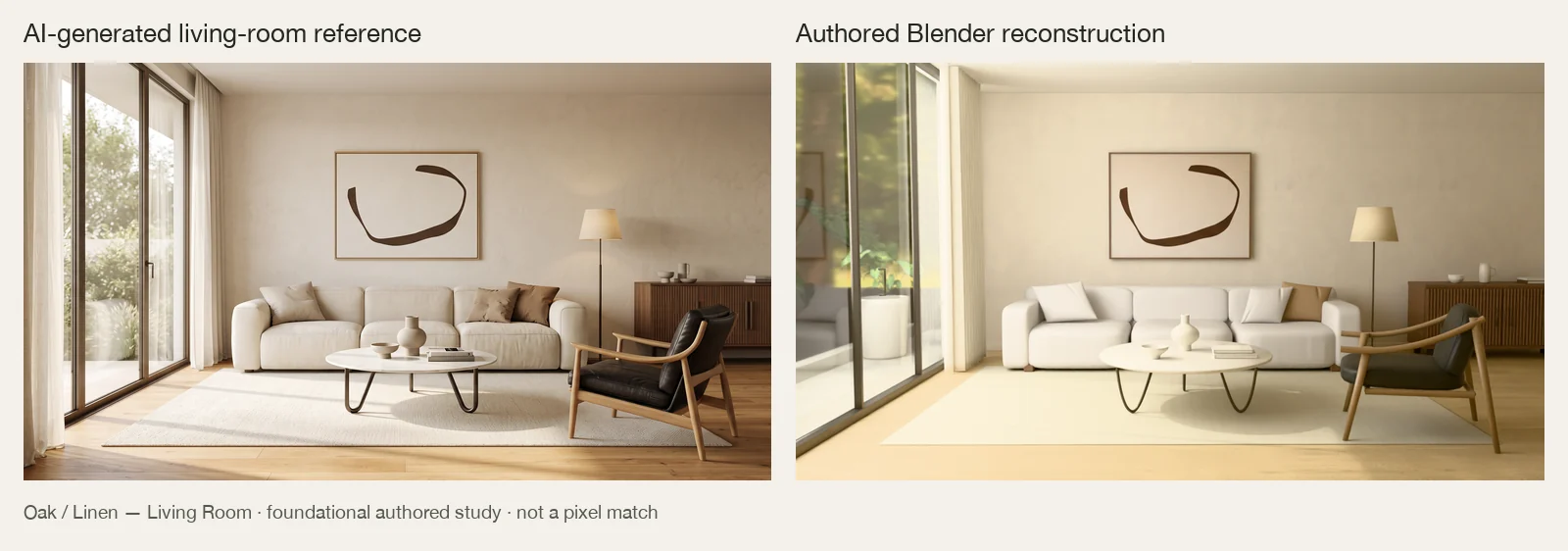](https://raw.githubusercontent.com/img2threejs/img2interior-media/375e6af7ab526d7c0c10be91b0e72f2757391ec7/living-room-comparison.webp)
- **Left: design reference. Right: reconstruction.** The reference is AI-generated, not a photograph or measured survey. The result is an actual render of the reopened Blender deliverable, not a retouched reference or an image plane standing in for a room.
- The **[live demo](https://img2threejs.io/living-room/)** is the same authored scene running in a hosted Three.js viewer — camera views, wireframe, curtain controls, sofa finishes and downloads. The screenshot below is an archived capture of that browser project, while the comparison image above is the native Blender deliverable; the live page is interactive.
- This is the **original Oak / Linen living-room research study** from which the packaged recipe and workflow lessons were extracted. It used scene-specific Blender/Python authoring and viewer integration, not a fresh run of the packaged 0.3.0 skill or the prompt below. Framing, proportions, fabric folds and lighting still differ from the reference; this is not a universal fidelity benchmark.
- <details>
- <summary><strong>Archived browser screenshot</strong> — same viewer as the live demo, captured frame rather than interactive page</summary>
- [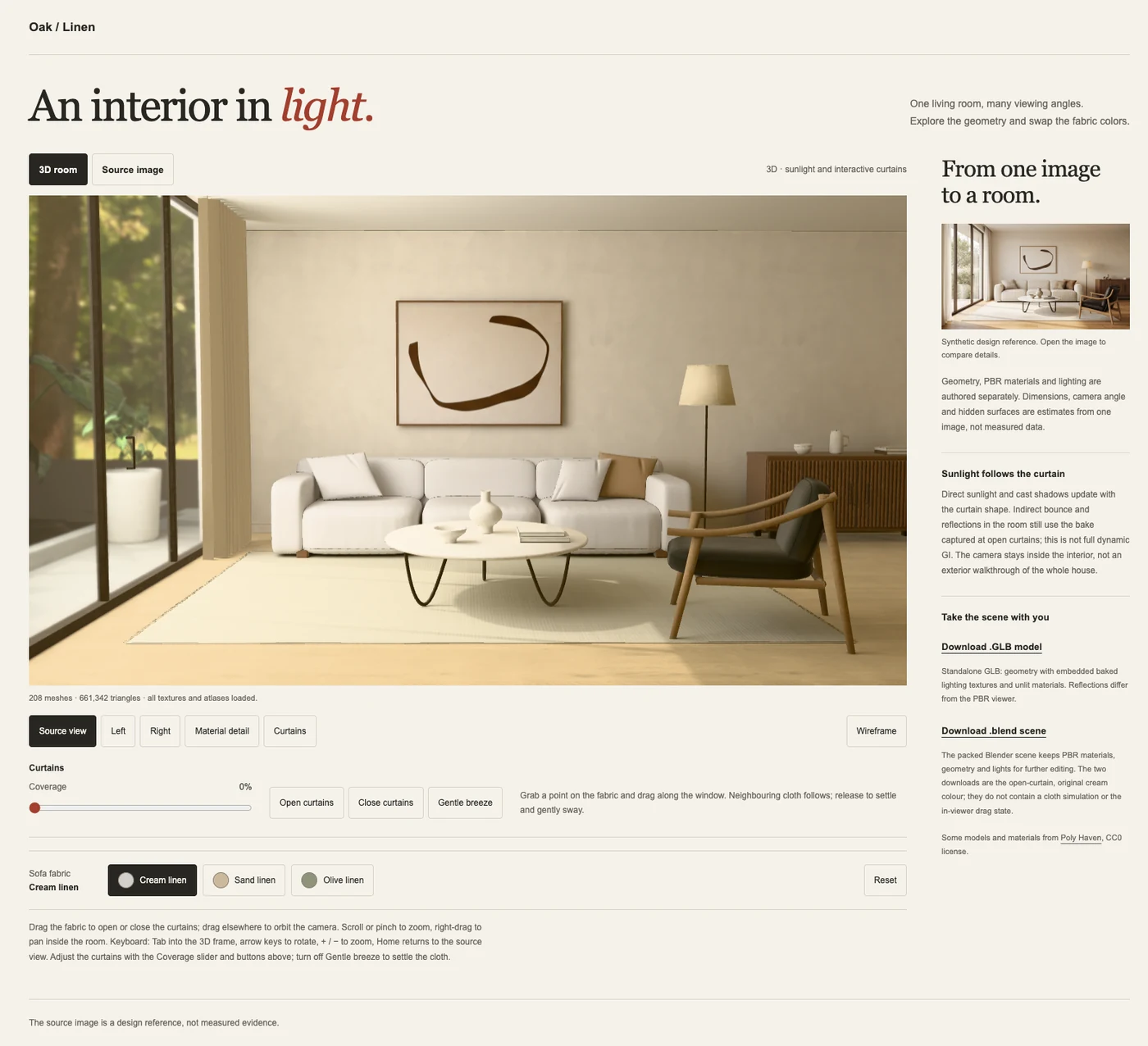](https://img2threejs.io/living-room/)
- This is a **static capture of the working Three.js project**; the live, interactive page lives at **[img2threejs.io/living-room/](https://img2threejs.io/living-room/)**. Indirect lighting is baked; curtain movement does not produce fully dynamic global illumination. The portable GLB is a separate static product, not a copy of every browser behavior.
- </details>
- [Live demo](https://img2threejs.io/living-room/) · [Public preview gallery](https://github.com/img2threejs/img2interior-media) · [Bundled gallery and limitations](docs/showcase/README.md)
- ## Copy-and-use prompt
- 1. **Install and activate the skill** using the [installation instructions](#installation). Your agent must be able to read images, execute local commands and inspect a real browser.
- 2. **Open your project**, outside the plugin checkout. Attach **one interior reference image** you have permission to use.
- 3. **Copy the entire prompt below.** No room-specific placeholders, JSON specification or Python builder to prepare yourself; the agent authors those inputs.
- ```text
- Use the installed img2-interior skill to reconstruct the attached room
- reference as an editable 3D interior and a working Three.js viewer in
- this project. Complete the workflow, not just a plan or a Blender file.
- Read the installed SKILL.md and its required reference guides first.
- Confirm that you can see the image and access the required agent tools,
- img2 harness, native authoring environment, image tools and WebGL browser.
- Set up missing dependencies only in project-local environments. If a
- required image, permission or compatible runtime is unavailable, report
- the exact blocker instead of inventing progress or substituting a room.
- Inspect the actual pixels. Identify the composition, camera, room shell,
- furniture, materials and lighting. Preserve the source and its provenance.
- Document estimated metre scale, dimensions, hidden surfaces and other
- single-view assumptions. Make reasonable labeled estimates; ask only
- when a material requirement cannot be decided safely.
- Author scene-specific, editable geometry and physically based materials.
- Do not reuse a bundled room as the answer, put the reference on furniture
- cards, or ask me to write the scene specification or builder. Use suitable
- permitted resources, keep their provenance, and preserve unrelated files.
- Render, open the images, compare against the reference and repair causes
- in camera/composition, geometry, then materials/lighting order. Inspect
- lateral and reverse views as well as the source view. Repeat the relevant
- reviews and regenerate affected bakes/exports after changes. A passing
- build, audit or score does not establish visual fidelity.
- Deliver all three products: a packed editable Blender master; a runtime
- GLB with every required sidecar and the working Three.js viewer; and a
- separate static portable GLB. Follow all eight review stages and the
- three blocking gates on current evidence without relaxing their checks.
- Launch and inspect the actual viewer. Exercise navigation, source view,
- wireframe, reset, applicable material/curtain controls, errors/retry and
- downloads at desktop and narrow widths. Reopen the native and portable
- files in independent consumer sessions and inspect actual renders.
- Hand off artifact locations, setup/launch/reproduction commands, observed
- verification evidence, resource notices and remaining visual/technical
- limits. Distinguish estimates, emulation and untested claims from proof.
- Do not claim exact recovery, universal photorealism or mobile performance.
- Do not use paid services, upload private images, publish packages, deploy
- publicly or change global configuration without separate authorization.
- ```
- **Keep the same workspace when continuing.** For a revision, describe the visible difference to fix; the skill should resume its recorded workflow, preserve evidence and revisit affected stages rather than initialize a new project. The prompt standardizes execution, not the artistic quality of every result.
- ## What you get
- | Product | Use it for | What travels with it |
- | --- | --- | --- |
- | **Packed Blender master** (`.blend`) | Edit geometry, cameras, materials and lighting | Native scene with packed images; editable rather than flattened into a reference picture |
- | **Runtime scene + Three.js viewer** | Explore the authored room in a browser | Runtime GLB, declared lightmaps/probe/other sidecars, viewer code and applicable controls |
- | **Portable GLB** | Open a standalone model in another glTF consumer | Embedded static baked appearance; no browser cloth state or full native PBR relighting |
- The handoff also includes the scene specification and Python builder, source/assumptions, resource notices, evidence, commands and known limitations. Generated rooms and full-resolution assets live in **your project**, not in the plugin package. The two small documentation previews above are not downloadable scene assets.
- ## Installation
- ### Before you start
- | Component | Requirement |
- | --- | --- |
- | Agent | Image-capable Claude Code, Codex or OpenCode, configured through img2; command execution and browser/image inspection tools |
- | Harness | img2 ≥0.4.0, core API 1 |
- | CLI / viewer | Git, npm and Node.js 18, 20 or ≥22; prefer a supported LTS release |
- | Audit / workspace tools | Python ≥3.10 |
- | Native authoring | Separate Python 3.11 environment with `bpy==4.3.0` and `numpy==1.26.4` |
- | Image tools / preview | Separate environment from `requirements-surfaces.txt`; a WebGL-capable browser |
- The harness registers the skill; it does not install bpy or create the finished app. The agent follows the bundled [environment setup](reference/production-runbook.md#2-prepare-project-local-environments) and preflight before authoring. Compatible Blender wheels must exist for your platform. Installation and use are free under the [license](LICENSE), including commercial project work; commercializing the tool itself requires prior written permission.
- ### Public npm install (preferred)
- Install `@img2threejs/img2interior@0.3.1` from the public npm registry into a dedicated, persistent prefix, then register it with the official img2 harness via `add --link`. `npm install` is the real distribution and tracking event; `add --link` is the host registration step. The package has no lifecycle scripts, so `npm install` performs only a fetch and a directory copy.
- ```sh
- npm install --prefix "$HOME/.local/share/img2interior" @img2threejs/img2interior@0.3.1
- npx --yes @img2threejs/img2@0.4.0 install --yes
- npx --yes @img2threejs/img2@0.4.0 add --link "$HOME/.local/share/img2interior/node_modules/@img2threejs/img2interior" --yes
- npx --yes @img2threejs/img2@0.4.0 doctor --json
- npx --yes @img2threejs/img2@0.4.0 sync --check
- ```
- Skip the `install --yes` step if a compatible harness already exists on this host; the `add --link` flow alone is sufficient then. Keep the dedicated prefix in place at `$HOME/.local/share/img2interior` — future `npm install --prefix "$HOME/.local/share/img2interior" @img2threejs/img2interior@<version>` commands update the live link without moving it. Do not pass `--force`, do not run a global install, and do not delete the prefix while a host link still points inside it.
- Restart the agent session, open your project and use the prompt above. The registry ID is **`interior`**; the agent-facing skill is **`img2-interior`**. To install from a Git clone or supplied source archive (pre-publication, an exact commit, or working without npm connectivity), follow [install from public source](reference/installation.md#install-from-public-source-or-supplied-archive). To remove and update, see [installation and removal](reference/installation.md).
- > **Why this two-step path?** The img2 0.4.0 harness `add npm:@img2threejs/img2interior@<version> --yes` flow expects `npm view` to return a nested `info.dist.integrity`, but npm 10/11 return a flat `dist.integrity`; `add` therefore refuses the package rather than registering it. Real consumers use `npm install` to fetch the public package into a dedicated prefix, then `add --link` that installed copy. The `add npm:` transport bug lives in the img2 harness, not in this package; until the harness ships a fix, the documented supported install path is the two-step flow above.
- ### Package and download metrics
- - **Package:** [`@img2threejs/img2interior`](https://www.npmjs.com/package/@img2threejs/img2interior), version `0.3.1`, published with `--access public`.
- - **Download counts** (last month, daily series, custom date ranges) and **package metadata** come from the documented public npm registry API — see [download metrics](reference/installation.md#download-metrics) for the exact endpoints and their limits. The version + downloads badges at the top of this README resolve through that same API; they reflect real registry values, not local instrumentation, and lag the registry by roughly one day.
- `npm install` is the source of the download counts that the badge shows; `add --link` is local-only registration and is not tracked by the npm registry.
- ## Guides
- Detailed guides are **bundled with the installed skill**; ask the agent to read them there. The GitHub repository and the public npm package ship the same project, so the links below point at the public GitHub repo. The live demo above and the bundled preview gallery need no extra access.
- | Guide | Start here when… |
- | --- | --- |
- | [Installation and release](reference/installation.md) | Installing from npm or source, updating, removing, or preparing a new public release |
- | [Production runbook](reference/production-runbook.md) · [Agent entry point](SKILL.md) | Running or resuming the complete reconstruction |
- | [Scene contract](reference/scene-contract.md) | Understanding editable scene inputs and the Blender builder |
- | [Resources](reference/resources.md) · [Materials](reference/materials.md) | Selecting assets, recording rights, and preparing PBR surfaces |
- | [Bake / export](reference/bake-export.md) · [Viewer](reference/viewer-integration.md) | Understanding the native/runtime/portable split |
- | [Delivery](reference/delivery.md) | Handing off and inspecting the final native/runtime/portable products |
- | [Changelog](CHANGELOG.md) · [Maintainer checks](reference/installation.md#maintainer-checks) | Reviewing changes or validating a contribution |
- ## Limits to understand
- - **One image is incomplete evidence.** Dimensions, hidden geometry, camera and material properties are estimates unless additional evidence is supplied.
- - **Visual review is required.** Contract gates catch stale or inconsistent deliverables; they cannot prove likeness, physical accuracy or photorealism. The showcase is not a universal benchmark.
- - **Lighting and exports differ.** Indirect bakes/probes are static. The portable product does not preserve every native material or browser interaction.
- - **Interaction is scoped.** Optional rail-mounted curtains use a position-based approximation, not a general cloth solver.
- - **Performance is scene-dependent.** Desktop or narrow-viewport captures do not certify physical phones, arbitrary hardware or production network performance.
- ## Support
- If this skill saved you time, consider supporting continued work via the same payment channels used by the broader img2threejs project:
- - Ko-fi: [ko-fi.com/O8A625YLSR](https://ko-fi.com/O8A625YLSR)
- - Donate page (VietQR / MoMo / PayPal / Binance Pay): [img2threejs.io/donate.html](https://img2threejs.io/donate.html)
- - Direct PayPal: [paypal.com/paypalme/NguyenHoai545](https://www.paypal.com/paypalme/NguyenHoai545)
- - Direct Binance Pay: [app.binance.com/uni-qr/Trcs9shL](https://app.binance.com/uni-qr/Trcs9shL)
- Supporting this project is not required to install or use the skill; the [license](#license) covers all permitted free use without it.
- ## Contributions
- Use [GitHub issues](https://github.com/img2threejs/img2interior/issues) for reproducible bugs and pull requests for fixes. Include plugin/harness versions, OS, the command, expected/actual behavior and a minimal reproduction. Remove credentials, private references, client assets and identifying paths before posting.
- Report security-sensitive information privately to the repository owner; read the bundled [security policy](SECURITY.md) before executing authored Python or consuming external resources. Paid generation, private-image uploads, public deployment and redistribution of third-party content need the relevant authorization; sharing this tool follows the [license](LICENSE).
- Keep generated projects, dependencies and private evidence out of commits; the approved documentation previews are the explicit exception. Describe the behavior changed and checks exercised. Modifications and free noncommercial sharing are permitted under the [license](LICENSE); agree contribution terms with the maintainer before submission. Separately licensed components retain their own terms; see [component notices](THIRD_PARTY_NOTICES.md) and [maintainer checks](reference/installation.md#maintainer-checks).
- ## License
- **Free to use, including commercial project work; commercialization of the tool requires permission.** The [img2 Interior Free Use, Restricted Commercialization License 1.0](LICENSE) permits use, modification, paid client work and commercial delivery of your outputs without a license fee. It also permits free noncommercial sharing with the license and notices preserved.
- You must obtain the copyright holder's **prior written permission** to sell or rebrand and resell the tool, bundle it into a commercial software product, or offer paid hosted/API access to its authoring or generation workflow. Attribution or publishing your modified source does not replace permission. Request it through [img2threejs](https://github.com/img2threejs).
- Your original scenes, models, renders and artwork remain yours. Viewer/runtime code may accompany paid output deliverables under the license's output exception; it may not be sold as a standalone toolkit without permission. Third-party content retains its own terms.
- This is **source-available**, not OSI-approved open source. [Component notices and prior grants](THIRD_PARTY_NOTICES.md) preserve separately licensed material, including existing Apache-2.0 rights and their commercial permissions; the new restrictions do not override those grants.
Ratings and comments
Sign in to rate this skill.
Sign inFree to use. If it’s helped, pass it on.