evoskills
🧬 Extend EvoScientist with Installable Skill & Knowledge Packs
Safety scan
A static text scan, not a guarantee. Select the badge to see what was scanned and every finding.
Check it deeper on your machine
It has changed since its scan on 11 Nov 2026.
As a Claude Code plugin, install it and then ask Claude Code:
/plugin marketplace add keithmackay/mackayi/plugin install scanskillsafety@mackayiDo a deep scan of https://github.com/evoscientist/evoskills with scanskillsafety
Or from a terminal, clone it and run it:
git clone https://github.com/keithmackay/scanskillsafety-skill ~/.claude/skills/scanskillsafetynode ~/.claude/skills/scanskillsafety/cli.cjs --deep 'https://github.com/evoscientist/evoskills'
It checks the exact commit: every file, its packages against OSV (api.osv.dev), how it compares with this page's scan (findsafeskills.com receives the repository's address), and, if you agree, Claude reading every file with your own Claude subscription. It never runs the code.
Badge for your README

Markdown
[](/listings/evoscientist--evoskills)HTML
<a href="/listings/evoscientist--evoskills"><img src="/api/listings/evoscientist--evoskills/badge.svg" alt="findsafeskills safety rating" /></a>Install
Install instructions from the README
As written by the repo's author. findsafeskills has not verified these steps.
> [!IMPORTANT] > These skills are purpose-built for EvoScientist — together they amplify each other, unlocking the full potential of both the agent and the skills. Under EvoScientist, skills evolve across research cycles through persistent memory (evo-memory).
In-session commands
Install all skills at once:
/install-skill EvoScientist/EvoSkills@skills
Or install a single skill:
/install-skill EvoScientist/EvoSkills@skills/paper-planning
Ask EvoScientist directly
Simply ask the agent in conversation:
"Install all skills from EvoScientist/EvoSkills@skills."
> [!TIP] > **Not using EvoScientist?** These skills are compatible with any coding agent. > One command via [**skills.sh**](https://skills.sh/) to install on Claude Code, OpenCode, Cursor, Codex, Gemini CLI, DeepAgents, and more: > ```bash > npx skills add EvoScientist/EvoSkills > ```
What was scanned
The files the safety scan read, as written by the repository's author and shown as plain text. Lines with a finding are marked.
README.md · README · 399 lines
View this file on GitHub (read at the repository's current version: the scan did not record which commit it read)
- # 🧬 EvoSkills
- <div align="center">
- **English | [简体中文](./README.zh-CN.md)**
- </div>
- **The official skill repository for [EvoScientist](https://github.com/EvoScientist/EvoScientist). Each skill is an installable knowledge pack that extends EvoScientist with domain-specific expertise.**
- ## 📦 Installation
- > [!IMPORTANT]
- > These skills are purpose-built for EvoScientist — together they amplify each other, unlocking the full potential of both the agent and the skills. Under EvoScientist, skills evolve across research cycles through persistent memory (evo-memory).
- ### In-session commands
- Install all skills at once:
- ```bash
- /install-skill EvoScientist/EvoSkills@skills
- ```
- Or install a single skill:
- ```bash
- /install-skill EvoScientist/EvoSkills@skills/paper-planning
- ```
- ### Ask EvoScientist directly
- Simply ask the agent in conversation:
- ```text
- "Install all skills from EvoScientist/EvoSkills@skills."
- ```
- > [!TIP]
- > **Not using EvoScientist?** These skills are compatible with any coding agent.
- > One command via [**skills.sh**](https://skills.sh/) to install on Claude Code, OpenCode, Cursor, Codex, Gemini CLI, DeepAgents, and more:
- > ```bash
- > npx skills add EvoScientist/EvoSkills
- > ```
- ## ✨ Available Skills
- | Skill | Description |
- | ----- | ----------- |
- | [`research-ideation`](#-research-ideation--literature-grounding-tournament--proposal) | 💡 Literature grounding, tournament ranking & proposal generation |
- | [`paper-planning`](#-paper-planning--research-paper-planning--outline-generation) | 📐 Research paper planning & outline generation |
- | [`experiment-pipeline`](#-experiment-pipeline--4-stage-experiment-execution) | 🧪 Structured 4-stage experiment execution |
- | [`experiment-craft`](#-experiment-craft--experiment-debugging--iteration) | 🔧 Experiment debugging, logging & iteration |
- | [`experiment-iterative-coder`](#-experiment-iterative-coder--iterative-code-refinement) | 🔄 Iterative code refinement (plan → code → evaluate → refine) |
- | [`paper-writing`](#%EF%B8%8F-paper-writing--section-by-section-paper-drafting) | ✍️ End-to-end paper writing assistance |
- | [`paper-review`](#-paper-review--self-review--quality-assurance) | 🔍 Automated paper review & feedback |
- | [`paper-rebuttal`](#-paper-rebuttal--rebuttal-writing-after-peer-review) | 💬 Rebuttal writing after peer review |
- | [`paper-figures`](#-paper-figures--publication-ready-matplotlib-figures-from-data) | 📊 Publication-ready matplotlib figures from tabular data |
- | [`academic-slides`](#-academic-slides--presentation--research-talk-creation) | 🎤 Academic presentation & research talk creation |
- | [`evo-memory`](#-evo-memory--persistent-research-memory--self-evolution) | 🧠 Persistent research memory & self-evolution |
- | [`paper-navigator`](#-paper-navigator--academic-paper-discovery--reading) | 📚 Academic paper discovery, evaluation & reading |
- | [`research-survey`](#-research-survey--literature-survey--synthesis) | 📝 Structured literature survey synthesis |
- | [`paper-graph`](#-paper-graph--lineage-map-of-a-research-field-via-mermaid-diagrams) | 🌳 Lineage map of a research field as Mermaid diagrams |
- | [`nano-banana`](#-nano-banana--ai-generated-slides--illustrations) | 🍌 AI-generated presentation slides & illustrations via Gemini |
- | [`evomath-tao`](#-evomath-tao--tao-style-olympiad-proof-workflow) | 🧮 Tao-style olympiad-grade proof workflow with calibrated abstention |
- > **Paper Suite + Self-Evolution Suite**: Each skill is self-contained — use them individually or combine freely. The self-evolution loop now runs through `research-ideation`, `experiment-pipeline`, and `evo-memory`.
- ## 🔌 MCP Server Marketplace
- The [`mcp/`](./mcp/) directory contains a curated collection of [MCP](https://modelcontextprotocol.io/) servers that extend agents with external tools — web search, academic paper retrieval, documentation lookup, and more. Browse the [full list](./mcp/README.md) or install directly:
- ```bash
- /install-mcp # interactive browser
- EvoSci mcp install arxiv # install by name
- ```
- ### ⛳️ Framework Overview
- <p align="center">
- <img src="assets/framework.png" alt="EvoScientist Framework" width="100%" />
- </p>
- The diagram above shows the full EvoScientist pipeline. The **Researcher Agent** (top, blue) runs idea tree search and Elo tournament ranking to produce a research proposal (in this repository, the `research-ideation` skill: three persona-driven refinement tracks whose champions are ranked in a three-match Elo round-robin). The **Engineer Agent** (bottom, green) executes the 4-stage experiment pipeline. The **Evolution Manager Agent** (right) manages three memory evolution mechanisms — IDE, IVE, and ESE — that feed learned knowledge back into **Ideation Memory (M_I)** and **Experimentation Memory (M_E)** for future cycles.
- #### 🎢 Skill Pipeline
- ```mermaid
- flowchart LR
- A["<b>🔬 Research Phase</b><br/>💡 research-ideation"]
- --> B["<b>⚙️ Experiment Phase</b><br/>📐 paper-planning<br/>🧪 experiment-pipeline<br/>🔧 experiment-craft<br/>🔄 experiment-iterative-coder"]
- --> C["<b>📝 Writing Phase</b><br/>✍️ paper-writing<br/>🔍 paper-review<br/>💬 paper-rebuttal<br/>🎤 academic-slides"]
- D[("🧠 evo-memory<br/>(IDE · IVE · ESE)")] <--> A
- D <--> B
- E["📚 paper-navigator<br/>(standalone)"] -.-> A
- E -.-> B
- F["🍌 nano-banana<br/>(standalone)"] -.-> C
- G["🧮 evomath-tao<br/>(standalone)"] -.-> A
- G -.-> B
- H["📝 research-survey<br/>(standalone)"] -.-> A
- H -.-> C
- I["🌳 paper-graph<br/>(standalone)"] -.-> A
- J["📊 paper-figures<br/>(standalone)"] -.-> C
- style A fill:#7C3AED,stroke:#5B21B6,stroke-width:2px,color:#fff
- style B fill:#D97706,stroke:#B45309,stroke-width:2px,color:#fff
- style C fill:#16A34A,stroke:#15803D,stroke-width:2px,color:#fff
- style D fill:#475569,stroke:#334155,stroke-width:2px,color:#fff
- style E fill:#0369A1,stroke:#075985,stroke-width:2px,color:#fff
- style F fill:#D97706,stroke:#B45309,stroke-width:2px,color:#fff
- style G fill:#BE185D,stroke:#9D174D,stroke-width:2px,color:#fff
- style H fill:#0891B2,stroke:#0E7490,stroke-width:2px,color:#fff
- style I fill:#65A30D,stroke:#4D7C0F,stroke-width:2px,color:#fff
- style J fill:#9333EA,stroke:#7E22CE,stroke-width:2px,color:#fff
- ```
- ---
- ### 💡 `research-ideation` — Literature Grounding, Tournament & Proposal
- The starting point of the research pipeline. It now covers the full path from literature grounding to ranked ideas to a concrete proposal:
- - **Load Prior Knowledge** — Read `evo-memory` first to reuse feasible directions and avoid known dead ends
- - **Literature Grounding** — Use `paper-navigator` to collect and analyze papers before generating ideas
- - **Multi-Track Ideation + Refinement** — Generate one idea per research direction, then refine each in its own track with three personas (innovator, pragmatist, critic)
- - **Elo Tournament** — Rank the three track champions on novelty, feasibility, relevance, and clarity; present all three, ranked
- - **Proposal Extension** — Expand the selected winner into a manuscript-quality research proposal
- ### 📝 `research-survey` — Literature Survey & Synthesis
- Dedicated skill for turning a large paper collection into a structured survey report:
- - **Adaptive Outline** — Generate a field-specific outline based on the query type and literature set
- - **Draft + Expansion Pipeline** — Draft from top papers, then deepen each section with the full collection
- - **Summary Refinement** — Build section summaries before rewriting the abstract, introduction, and conclusion
- - **Survey-Grade Output** — Comparative tables, taxonomy-based method organization, dense citations, and references
- ### 📐 `paper-planning` — Research Paper Planning & Outline Generation
- Guides pre-writing planning before a single word is drafted. Covers four key activities:
- - **Story Design** — Reverse-engineer the narrative: task → challenge → insight → contribution → advantage
- - **Experiment Planning** — Plan comparisons, ablations, and demo scenarios with structured checklists
- - **Figure Design** — Pipeline figures that highlight novelty; teaser figures that hook reviewers
- - **Timeline Management** — 4-week countdown schedule from outline to submission
- Includes counterintuitive tactics: write your rejection letter first, narrow claims before broadening, and plan fallback narratives.
- ### 🧪 `experiment-pipeline` — 4-Stage Experiment Execution
- A structured framework for executing research experiments with attempt budgets and gate conditions:
- - **Stage 1: Initial Implementation** — Get baseline code running and reproduce known results (≤20 attempts)
- - **Stage 2: Hyperparameter Tuning** — Optimize configuration for your setup (≤12 attempts)
- - **Stage 3: Proposed Method** — Implement and validate the novel method (≤12 attempts)
- - **Stage 4: Ablation Study** — Prove each component's contribution (≤18 attempts)
- - **Code Trajectory Logging** — Structured attempt logging that feeds into `evo-memory`
- - **Counterintuitive Rules** — Initial implementation is not wasted time; budget limits prevent rabbit holes; failed attempts are data
- Integrates with `experiment-craft` for failure diagnosis within stages and `evo-memory` for cross-cycle learning.
- ### 🔧 `experiment-craft` — Experiment Debugging & Iteration
- A systematic approach to experiment debugging, logging, and iterative improvement:
- - **5-Step Diagnostic Flow** — Collect failures → find a working version → bridge the gap → hypothesize → fix
- - **Counterintuitive Rules** — Change one variable at a time; effective experiments beat more experiments
- - **Experiment Logging** — 5-section structured log template for reproducible records
- - **Handoff to Paper-Writing** — Feed validated results and logs into `paper-writing` for drafting
- ### 🔄 `experiment-iterative-coder` — Iterative Code Refinement
- Structured plan → code → evaluate → refine cycles for higher code quality:
- - **Phase Decomposition** — Break complex tasks into 1-5 sequential phases
- - **Iteration Loop** — Up to 3 iterations per phase (10 total): plan, code, run lint/tests, score, decide
- - **Objective Evaluation** — ruff lint + pytest with dynamic score weighting and hard caps
- - **Failure Mode Guidance** — Targeted responses for timeout, syntax, import, test, and lint failures
- Integrates with `experiment-craft` for stuck diagnoses and `evo-memory` for loading prior strategies.
- ### ✍️ `paper-writing` — Section-by-Section Paper Drafting
- A proven 11-step workflow for writing academic papers with LaTeX templates:
- - **Structured Process** — From pipeline sketch → story design → Method → Experiments → Related Work → Abstract → Title
- - **Section Templates** — Three Abstract templates, four Introduction openers, Method module structure, Experiments organization
- - **LaTeX Assets** — Annotated paper skeleton (`paper-skeleton.tex`) and booktabs table macros (`table-style.tex`)
- - **Writing Principles** — One message per paragraph, topic sentence first, terminology consistency, reverse-outlining
- - **Counterintuitive Tactics** — Underclaim in prose / overdeliver in evidence; lead with mechanism, not just metrics
- ### 🔍 `paper-review` — Self-Review & Quality Assurance
- Systematic self-review before submission using adversarial and counterintuitive review strategies:
- - **5-Aspect Checklist** — Contribution sufficiency, writing clarity, results quality, testing completeness, method design
- - **Reverse-Outlining** — Extract the outline from finished paragraphs to verify logical flow
- - **Figure & Table Quality Checks** — Captions, resolution, booktabs, color-blind friendliness
- - **Rejection Simulation** — Force a reject summary first; attack your own novelty claim
- - **Handoff to Rebuttal** — After review, feed identified weaknesses into `paper-rebuttal` for response preparation
- ### 💬 `paper-rebuttal` — Rebuttal Writing After Peer Review
- Dedicated rebuttal skill for responding to reviewer feedback after peer review:
- - **Score Diagnosis** — Color-code every reviewer comment: red (critical), orange (important), gray (minor), green (positive)
- - **Champion Strategy** — Arm your most positive reviewer with evidence for the Area Chair discussion
- - **Tactical Writing** — 18 rules for structure, content, and tone in rebuttal responses
- - **Counterintuitive Principles** — Submit even with extreme scores; concede small points to win the big argument
- - **Common Concerns** — Response strategies for 12 frequently raised reviewer complaints
- ### 📊 `paper-figures` — Publication-Ready Matplotlib Figures from Data
- A spec-first workflow that turns CSVs and natural-language descriptions into standalone PNGs and reproducible matplotlib scripts:
- - **7-Step Protocol** — Plan Figure → Inspect Data → Write `figure-spec.md` → Pick matplotlib idiom → Apply publication style → Write and run the script → Audit, with `plot.py` + `plot.png` as the always-paired output
- - **Spec-First Discipline** — Every figure is preceded by a compact `figure-spec.md` contract (axes, scales, series, forbidden elements, assumptions) that the audit checks against
- - **4 Honest Status Labels** — `PASSED` / `PASSED_WITH_WARNINGS` / `REPAIRED` / `FAILED_NEEDS_HANDOFF`. The script executing is not proof the figure matches the request
- - **Structural Audit, Not Visual** — Verifies title, axis labels, series ordering, colors, annotations, and axis bounds against the description (LLM visual inspection of PNGs is unreliable)
- - **Broad Chart Coverage** — Scatter, line, bar, pie, ring, bubble, tornado, KDE, violin, box, heatmap, histogram, area, and composite multi-panel figures
- - **Counterintuitive Rules** — Don't drop data silently; don't invent uninvited elements; CSV is authoritative when it disagrees with the description; tight framing that crops a named feature is equivalent to silent data dropping
- ### 🎤 `academic-slides` — Presentation & Research Talk Creation
- A structured approach to creating academic presentations and preparing research talks:
- - **Narrative Arc** — Define scope, audience, and key takeaway before touching slides
- - **Slide Design** — 10 design rules, visual hierarchy, one idea per slide, claim-style titles
- - **Practical Creation** — `.pptx` file generation with color palettes, layout code, charts, and figures
- - **Delivery & Q&A** — Rehearsal protocol, timing, and backup slide preparation
- - **Counterintuitive Rules** — Slides are not your paper; enthusiasm beats polish; related work builds motivation, not citation counts
- ### 🧠 `evo-memory` — Persistent Research Memory & Self-Evolution
- The learning layer that accumulates knowledge across research cycles. Maintains two memory stores and implements three evolution mechanisms:
- - **Ideation Memory (M_I)** — Tracks feasible and unsuccessful research directions across ideation cycles
- - **Experimentation Memory (M_E)** — Stores reusable data processing and model training strategies (paper core), plus architecture and debugging (extensions)
- - **IDE (Idea Direction Evolution)** — Extracts promising directions after `research-ideation`
- - **IVE (Idea Validation Evolution)** — Classifies experiment failures as implementation vs fundamental direction failures
- - **ESE (Experiment Strategy Evolution)** — Distills reusable patterns from successful experiment pipelines
- Read by `research-ideation` and `experiment-pipeline` at cycle start; updated after each cycle completes.
- ### 📚 `paper-navigator` — Academic Paper Discovery & Reading
- Finds and reads academic papers, routing by intent and judging by relevance:
- - **Router** — A known paper (title, URL, or ID) takes the single-call POINT branch and returns a Paper Card; "find papers about X" and survey-scale requests take the LIST / ITERATIVE branch
- - **Rubric First** — On the LIST / ITERATIVE branch, the agent writes a rubric of core (must-have) and secondary criteria before any search; every later step checks papers against it
- - **Probe + Up to 3 Rounds** — A two-query probe, then up to three keyword-search rounds (breadth, deepen, close). With a Semantic Scholar API key, citation traversal and recommendations widen the search for survey-scale requests, or once at least three papers have passed triage. A saturation gate after the probe and after each round decides whether key gaps remain
- - **Triage Without Scores** — Each paper is marked All-core / Partial / Irrelevant against the rubric, with a quoted span as evidence for every criterion it is said to meet; when an abstract is silent on a core criterion, body-text snippets can settle it (Semantic Scholar API key required). No LLM-as-judge, no numeric scoring
- - **Read** — Full-text retrieval via Jina Reader with 3-level reading strategy (Technical, Analytical, Contextual)
- Includes Python scripts powered by Semantic Scholar, arXiv (via the DeepXiv SDK), HuggingFace, GitHub, and Jina Reader.
- ### 🌳 `paper-graph` — Lineage Map of a Research Field via Mermaid Diagrams
- A skill that turns a research topic or seed paper into a Markdown report tracing how a field evolved — challenges, solutions, and per-solution citation lineage, all rendered as embedded Mermaid diagrams:
- - **Two Graph Layers** — High-level taxonomy (root → challenges → solutions → papers) plus one per-solution evolution path tracing paper-to-paper "evolution from" edges and open challenges
- - **Agent-Driven LLM Calls** — The skill ships deterministic data fetchers (Semantic Scholar / DeepXiv), prompt templates, and Mermaid renderers; the host agent runs every LLM stage, so the skill needs no model API key of its own (a Semantic Scholar API key is required for fetching papers)
- - **Edge Audit Pass** — Every claimed "evolution from" edge is audited by a separate LLM step, then re-checked by the renderer: a verbatim quote from each paper must be found in its text and known publication years must be in order, or the edge is not drawn
- - **Renders Anywhere** — Mermaid in fenced Markdown blocks views directly in GitHub, Obsidian, VS Code (with a Mermaid extension), and other Markdown viewers — no external rendering pipeline
- - **Use Cases** — "History of <topic>", "What did <paper> build on?", "Lineage of ideas in <field>", "Citation tree of <paper>"
- ### 🍌 `nano-banana` — AI-Generated Slides & Illustrations
- Generate professional presentation slides and high-quality illustrations using Gemini's image generation API, with an interactive browser-based review loop:
- - **7-Phase Workflow** — Content planning conversation → slides_plan.json → style selection & batch generation → browser review → feedback editing → PPTX packaging → cleanup
- - **3 Visual Styles** — Lineal Color (flat icons, educational), Gradient Glass (glassmorphism, premium), Vector Illustration (retro, approachable)
- - **Interactive Review** — Local HTTP server with per-slide feedback; edits are applied without regenerating the entire deck
- - **Multi-Model Support** — `gemini-3-pro-image-preview` (best quality), `gemini-3.1-flash-image-preview` (fast iteration), `gemini-2.5-flash-image` (rapid prototyping)
- - **Counterintuitive Rules** — More planning = better slides; edit don't regenerate; never read generated images yourself (use the review server)
- ### 🧮 `evomath-tao` — Tao-style Olympiad Proof Workflow
- A rigorous proof workflow that operationalizes Terence Tao's research-math practice for contest-style mathematics. Outputs a complete proof, a verified counterexample, a calibrated partial result, or a clean handoff — never a hand-waved "PROVED":
- - **5-Step Protocol** — Plan Briefly → Try Candidates → Assemble → Audit → Reflect, driven by TodoWrite + per-phase validators
- - **5-Round Internal Mini-Process per Candidate** — Solve → Self-improve → Self-verify → Correct → Repeat. **No tool use during Solve** (pencil-and-paper discipline)
- - **5 Honest Status Labels** — `PROVED` / `REFUTED` / `VERIFIED_NUMERICALLY` / `CONJECTURED` / `HANDED_OFF`. Numerical evidence is NOT a proof
- - **3-Safeguard Audit** — Verifier context isolation, asymmetric voting (4 HOLDS to confirm, 2 HOLE FOUND to refute), pigeonhole exit
- - **Named-Pattern Screen** — Library of recurring failure modes (P4, P5, P6, P18, P40, P41) checked before any PROVED award
- - **Calibrated Abstention** — When verification fails repeatedly, the skill downgrades the status instead of bluffing
- **IMO 2025 evaluation (Claude Opus 4.7, 6 parallel subagents):** 4 PROVED (P1 / P2 / P4 / P5) · 1 CONJECTURED (P3, c = 4 with odd-prime gap) · 1 HANDED_OFF (P6, 2112 sketched). All 6 numeric/classification answers match the official IMO 2025 keys.
- <p align="right"><a href="#top">🔝Back to top</a></p>
- ## 🎯 ᯓ➤ Roadmap
- Completed:
- - [x] 🧠 **Self-Evolution Suite** — `research-ideation`, `experiment-pipeline`, `evo-memory`
- - [x] 📚 **Literature Survey** — Systematic literature search, filtering, and survey generation
- - [x] 🔄 **Iterative Coder** — Iterative code refinement with plan → code → evaluate → refine cycles
- - [x] 🎨 **Visual Generation** — AI-generated slides & illustrations (`nano-banana`)
- - [x] 🏅 **Math Olympiad** — Tao-style proof workflow with calibrated abstention (`evomath-tao`)
- Coming soon:
- - [ ] 🔬 **Paper Reproduction** — Read a paper, reproduce its core results, and verify claims
- - [ ] 💡 **Grant & Proposal Writing** — Research proposal drafting with funding agency conventions
- - [ ] 🤖 **Peer Debate** — Multi-agent adversarial discussion to stress-test research ideas
- - [ ] 📈 **Trend Radar** — Analyze publication trends, identify emerging topics & research gaps
- - [ ] 🗣️ **Paper QA** — Interactive question-answering over paper collections, extracting key findings & cross-referencing claims
- Stay tuned — more skills are on the way!
- <p align="right"><a href="#top">🔝Back to top</a></p>
- ## 🌍 Project Roles
- <table>
- <tbody>
- <tr>
- <td align="center">
- <a href="https://x-izhang.github.io/">
- <img src="https://x-izhang.github.io/author/xi-zhang/avatar.jpg"
- width="100" height="100"
- style="object-fit: cover; border-radius: 20%;" alt="Xi Zhang"/>
- <br />
- <sub><b>Xi Zhang</b></sub>
- </a>
- </td>
- <td align="center">
- <a href="https://youganglyu.github.io/">
- <img src="https://youganglyu.github.io/images/profile.png"
- width="100" height="100"
- style="object-fit: cover; border-radius: 20%;" alt="Yougang Lyu"/>
- <br />
- <sub><b>Yougang Lyu</b></sub>
- </a>
- </td>
- <td align="center">
- <a href="https://din0s.me/">
- <img src="https://din0s.me/images/pk.jpg"
- width="100" height="100"
- style="object-fit: cover; border-radius: 20%;" alt="Dinos Papakostas"/>
- <br />
- <sub><b>Dinos Papakostas</b></sub>
- </a>
- </td>
- <td align="center">
- <a href="https://go0day.github.io/">
- <img src="https://go0day.github.io/authors/admin/avatar_hu_ee1051aceae96124.png"
- width="100" height="100"
- style="object-fit: cover; border-radius: 20%;" alt="Yuyue Zhao"/>
- <br />
- <sub><b>Yuyue Zhao</b></sub>
- </a>
- </td>
- </tr>
- </tbody>
- </table>
- > <a href="https://xiaoyi.huawei.com/chat/research"><img src="./assets/xiaoyi-deepresearch.webp" height="16" alt="Xiaoyi DeepResearch" align="center" /></a> [*Xiaoyi DeepResearch*](https://xiaoyi.huawei.com/chat/research) *Team* and the wider open-source community contribute to this project.
- For any enquiries or collaboration opportunities, please contact: [**EvoScientist.ai@gmail.com**](mailto:evoscientist.ai@gmail.com)
- <p align="right"><a href="#top">🔝Back to top</a></p>
- ## 🤝 Contributing
- We welcome contributions! See the guides for [skills](./skills/README.md) and [MCP servers](./mcp/README.md), or start with the [Contributing Guidelines](./CONTRIBUTING.md).
- Every contribution brings us one step closer to a future where AI accelerates scientific breakthroughs for all of humanity.
- <a href="https://github.com/EvoScientist/EvoSkills/graphs/contributors">
- <img src="https://contrib.rocks/image?repo=EvoScientist/EvoSkills" />
- </a>
- ### 📈 Star History
- [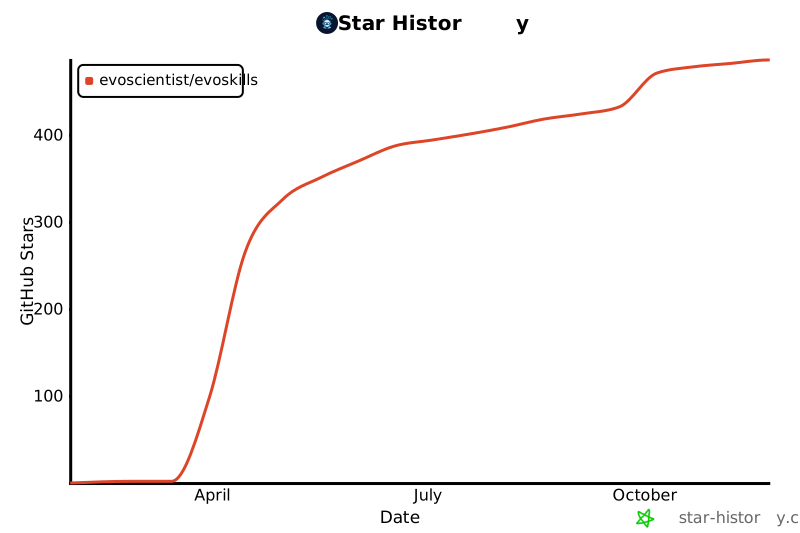](https://www.star-history.com/?repos=EvoScientist%2FEvoSkills&type=date&legend=top-left)
- <p align="right"><a href="#top">🔝Back to top</a></p>
- ## 📝 Citation
- If you find our paper and code useful in your research and applications, please cite using this BibTeX:
- ```bibtex
- @article{evoscientist2026,
- title={EvoScientist: Towards Multi-Agent Evolving AI Scientists for End-to-End Scientific Discovery},
- author={Yougang Lyu and Xi Zhang and Xinhao Yi and Yuyue Zhao and Shuyu Guo and Wenxiang Hu and Jan Piotrowski and Jakub Kaliski and Jacopo Urbani and Zaiqiao Meng and Lun Zhou and Xiaohui Yan},
- journal={arXiv preprint arXiv:2603.08127},
- year={2026}
- }
- ```
- <p align="right"><a href="#top">🔝Back to top</a></p>
- ## 📜 License
- This project is licensed under the Apache License 2.0 - see the [LICENSE](./LICENSE) file for details.
- <p align="right"><a href="#top">🔝Back to top</a></p>
Ratings and comments
Sign in to rate this skill.
Sign inFree to use. If it’s helped, pass it on.