hevy-mcp
Read, analyze, create, and update Hevy workouts, routines, exercises, and body measurements in Claude.
Safety scan
A static text scan, not a guarantee. Select the badge to see what was scanned and every finding.
Check it deeper on your machine
It has changed since its scan on 11 Nov 2026. Its scripts were only partly scanned.
As a Claude Code plugin, install it and then ask Claude Code:
/plugin marketplace add keithmackay/mackayi/plugin install scanskillsafety@mackayiDo a deep scan of https://github.com/chrisdoc/hevy-mcp with scanskillsafety
Or from a terminal, clone it and run it:
git clone https://github.com/keithmackay/scanskillsafety-skill ~/.claude/skills/scanskillsafetynode ~/.claude/skills/scanskillsafety/cli.cjs --deep 'https://github.com/chrisdoc/hevy-mcp'
It checks the exact commit: every file, its packages against OSV (api.osv.dev), how it compares with this page's scan (findsafeskills.com receives the repository's address), and, if you agree, Claude reading every file with your own Claude subscription. It never runs the code.
Badge for your README

Markdown
[](/listings/chrisdoc--hevy-mcp)HTML
<a href="/listings/chrisdoc--hevy-mcp"><img src="/api/listings/chrisdoc--hevy-mcp/badge.svg" alt="findsafeskills safety rating" /></a>Install
Install instructions from the README
As written by the repo's author. findsafeskills has not verified these steps.
1. Get your Hevy API key
Create an API key in [Hevy's API settings](https://hevy.com/settings?developer), then keep it somewhere secure. API access currently requires a Hevy PRO subscription.
2. Connect `hevy-mcp` to your client
The hosted Cloudflare endpoint is the fastest way to start. It runs remotely, so your client does not need Node.js, Bun, Docker, or a local server process.
Connect to the hosted endpoint
Production URL:
https://mcp.hevy-mcp.dev/mcp
The endpoint uses Streamable HTTP. Send your Hevy API key as a bearer token on every request.
Codex
Codex CLI, the Codex desktop app, and the IDE extension share the same MCP configuration. Make your Hevy API key available in the environment that starts Codex, then add the hosted server:
export HEVY_API_KEY=your-hevy-api-key
codex mcp add hevy \
  --url https://mcp.hevy-mcp.dev/mcp \
  --bearer-token-env-var HEVY_API_KEY
Codex stores the environment variable name, not the key itself, in its MCP configuration. Restart Codex or begin a new session, then run `codex mcp list` to verify the server is configured.
Other Streamable HTTP clients
Clients that accept a remote MCP URL and fixed headers commonly use this shape:
{
	"mcpServers": {
		"hevy": {
			"url": "https://mcp.hevy-mcp.dev/mcp",
			"headers": {
				"Authorization": "Bearer your-hevy-api-key"
			}
		}
	}
}Exact configuration keys vary by client. The hosted server requires support for Streamable HTTP and a fixed `Authorization` header.
> [!IMPORTANT] > Treat the bearer value like a password. The Worker validates it with Hevy for > each request, does not store it, and forwards it to Hevy only as the required > `api-key` header.
Run locally instead
Choose local stdio if you prefer to run the server on your own machine or your client cannot attach a fixed authorization header to remote MCP requests.
Codex
codex mcp add hevy \
  --env HEVY_API_KEY=your-hevy-api-key \
  -- npx -y hevy-mcp
Claude Desktop or Cursor
Add this `mcpServers` entry to your client configuration:
{
	"mcpServers": {
		"hevy": {
			"command": "npx",
			"args": ["-y", "hevy-mcp"],
			"env": {
				"HEVY_API_KEY": "your-hevy-api-key"
			}
		}
	}
}Google Antigravity
There are two ways to configure the Hevy MCP server for Google Antigravity (`agy`):
Option A: Automatic Plugin Installation (Recommended)
This utilizes the built-in plugin system:
The plugin reads the repository-root `mcp_config.json` to start the local stdio server. That configuration intentionally contains no API key; the server inherits `HEVY_API_KEY` from the host environment as described below. This is separate from the manual, user-global configuration described below and from the repository's `.mcp.json`, which configures hosted HTTP/OAuth.
1. Install the plugin:
agy plugin install https://github.com/chrisdoc/hevy-mcp
2. Provide the `HEVY_API_KEY` in your host shell environment so the CLI child process can inherit it: - **Persistent:** Save the environment variable `HEVY_API_KEY` in your system/shell configurations: - **macOS / Linux:** Add it to your shell profile configurations (e.g., `~/.zshrc` or `~/.bashrc`): ```bash export HEVY_API_KEY="your-actual-api-key" ``` - **Windows:** Add it to your User or System Environment Variables. In PowerShell, you can run: ```powershell [Environment]::SetEnvironmentVariable("HEVY_API_KEY", "your-actual-api-key", "User") ``` - **Temporary (Session-only):** If you do not want to persist the key, export it in your active terminal session before running `agy`: ```bash export HEVY_API_KEY="your-actual-api-key" ```
Option B: Manual Configuration (No Plugin)
If you prefer configuring it statically via the global configuration file:
1. Open your global MCP configuration file:
What was scanned
The files the safety scan read, as written by the repository's author and shown as plain text. Lines with a finding are marked.
.claude-plugin/plugin.json · Manifest · 5 lines
View this file on GitHub (read at the repository's current version: the scan did not record which commit it read)
This file has changed since it was scanned, so this is not exactly the text that was scanned, and no line is marked. The findings are listed with the safety scan above.
- {
- "name": "hevy-mcp",
- "version": "1.0.0",
- "description": "Read, analyze, create, and update Hevy workouts, routines, exercises, and body measurements in Claude."
- }
README.md · README · 711 lines
View this file on GitHub (read at the repository's current version: the scan did not record which commit it read)
This file has changed since it was scanned, so this is not exactly the text that was scanned, and no line is marked. The findings are listed with the safety scan above.
- # Hevy MCP Server
- <div align="center">
- **Talk to your Hevy workout data from Claude, Cursor, Codex, and other MCP clients.**
- [](https://www.npmjs.com/package/hevy-mcp)
- [](https://www.npmjs.com/package/hevy-mcp)
- [](https://github.com/chrisdoc/hevy-mcp/actions/workflows/build-and-test.yml)
- [](https://codecov.io/gh/chrisdoc/hevy-mcp)
- [](https://github.com/chrisdoc/hevy-mcp/stargazers)
- [](#hosted-cloudflare-endpoint)
- [](./LICENSE)
- [](https://mcptoplist.com/server/io.github.chrisdoc%2Fhevy-mcp)
- [Connect to the hosted MCP](#connect-to-the-hosted-endpoint) · [Use the Hevy CLI](#hevy-cli) · [Watch the 18-second demo](https://raw.githubusercontent.com/chrisdoc/hevy-mcp/main/docs/assets/hevy-mcp-demo.mp4) · [Explore all 23 tools](#tools) · [Documentation](./docs/index.md)
- </div>
- ## Hevy CLI
- Prefer the terminal? The separate
- [`@chrisdoc/hevy-cli`](https://www.npmjs.com/package/@chrisdoc/hevy-cli)
- package reads workouts, routines, exercises, and body measurements directly
- from the Hevy API, and can create or update those resources with explicit
- confirmation. Deletion is not supported.
- ```sh
- npm install -g @chrisdoc/hevy-cli
- export HEVY_API_KEY=your-hevy-api-key
- hevy workouts list --page-size 10
- hevy summary --weeks 4
- ```
- Add `--json` to any command for scripts and pipelines. The CLI is a standalone
- Hevy API client, not an MCP wrapper. See
- [`packages/cli/README.md`](packages/cli/README.md) for the full command
- reference, pagination behavior, and exit codes.
- `hevy-mcp` is an open-source [Model Context Protocol (MCP)](https://modelcontextprotocol.io/)
- server for the [Hevy](https://www.hevyapp.com/) fitness and workout tracking
- app. It lets AI assistants read, analyze, create, and update your Hevy workouts,
- routines, exercise templates, and body measurements through authenticated Hevy
- API requests.
- The Node stdio/HTTP adapter and Cloudflare Worker share the same MCP tools.
- See [deployment modes](./docs/deployment-modes.md) to choose a transport, or
- [architecture](./docs/architecture.md) for workspace ownership, runtime scopes,
- and supported embedding APIs.
- > A Hevy API key, available with **Hevy PRO**, is required.
- ## See it in action
- [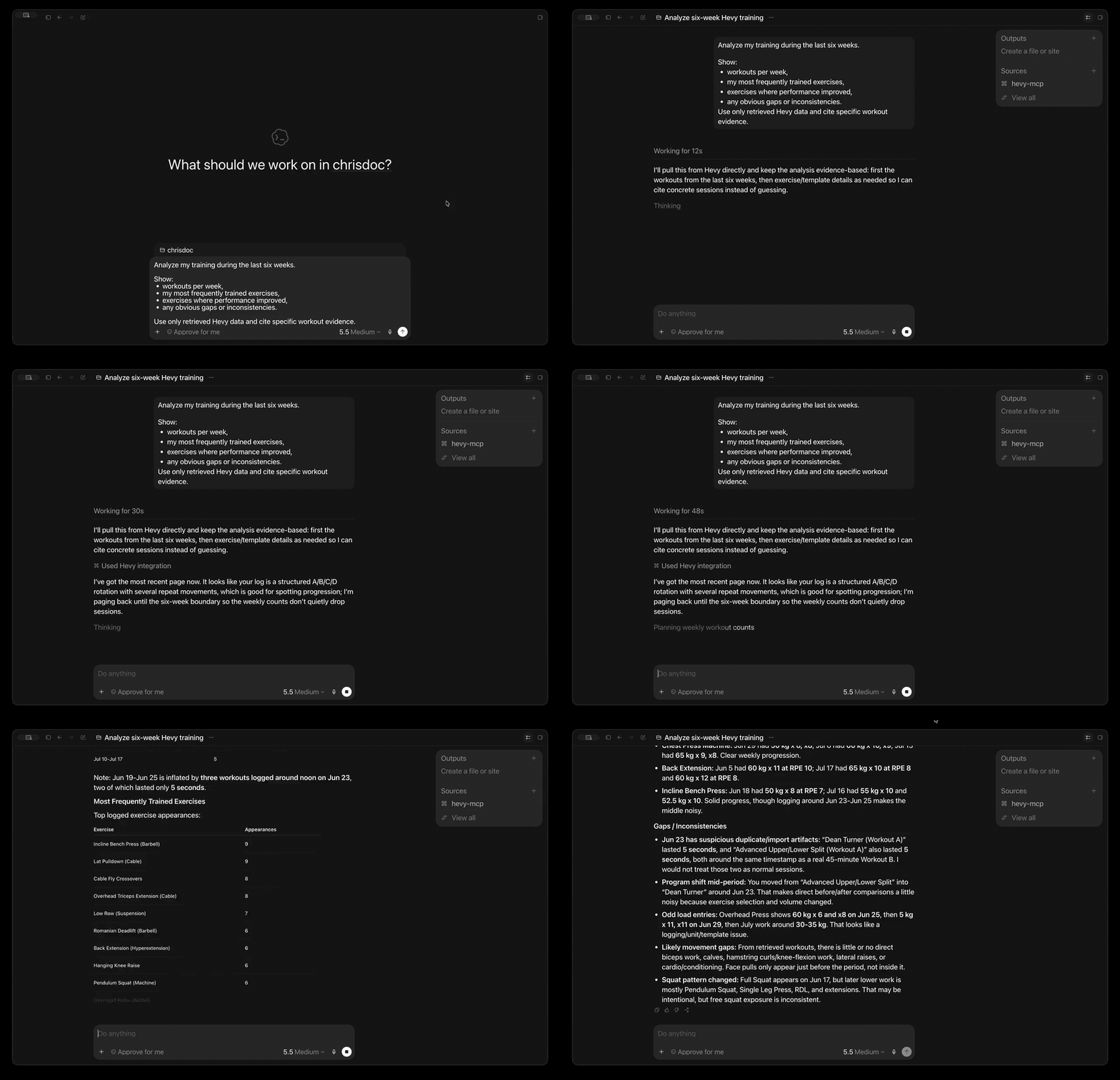](https://raw.githubusercontent.com/chrisdoc/hevy-mcp/main/docs/assets/hevy-mcp-demo.mp4)
- <p align="center"><sub>Click the preview to play the full-quality 18-second demo.</sub></p>
- In the demo, the assistant retrieves real Hevy data and answers a multi-part
- training question with evidence from the user's workout history.
- ## What can you do with it?
- - **Analyze training progress:** summarize 1-12 weeks of workouts and body
- measurements in one tool call.
- - **Ask questions in plain language:** find recent sessions, frequently trained
- exercises, consistency gaps, routine details, or exercise history.
- - **Plan and log training:** create or update workouts, routines, routine folders,
- custom exercises, and body measurements.
- - **Search without huge responses:** discover routines and exercise templates with
- compact, AI-friendly results.
- - **Connect from your preferred MCP client:** use the hosted Streamable HTTP
- endpoint or run locally with Codex, Claude Desktop, Cursor, and other clients.
- - **Start without installing anything:** connect directly to the production
- Cloudflare Worker—no Node.js, package download, or Docker container required.
- - **Keep local control when you want it:** run the same server with `npx`, `bunx`,
- or the official Docker image.
- Try asking:
- > Analyze my training over the last six weeks. Show workouts per week, my most
- > frequently trained exercises, any obvious gaps or inconsistencies, and cite the
- > workout evidence you used.
- > Find my push-day routine and show its exercises and sets.
- > Compare my recent body measurements with my training consistency.
- > Create a completed workout from my saved routine. Ask me for any missing set
- > results before writing it to Hevy.
- ## Claude integration
- The repository includes a Claude plugin that connects to the hosted OAuth-enabled
- MCP endpoint without embedding a user's Hevy API key.
- ### Claude.ai and Claude Desktop
- In Claude, open **Settings → Connectors → Add custom connector** and enter:
- ```text
- https://mcp.hevy-mcp.dev/mcp
- ```
- Complete the OAuth flow and enter the Hevy API key when prompted. The same
- remote endpoint can be used by Claude Desktop and other clients that support
- remote MCP connectors.
- ### Claude Code and Cowork
- The Claude plugin is defined by [`.claude-plugin/plugin.json`](./.claude-plugin/plugin.json)
- and [`.mcp.json`](./.mcp.json). Install it from this public repository or from
- the Claude Plugin Directory after publication. It adds the hosted Hevy MCP
- connector and the [Hevy workout skill](./skills/hevy-workouts/SKILL.md).
- See the [privacy policy](./docs/privacy-policy.md) for the hosted service's
- data handling details.
- ## Quick start
- ### 1. Get your Hevy API key
- Create an API key in [Hevy's API settings](https://hevy.com/settings?developer), then
- keep it somewhere secure. API access currently requires a Hevy PRO subscription.
- ### 2. Connect `hevy-mcp` to your client
- The hosted Cloudflare endpoint is the fastest way to start. It runs remotely,
- so your client does not need Node.js, Bun, Docker, or a local server process.
- #### Connect to the hosted endpoint
- Production URL:
- ```text
- https://mcp.hevy-mcp.dev/mcp
- ```
- The endpoint uses Streamable HTTP. Send your Hevy API key as a bearer token on
- every request.
- ##### Codex
- Codex CLI, the Codex desktop app, and the IDE extension share the same MCP
- configuration. Make your Hevy API key available in the environment that starts
- Codex, then add the hosted server:
- ```bash
- export HEVY_API_KEY=your-hevy-api-key
- codex mcp add hevy \
- --url https://mcp.hevy-mcp.dev/mcp \
- --bearer-token-env-var HEVY_API_KEY
- ```
- Codex stores the environment variable name, not the key itself, in its MCP
- configuration. Restart Codex or begin a new session, then run `codex mcp list`
- to verify the server is configured.
- ##### Other Streamable HTTP clients
- Clients that accept a remote MCP URL and fixed headers commonly use this shape:
- ```json
- {
- "mcpServers": {
- "hevy": {
- "url": "https://mcp.hevy-mcp.dev/mcp",
- "headers": {
- "Authorization": "Bearer your-hevy-api-key"
- }
- }
- }
- }
- ```
- Exact configuration keys vary by client. The hosted server requires support for
- Streamable HTTP and a fixed `Authorization` header.
- > [!IMPORTANT]
- > Treat the bearer value like a password. The Worker validates it with Hevy for
- > each request, does not store it, and forwards it to Hevy only as the required
- > `api-key` header.
- #### Run locally instead
- Choose local stdio if you prefer to run the server on your own machine or your
- client cannot attach a fixed authorization header to remote MCP requests.
- ##### Codex
- ```bash
- codex mcp add hevy \
- --env HEVY_API_KEY=your-hevy-api-key \
- -- npx -y hevy-mcp
- ```
- ##### Claude Desktop or Cursor
- Add this `mcpServers` entry to your client configuration:
- ```json
- {
- "mcpServers": {
- "hevy": {
- "command": "npx",
- "args": ["-y", "hevy-mcp"],
- "env": {
- "HEVY_API_KEY": "your-hevy-api-key"
- }
- }
- }
- }
- ```
- ##### Google Antigravity
- There are two ways to configure the Hevy MCP server for Google Antigravity (`agy`):
- ###### Option A: Automatic Plugin Installation (Recommended)
- This utilizes the built-in plugin system:
- The plugin reads the repository-root `mcp_config.json` to start the local
- stdio server. That configuration intentionally contains no API key; the server
- inherits `HEVY_API_KEY` from the host environment as described below. This is
- separate from the manual, user-global configuration described below and from
- the repository's `.mcp.json`, which configures hosted HTTP/OAuth.
- 1. Install the plugin:
- ```bash
- agy plugin install https://github.com/chrisdoc/hevy-mcp
- ```
- 2. Provide the `HEVY_API_KEY` in your host shell environment so the CLI child process can inherit it:
- - **Persistent:** Save the environment variable `HEVY_API_KEY` in your system/shell configurations:
- - **macOS / Linux:** Add it to your shell profile configurations (e.g., `~/.zshrc` or `~/.bashrc`):
- ```bash
- export HEVY_API_KEY="your-actual-api-key"
- ```
- - **Windows:** Add it to your User or System Environment Variables. In PowerShell, you can run:
- ```powershell
- [Environment]::SetEnvironmentVariable("HEVY_API_KEY", "your-actual-api-key", "User")
- ```
- - **Temporary (Session-only):** If you do not want to persist the key, export it in your active terminal session before running `agy`:
- ```bash
- export HEVY_API_KEY="your-actual-api-key"
- ```
- ###### Option B: Manual Configuration (No Plugin)
- If you prefer configuring it statically via the global configuration file:
- 1. Open your global MCP configuration file:
- - **Location:** `~/.gemini/config/mcp_config.json`
- 2. Add the `hevy` configuration block under the `mcpServers` key. Make sure to merge this entry with any existing servers you have configured rather than replacing the entire file contents:
- ```json
- {
- "mcpServers": {
- "hevy": {
- "command": "npx",
- "args": ["-y", "hevy-mcp"],
- "env": {
- "HEVY_API_KEY": "your-actual-api-key"
- }
- }
- }
- }
- ```
- Common local configuration locations:
- - **Claude Desktop on macOS:**
- `~/Library/Application Support/Claude/claude_desktop_config.json`
- - **Claude Desktop on Windows:**
- `%APPDATA%\Claude\claude_desktop_config.json`
- - **Cursor:** `~/.cursor/mcp.json`
- Restart or reconnect the client after saving the file.
- ##### Any stdio MCP client
- Configure your client to launch this command with `HEVY_API_KEY` in the child
- process environment:
- ```bash
- npx -y hevy-mcp
- ```
- `npx` requires Node.js 20 or newer. Restart or reconnect your client after
- saving its configuration.
- <details>
- <summary><strong>Use bunx instead</strong></summary>
- Requires [Bun](https://bun.sh/):
- ```json
- {
- "mcpServers": {
- "hevy": {
- "command": "bunx",
- "args": ["hevy-mcp@latest"],
- "env": {
- "HEVY_API_KEY": "your-hevy-api-key"
- }
- }
- }
- }
- ```
- </details>
- <details>
- <summary><strong>Use Docker instead</strong></summary>
- Official images support `linux/amd64` and `linux/arm64`. Keep stdin open with
- `-i` because the container runs the stdio MCP server:
- ```bash
- export HEVY_API_KEY=your-hevy-api-key
- docker run -i --rm -e HEVY_API_KEY ghcr.io/chrisdoc/hevy-mcp:latest
- ```
- For an MCP client, store the key in a protected environment file and configure
- the client to launch Docker:
- ```json
- {
- "mcpServers": {
- "hevy": {
- "command": "docker",
- "args": [
- "run",
- "-i",
- "--rm",
- "--env-file",
- "/absolute/path/to/hevy-mcp.env",
- "ghcr.io/chrisdoc/hevy-mcp:latest"
- ]
- }
- }
- }
- ```
- Pin an exact image tag such as `ghcr.io/chrisdoc/hevy-mcp:X.Y.Z` when you need
- reproducible upgrades.
- </details>
- You can also add the npm server to supported clients with
- [`add-mcp`](https://github.com/neon-solutions/add-mcp):
- ```bash
- npx add-mcp hevy-mcp --env "HEVY_API_KEY=your-hevy-api-key"
- ```
- ### 3. Ask your first question
- Try one of these after restarting or reconnecting your MCP client:
- - “Give me a training summary for the last four weeks.”
- - “What routines do I have saved on Hevy?”
- - “Show my three most recent workouts.”
- - “Find exercise templates containing squat.”
- - “Which Hevy account is connected?”
- Your assistant should ask for approval before mutation tools when the client
- supports tool confirmations.
- ## How it works
- ```text
- Hosted: Your AI assistant → Streamable HTTP → Cloudflare Worker → Hevy API
- Local: Your AI assistant → MCP over stdio → local hevy-mcp → Hevy API
- ```
- The hosted endpoint creates a fresh MCP server and Hevy client for each request.
- Direct bearer authentication uses the supplied Hevy key and caches successful
- validation for 15 minutes without persisting the raw key. OAuth instead stores
- the key encrypted in a grant. Neither path creates a shared MCP user session.
- The local server follows the same tool contract but receives the Hevy key
- through its process environment.
- In either mode, read tools retrieve data; mutation tools create or replace data
- only when your assistant calls them.
- ## Guided prompts
- These server-provided MCP prompts coordinate common multi-step workflows:
- | Prompt | Arguments | Workflow |
- | ----------------------------- | ------------------------------------------ | ---------------------------------------------------------------------------------------------------------------------- |
- | `analyze-workout-progress` | Optional `weeks` from 1-12; default `4` | Calls `get-training-summary`, then analyzes workout activity and body-measurement trends from the returned evidence. |
- | `create-workout-from-routine` | Required `routine_id` and UTC `start_time` | Loads a routine, collects actual completed-set data and an end time, then creates a workout without inventing results. |
- ## Tools
- `hevy-mcp` registers 23 tools. Read-only tools are safe for exploration; create
- and update tools are exposed with MCP mutation annotations so compatible clients
- can request confirmation.
- | Category | Tool | Description |
- | ----------------- | ---------------------- | ------------------------------------------------------------------------------------- |
- | Training analysis | `get-training-summary` | Summarize 1-12 weeks of workout activity and body-measurement trends in one call. |
- | Workouts | `get-workouts` | List workouts in Hevy API order, not by start time, with exercise and timing details. |
- | Workouts | `get-workout` | Get complete details for one workout by ID. |
- | Workouts | `get-workout-events` | List workout update and delete events since a timestamp. |
- | Workouts | `create-workout` | Create a completed workout in Hevy. |
- | Workouts | `update-workout` | Patch workout metadata by ID; `is_private` is required, while other omitted fields and all exercises remain unchanged. |
- | Workouts | `replace-workout-exercises` | Replace all exercises and sets; `is_private` is required and updated, while other workout metadata remains unchanged. |
- | Routines | `search-routines` | Search routine titles and return compact metadata for discovery. |
- | Routines | `get-routines` | List custom and default workout routines. |
- | Routines | `get-routine` | Get one routine and its exercise configuration by ID. |
- | Routines | `create-routine` | Create a reusable workout routine. |
- | Routines | `update-routine` | Replace an existing routine's content. |
- | Routine folders | `get-routine-folder` | Get one routine folder's metadata by ID. |
- | Routine folders | `create-routine-folder` | Create a routine folder. |
- | Exercise templates | `get-exercise-template` | Get complete metadata for one exercise template by ID. |
- | Exercise templates | `search-exercise-templates` | Search the full exercise catalog by title substring. |
- | Exercise templates | `create-exercise-template` | Create a custom exercise template. |
- | Exercise history | `get-exercise-history` | Get past performed sets for one exercise template. |
- | Body measurements | `get-body-measurements` | List dated body measurements. |
- | Body measurements | `get-body-measurement` | Get the body measurement entry for one date. |
- | Body measurements | `create-body-measurement` | Create a dated body measurement. |
- | Body measurements | `update-body-measurement` | Update the body measurement for an existing date. |
- | Diagnostics | `feedback` | Report a concise, privacy-safe description of an issue or unexpected behavior. |
- `create-routine` and `update-routine` require a top-level `routine` envelope with a non-empty `exercises` array; each exercise must contain at least one set, and fields use snake_case at every level:
- ```json
- {
- "routine": {
- "title": "Full Body A",
- "folder_id": 123,
- "notes": "First four exercises are the minimum viable workout",
- "exercises": [
- {
- "exercise_template_id": "30E293E3",
- "superset_id": null,
- "rest_seconds": 120,
- "notes": "Controlled active ROM",
- "sets": [
- {
- "type": "normal",
- "rep_range": {
- "start": 6,
- "end": 10
- }
- }
- ]
- }
- ]
- }
- }
- ```
- The Hevy API currently exposes no delete endpoints for workouts, routines,
- routine folders, exercise templates, or body measurements, so there are no
- corresponding delete tools.
- ### Resources
- | Name | URI | Description |
- | -------------------- | --------------------------- | -------------------------------------------- |
- | `user-profile` | `hevy://user` | Authenticated Hevy user profile. |
- | `workout-count` | `hevy://workout-count` | Total number of workouts in the account. |
- | `exercise-templates` | `hevy://exercise-templates` | Full formatted exercise template catalog. |
- | `routine-folders` | `hevy://routine-folders` | Full formatted list of Hevy routine folders. |
- ## Hosted Cloudflare endpoint
- The production MCP server is live at:
- ```text
- https://mcp.hevy-mcp.dev/mcp
- ```
- It is the quickest way to use `hevy-mcp`: there is nothing to install or keep
- running locally, and it exposes the same 23 tools as the npm package and Docker
- image.
- The Cloudflare Worker uses stateless **Streamable HTTP** at `POST /mcp`.
- Clients must send their Hevy API key as a fixed authorization header:
- ```json
- {
- "mcpServers": {
- "hevy": {
- "url": "https://mcp.hevy-mcp.dev/mcp",
- "headers": {
- "Authorization": "Bearer your-hevy-api-key"
- }
- }
- }
- }
- ```
- In this configuration the bearer value is your Hevy API key, not an OAuth
- token. The Worker caches successful validation for 15 minutes under a hashed
- key, does not persist the raw key on this direct path, and forwards it upstream
- only as Hevy's required `api-key` header.
- ### OAuth for Claude.ai and other remote MCP clients
- The hosted production Worker is deployed with an `OAUTH_KV` namespace binding,
- so it exposes a full OAuth 2.1 layer for clients that cannot send a fixed
- header, such as Claude.ai custom connectors. Self-hosted Workers can opt in by
- following the `OAUTH_KV` setup in [CONTRIBUTING.md](./CONTRIBUTING.md):
- - RFC 8414 / RFC 9728 discovery metadata under `/.well-known/`
- - Client ID Metadata Documents (CIMD), with dynamic client registration
- (`/register`) as a fallback, and PKCE token exchange (`/token`)
- - An `/authorize` page where you paste your Hevy API key once; the key is
- validated with Hevy and stored encrypted inside the OAuth grant
- Add the Worker URL ending in `/mcp` as a Claude.ai custom connector and
- complete the authorization flow in the browser. Direct
- `Authorization: Bearer <hevy-api-key>` requests keep working unchanged — the
- OAuth layer is purely additive. Revoking or rotating your Hevy key prevents
- subsequent Hevy API access with that key; it does not itself delete stored
- grants or immediately clear cached validation.
- OAuth access tokens last seven days and refresh tokens last 30 days. This
- reduces KV writes from frequent hourly refreshes while preserving automatic
- refresh for supported clients.
- The endpoint does not expose legacy SSE or a `GET` event stream. Without the
- opt-in OAuth layer, clients that require OAuth discovery, dynamic
- registration, CIMD, or token refresh are not compatible unless they can send
- the fixed custom header above.
- ### Self-host the Worker
- A clean clone can deploy the portable TypeScript Cloudflare configuration with
- `pnpm --dir packages/worker exec cf deploy` and receive a `workers.dev` URL. OAuth
- requires your own `OAUTH_KV` namespace; custom domains, routes, and
- observability destinations are optional account-owned settings. See
- [CONTRIBUTING.md](./CONTRIBUTING.md#cloudflare-worker-development) for setup and
- for the distinction between self-hosting and the maintainer-only named
- environments.
- See [CONTRIBUTING.md](./CONTRIBUTING.md) to deploy the Cloudflare Worker for
- self-hosted Streamable HTTP.
- ## Advanced configuration
- | Setting | Default | Scope | Notes |
- | -------------------------------- | ------------------------------------------ | ----------------------------- | -------------------------------------------------------------------------------------------------------------- |
- | `HEVY_API_KEY` | None; required | Local stdio or HTTP | Hevy API key from the Hevy app. Never pass it in a URL. |
- | `HEVY_MCP_API_TIMEOUT` | `60000` ms | Local stdio | Positive Hevy API timeout in milliseconds. Invalid values fall back to 60 seconds. |
- | `HEVY_MCP_DEBUG` | Disabled | Local Node | Set to exactly `1` for privacy-bounded diagnostics on stderr. Stdout remains reserved for MCP JSON-RPC. |
- | `HEVY_MCP_HTTP_BEARER_TOKEN` | None | Non-loopback HTTP | Required when `--host` is not loopback; use a separate token, never the Hevy API key. |
- | `HEVY_MCP_HTTP_MAX_SESSIONS` | `100` | Local HTTP | Maximum established sessions, including sessions currently initializing; excess requests receive `429`. |
- | `HEVY_MCP_HTTP_MAX_INITIALIZING` | `10` | Local HTTP | Maximum concurrent session initializations; excess requests receive `503` and are not queued. |
- | `HEVY_MCP_HTTP_IDLE_TIMEOUT_MS` | `1800000` ms | Local HTTP | Idle sessions are evicted after 30 minutes; each session request resets the timer. |
- | `HEVY_MCP_HTTP_BODY_TIMEOUT_MS` | `30000` ms | Local HTTP | Stalled request bodies receive `408`; values are bounded to five minutes. |
- | `HEVY_MCP_TELEMETRY` | Built: on; source: off | Local Node | Set `0` to disable telemetry or `1` to opt in for source runs. Imports remain side-effect-free. |
- | `HEVY_MCP_TELEMETRY_DIAGNOSTICS` | Enabled | Local Node | Set to exactly `0` to keep structural telemetry while suppressing exception messages and stacks. |
- | `XDG_CACHE_HOME` | `~/.cache` | Local stdio | Changes the root for the npm update-check cache at `hevy-mcp/update-check.json`. |
- | `SENTRY_DSN` | Packaged Sentry SaaS project DSN | Optional local Node telemetry | Sentry project DSN override. An empty value disables Sentry export. The Worker does not import Node telemetry. |
- | `SENTRY_RELEASE` | `hevy-mcp@<installed-version>` | Optional local Node telemetry | Overrides the release label attached to local Sentry error events. |
- | `SENTRY_ENVIRONMENT` | Built: `production`; source: `development` | Optional local Node telemetry | Overrides the environment label for enabled Sentry error events. |
- | `-h`, `--help` | N/A | Local stdio CLI | Print supported options and exit. |
- | `-v`, `--version` | N/A | Local stdio CLI | Print the installed version and exit. |
- The local Node executable uses stdio by default. Opt into local Streamable
- HTTP with:
- ```bash
- HEVY_API_KEY=your-hevy-api-key npx hevy-mcp --transport http --host 127.0.0.1 --port 3000
- ```
- The local MCP endpoint is `http://127.0.0.1:3000/mcp`; non-loopback binds
- require the separate `HEVY_MCP_HTTP_BEARER_TOKEN` environment variable. A
- Docker deployment must publish the port explicitly:
- ```bash
- docker run --rm -p 3000:3000 -e HEVY_API_KEY -e HEVY_MCP_HTTP_BEARER_TOKEN \\
- ghcr.io/chrisdoc/hevy-mcp:latest --transport http --host 0.0.0.0 --port 3000
- ```
- This Node HTTP mode is distinct from the stateless Cloudflare Worker HTTP
- endpoint described above: the Node server owns stateful client sessions, while
- the Worker is designed for hosted deployment and does not import Node code.
- ### Cache behavior
- `search-exercise-templates` and `hevy://exercise-templates` share a
- server-scoped in-memory catalog cache:
- - Entries live for five minutes, and the cache holds at most one catalog.
- - Concurrent catalog requests share an in-flight fetch when possible.
- - `search-exercise-templates` accepts `refresh: true` to invalidate the cache.
- - Each hosted Worker request gets a fresh catalog cache, preventing cross-key sharing.
- - Each local HTTP session owns its own MCP server and catalog cache; caches are
- not shared across sessions.
- ### Local Node telemetry and privacy
- Published Node builds enable project telemetry by default. Unbuilt source runs
- (such as development and probe scripts) disable it unless
- `HEVY_MCP_TELEMETRY=1` is set explicitly. This is local Node behavior only; the
- Cloudflare Worker does not import Node telemetry. Set `HEVY_MCP_TELEMETRY=0`
- before launching Node to disable all project telemetry in either mode. In
- published builds, every value except the literal `0` retains the enabled default.
- The scoped Node lifecycle Layer acquires telemetry; importing the package remains
- side-effect-free. Enabled source runs, and any build without an injected
- version (release `hevy-mcp@dev`), use the Sentry environment `development`;
- versioned published builds use `production`. Set `SENTRY_ENVIRONMENT` to
- override this label, for example to `qa` or `staging`. The master setting takes precedence over
- `SENTRY_DSN` and packaged or
- runtime `OTEL_COLLECTOR_TOKEN` credentials, so the disabled path creates no
- telemetry exporters or periodic metric readers and makes no telemetry network
- requests. `SENTRY_DSN` remains a Sentry-only setting; when telemetry is enabled,
- an empty value disables only Sentry export.
- When enabled, actionable errors are sent to the Sentry project configured by
- `SENTRY_DSN`; Sentry performance tracing is disabled. Exception messages and
- stacks are bounded and scrubbed before export. Set
- `HEVY_MCP_TELEMETRY_DIAGNOSTICS=0` to keep structural traces and metrics while
- suppressing those details. Traces and metrics continue to be sent to the
- collector at
- <https://otel.chrisdoc.dev/v1/traces> and
- <https://otel.chrisdoc.dev/v1/metrics>. The project uses its own OpenTelemetry
- Collector; downstream destinations are configured in that infrastructure.
- Metrics export every 30 seconds. See [observability documentation](./docs/observability.md)
- for Cloudflare OTLP export and domain tracing.
- The raw API key is never exported. Ordinary tool telemetry can include a short,
- deterministic HMAC pseudonym derived from the key for correlation; `feedback`
- uses a separate unobserved path. A per-failure diagnostic ID and OTel trace ID
- may be attached to actionable errors. See
- [telemetry data dictionary](./docs/telemetry-data-dictionary.md) for the bounded
- telemetry fields and privacy contract.
- Exception messages and stacks are treated as diagnostic details: they are
- length-limited, scrubbed for credentials, URLs, and local home paths, and
- removed entirely when `HEVY_MCP_TELEMETRY_DIAGNOSTICS=0`. Prompts, tool
- arguments, tool results, request bodies, API keys, raw identifiers/queries,
- exact dates, workout/routine/folder/template/body-measurement content,
- names/titles/descriptions/notes, measurement values, arbitrary client
- metadata, and unnormalized endpoint paths remain prohibited.
- ## Security and mutations
- - Keep `HEVY_API_KEY` out of source control, URLs, logs, and screenshots.
- - Local clients provide the key through the child process environment.
- - Direct hosted clients send the Hevy key only in the `Authorization: Bearer`
- header; successful validation is cached, but the raw key is not persisted.
- OAuth grants store the key encrypted. Both paths send it to Hevy only as the
- `api-key` header.
- - Browser MCP requests must be same-origin or match an exact allowlisted
- origin. The default allowlist includes Claude.ai, ChatGPT, VS Code for the
- Web, and github.dev; self-hosted deployments can override it with
- `MCP_ALLOWED_ORIGINS`. See [deployment modes](./docs/deployment-modes.md#origins-and-self-hosting)
- for the OAuth authorization-form exception.
- - Local development can copy `.dev.vars.example` to `.dev.vars` to disable
- Origin validation for MCP Inspector. PR preview Workers use the same
- development-only setting because their browser origins are dynamic. Never
- set `MCP_DISABLE_ORIGIN_CHECK=true` on a production Worker.
- - Create operations can produce duplicates when retried. Routine updates
- replace content; workout metadata updates preserve omitted fields and
- exercises, while `replace-workout-exercises` replaces all exercises and sets.
- Review tool inputs and use client confirmations.
- ## Troubleshooting
- - **The server does not appear:** restart or reconnect your MCP client after
- changing its configuration.
- - **`npx` fails:** confirm that Node.js 20 or newer is installed, then run
- `npx -y hevy-mcp --version` in a terminal.
- - **Codex cannot see the server:** run `codex mcp list`, then start a new Codex
- session after confirming the `hevy` entry exists.
- - **Hevy API returns 401:** the key is invalid, expired, revoked, or
- misconfigured. Verify or create an active key at
- [Hevy's API settings](https://hevy.com/settings?developer), then restart the client.
- - **Hosted authentication fails:** confirm the key belongs to a Hevy PRO
- account and is sent as `Authorization: Bearer <HEVY_API_KEY>`.
- - **Local authentication fails:** confirm the key is active and available to the
- MCP child process as `HEVY_API_KEY`.
- - **Need diagnostics:** set `HEVY_MCP_DEBUG=1`. Diagnostic output goes to stderr
- and does not interfere with MCP messages on stdout.
- If you find a bug or have a feature request, [open an issue](https://github.com/chrisdoc/hevy-mcp/issues).
- ## Contributing
- Contributions are welcome. Developer setup, testing lanes, generated-client
- workflows, Cloudflare Worker deployment, and pull request rules are documented
- in [CONTRIBUTING.md](./CONTRIBUTING.md).
- Use mise for the pinned Node.js and pnpm versions, then run the deterministic
- unit lane. It does not need a live Hevy API key:
- ```bash
- MISE_AUTO_INSTALL=false mise install
- MISE_AUTO_INSTALL=false mise exec -- pnpm install
- MISE_AUTO_INSTALL=false mise exec -- pnpm run test:unit
- ```
- ## License and acknowledgements
- - **License:** [MIT](./LICENSE)
- - **Credits:** [Model Context Protocol](https://github.com/modelcontextprotocol)
- and [Hevy Fitness](https://www.hevyapp.com/)
Version history
v1.0.010/21/2026
v6.2.110/18/2026
Ratings and comments
Sign in to rate this skill.
Sign inFree to use. If it’s helped, pass it on.