QuickDesk
QuickDesk is the first AI-native remote desktop — an open-source, free application with a built-in MCP (Model Context Protocol) Server that lets any AI agent see and control remote computers.
Safety scan
A static text scan, not a guarantee. Select the badge to see what was scanned and every finding.
Check it deeper on your machine
It has changed since its scan on 11 Nov 2026.
As a Claude Code plugin, install it and then ask Claude Code:
/plugin marketplace add keithmackay/mackayi/plugin install scanskillsafety@mackayiDo a deep scan of https://github.com/barry-ran/QuickDesk with scanskillsafety
Or from a terminal, clone it and run it:
git clone https://github.com/keithmackay/scanskillsafety-skill ~/.claude/skills/scanskillsafetynode ~/.claude/skills/scanskillsafety/cli.cjs --deep 'https://github.com/barry-ran/QuickDesk'
It checks the exact commit: every file, its packages against OSV (api.osv.dev), how it compares with this page's scan (findsafeskills.com receives the repository's address), and, if you agree, Claude reading every file with your own Claude subscription. It never runs the code.
Badge for your README

Markdown
[](/listings/barry-ran--quickdesk)HTML
<a href="/listings/barry-ran--quickdesk"><img src="/api/listings/barry-ran--quickdesk/badge.svg" alt="findsafeskills safety rating" /></a>Install
Install instructions from the README
As written by the repo's author. findsafeskills has not verified these steps.
Download
Go to [Releases](https://github.com/barry-ran/QuickDesk/releases) to download the latest version:
| Platform | Download | |----------|----------| | Windows x64 | [QuickDesk-win-x64-setup.exe](https://github.com/barry-ran/QuickDesk/releases/latest) | | macOS ARM64 | [QuickDesk-mac-arm64.dmg](https://github.com/barry-ran/QuickDesk/releases/latest) |
Usage
1. Install and run QuickDesk on both the **host** (remote) and **client** (local) machines 2. The host will automatically generate a **Device ID** and **Access Code** 3. On the client, enter the host's Device ID and Access Code, then click **Connect** 4. You're now remotely controlling the host machine
Silent install (Windows installer)
The Windows package is built with **Inno Setup** (`scripts/installer/quickdesk.iss`). Standard Inno command-line switches apply:
| Switch | Meaning | |--------|---------| | `/SILENT` | No wizard pages; progress window may appear | | `/VERYSILENT` | Fully unattended (no progress window) | | `/DIR="path"` | Install directory (optional) | | `/TASKS="..."` | Comma-separated tasks from `[Tasks]` |
Available tasks:
| Task | Description | |------|-------------| | `desktopicon` | Create desktop shortcut | | `startmenuicon` | Create Start Menu shortcut | | `vdd` | Install virtual display driver (IDD) and related files, required for virtual display feature |
All three tasks are selected by default (`Flags: checkedonce` — checked on first install, preserves user choice on upgrades). To skip the virtual display driver, explicitly exclude `vdd` via `/TASKS`.
Examples:
REM Default tasks (includes virtual display driver when selected in script defaults)
QuickDesk-win-x64-setup.exe /VERYSILENT

REM Explicit tasks
QuickDesk-win-x64-setup.exe /VERYSILENT /TASKS="desktopicon,startmenuicon,vdd"

REM Install without virtual display driver
QuickDesk-win-x64-setup.exe /VERYSILENT /TASKS="desktopicon,startmenuicon"

REM Custom install path
QuickDesk-win-x64-setup.exe /VERYSILENT /DIR="D:\QuickDesk"
After a silent install, **QuickDesk.exe is not auto-launched** (`skipifsilent` in the installer script), but the **QuickDeskHost** Windows service is still installed and started when configured in `[Run]`.
Administrator rights are required (`PrivilegesRequired=admin` in the script).
What was scanned
The files the safety scan read, as written by the repository's author and shown as plain text. Lines with a finding are marked.
README.md · README · 510 lines
View this file on GitHub (read at the repository's current version: the scan did not record which commit it read)
- <p align="center">
- <img src="docs/image/logo.png" alt="QuickDesk Logo" width="120">
- </p>
- <h1 align="center">QuickDesk</h1>
- <p align="center">
- <strong>The First AI-Native Remote Desktop</strong><br>
- Built-in MCP Server · AI Agents Control Any Remote Computer · Open-Source & Free
- </p>
- <p align="center">
- <a href="https://github.com/barry-ran/QuickDesk/actions/workflows/quickdesk-windows.yml">
- <img src="https://github.com/barry-ran/QuickDesk/actions/workflows/quickdesk-windows.yml/badge.svg" alt="Windows Build">
- </a>
- <a href="https://github.com/barry-ran/QuickDesk/actions/workflows/quickdesk-macos.yml">
- <img src="https://github.com/barry-ran/QuickDesk/actions/workflows/quickdesk-macos.yml/badge.svg" alt="macOS Build">
- </a>
- <a href="https://github.com/barry-ran/QuickDesk/releases">
- <img src="https://img.shields.io/github/v/release/barry-ran/QuickDesk" alt="Release">
- </a>
- <a href="https://github.com/barry-ran/QuickDesk/stargazers">
- <img src="https://img.shields.io/github/stars/barry-ran/QuickDesk" alt="Stars">
- </a>
- <a href="LICENSE">
- <img src="https://img.shields.io/github/license/barry-ran/QuickDesk" alt="License">
- </a>
- </p>
- <p align="center">
- English | <a href="README_zh.md">中文</a>
- </p>
- <p align="center">
- <a href="https://t.me/+utsmSUhNLc1iNTY1">Telegram</a> | <a href="https://github.com/barry-ran/QuickDesk/issues">Issues</a> | <a href="https://github.com/barry-ran/QuickDesk/releases">Download</a>
- </p>
- ---
- QuickDesk is the **first AI-native remote desktop** — an open-source, free application with a **built-in MCP (Model Context Protocol) Server** that lets any AI agent see and control remote computers.
- While other remote desktop tools only serve human users, QuickDesk extends **AI Computer Use** from "local machine only" to **"any remote machine in the world"**. Connect Claude, GPT, Cursor, or any MCP-compatible AI to QuickDesk, and it can screenshot, click, type, drag, and automate across remote desktops — just like a human operator, but faster and 24/7.
- Built on Google Chromium Remoting technology (the engine behind Chrome Remote Desktop), QuickDesk delivers industrial-grade performance, stability, and security refined over 10+ years by Google.
- Main Interface
- 
- Remote Desktop
- 
- AI Config
- 
- ## Why QuickDesk?
- ### AI-First: The Only Remote Desktop with MCP Support [ → MCP Integration Guide](docs/mcp-integration.md)
- - **Built-in MCP Server**: AI agents connect via standard MCP protocol — no plugins, no hacks, zero configuration
- - **Dual Transport**: stdio mode (AI client spawns process) or HTTP/SSE mode (QuickDesk hosts MCP server for multi-client access)
- - **Full Computer Use Toolkit**: 20+ MCP tools — screenshot, click, type, drag, scroll, hotkeys, clipboard, and more
- - **Real-Time Visibility**: AI operations are displayed in the QuickDesk GUI in real time — the user sees every mouse move and keystroke, and can intervene at any time
- - **Multi-Device AI Orchestration**: AI can connect to and control multiple remote machines simultaneously — batch automation, cross-device workflows, fleet management
- - **Guided Prompts**: 9 built-in MCP prompt templates covering remote operation, server health check, batch automation, system diagnosis, screen analysis, multi-device orchestration, and SOP documentation
- ### High-Performance Foundation
- - **Open-Source & Free**: MIT License, no feature restrictions, no connection limits, commercial use welcome
- - **Self-Hosted**: Deploy your own signaling and TURN relay servers, keep full control of your data
- - **Commercial-Grade Foundation**: Built on Chromium Remoting — the same technology powering Chrome Remote Desktop, refined by Google for 10+ years and proven by billions of users
- - **Pure C++ Ultimate Performance**: Full C++ stack from protocol core to GUI — no GC pauses, no runtime overhead, minimal memory and CPU footprint
- - **Modern Codecs**: H.264, VP8, VP9, AV1 — flexibly switch based on network and hardware conditions
- - **WebRTC P2P Direct Connection**: Prioritizes peer-to-peer connections for lowest latency; automatically falls back to TURN relay when traversal fails
- - **Cross-Platform**: Windows and macOS supported (Linux planned)
- - **Modern UI**: Fluent Design interface built with Qt 6 + QML, with light and dark themes
- ## Comparison
- | Feature | QuickDesk | RustDesk | BildDesk | ToDesk | TeamViewer |
- |---------|:---------:|:--------:|:--------:|:------:|:----------:|
- | **AI Agent Support (MCP)** | ✅ Built-in | ❌ | ❌ | ❌ | ❌ |
- | **Open Source** | ✅ MIT | ✅ AGPL-3.0 | ❌ | ❌ | ❌ |
- | **Free for Commercial Use** | ✅ | ❌ License required | ❌ | ❌ | ❌ |
- | **Core Language** | C++ | Rust + Dart | — | — | — |
- | **Remote Protocol** | Chromium Remoting (WebRTC) | Custom | Custom | Custom | Custom |
- | **Protocol Maturity** | ⭐⭐⭐⭐⭐ Google 10yr+ | ⭐⭐⭐ | ⭐⭐ | ⭐⭐⭐ | ⭐⭐⭐⭐⭐ |
- | **P2P Direct** | ✅ WebRTC ICE | ✅ TCP Hole Punching | ✅ | ✅ | ✅ |
- | **Video Codecs** | H.264/VP8/VP9/AV1 | VP8/VP9/AV1/H.264/H.265 | — | — | — |
- | **Self-Hosted** | ✅ Full solution | ✅ | ❌ | ❌ | ❌ |
- | **GUI Framework** | Qt 6 (C++) | Flutter (Dart) | — | — | — |
- | **Memory Usage** | ⭐⭐⭐⭐⭐ Very Low | ⭐⭐⭐ Medium | — | ⭐⭐⭐ | ⭐⭐⭐ |
- | **CPU Usage** | ⭐⭐⭐⭐⭐ Very Low | ⭐⭐⭐ Medium | — | ⭐⭐⭐ | ⭐⭐⭐ |
- | **Windows** | ✅ | ✅ | ✅ | ✅ | ✅ |
- | **macOS** | ✅ | ✅ | ✅ | ✅ | ✅ |
- | **Linux** | 🔜 | ✅ | ❌ | ✅ | ✅ |
- | **iOS/Android** | 🔜 | ✅ | ✅ | ✅ | ✅ |
- ### Why Best-in-Class Performance?
- 1. **Pure C++ Full Stack**: The entire stack — from low-level protocol to GUI — is implemented in C++. No garbage collection pauses, no VM/runtime overhead. Compared to RustDesk's Dart/Flutter GUI layer or ToDesk's Electron-based approach, CPU and memory usage are significantly lower.
- 2. **Chromium-Level Optimization**: Core paths for video encoding/decoding, network transmission, and screen capture directly reuse Chromium's highly optimized C++ code, including SIMD instruction optimization and zero-copy rendering pipelines.
- 3. **Shared Memory Video Transfer**: QuickDesk uses shared memory to pass video frames (YUV I420) between processes, eliminating the serialization/deserialization and data copying overhead of traditional IPC.
- 4. **GPU-Accelerated Rendering**: YUV data is fed directly into the GPU rendering pipeline via Qt 6's `QVideoSink`, achieving zero-CPU-copy video rendering.
- ## Features
- ### AI Integration (MCP Server)
- - Built-in MCP Server — AI agents connect via standard protocol, works with Cursor, Claude Desktop, VS Code, and any MCP client
- - Dual transport: stdio (AI client launches process) or HTTP/SSE (QuickDesk manages MCP server, multiple AI clients connect)
- - Persistent MCP transport mode — remembers your stdio/HTTP choice across restarts
- - 40+ MCP tools: screenshot, mouse click/drag/scroll, keyboard type/hotkey, clipboard, OCR text recognition, UI element detection, screen verification, and more
- - Host-side skill host with built-in skills (system info, file operations, shell execution) — run structured tools on the remote machine
- - Pluggable skills architecture — add custom skill directories, skills auto-load and sync to connected clients
- - Skill host toggle in Settings — enable/disable the skill host process with persistent configuration
- - MCP Resources: real-time device status, connection info, host details
- - 9 MCP Prompts: operation guide, server health check, batch automation, system diagnosis, screen analysis, multi-device orchestration, SOP documentation
- - Real-time event streaming: connection state changes, clipboard updates, screen changes, performance stats
- - Event-driven tools: wait_for_event, wait_for_connection_state, wait_for_clipboard_change, wait_for_screen_change for reactive automation
- - Background automation mode: `show_window=false` for headless batch operations
- - Screenshot scaling: adjustable resolution for faster AI processing
- ### Remote Control
- - High-definition, low-latency remote desktop display
- - Full keyboard and mouse mapping
- - Real-time remote cursor synchronization
- - Bidirectional clipboard sync
- - Adaptive frame rate and bitrate
- - Frame rate boost mode (Office / Gaming)
- - Privacy screen mode — blacks out the host's physical display and blocks local keyboard/mouse input during remote control, protecting session privacy (Windows 10 2004+)
- - Virtual display — creates virtual monitors via IDD driver for multi-screen extension, headless server remote access, privacy isolation, and resolution adaptation (Windows 10 2004+, requires virtual display driver installation)
- ### Connection Management
- - 9-digit Device ID + temporary access code mechanism
- - Auto-refresh access code (configurable: 30 min to 24 hours, or never)
- - Multi-tab simultaneous connections to multiple remote devices
- - Connection history with quick reconnect
- - Real-time connection status monitoring
- ### Performance Monitoring
- - Detailed latency breakdown panel (Capture → Encode → Network → Decode → Render)
- - Real-time frame rate, bitrate, and bandwidth statistics
- - Input round-trip time (RTT) monitoring
- - Encoding resolution and quality information
- ### Personalization
- - Fluent Design style interface
- - Light and dark theme switching
- - i18n support (Chinese / English)
- - Video codec preference (H.264 / VP8 / VP9 / AV1)
- ### Self-Hosted Deployment
- - Custom signaling server address
- - Custom STUN/TURN servers
- - Complete server deployment solution (Go signaling server + PostgreSQL + Redis + coturn)
- - **Web Admin Panel** — full-featured management dashboard for the signaling server:
- - Real-time monitoring with ECharts trend charts (connections, new devices over 24h/7d/30d)
- - Device management with search, filter, sort, pagination, batch operations, and device groups
- - User management with batch enable/disable/delete/set-level
- - Admin TOTP two-factor authentication (QR code setup, Google Authenticator compatible)
- - Operation audit logs with filtering by action/admin/time range
- - IP whitelist (CIDR support) for admin panel access control
- - Webhook notifications (device online/offline, new device/user, connection failures)
- - CSV data export for devices, users, and activity logs
- ## Architecture
- QuickDesk uses a modular multi-process architecture:
- ```mermaid
- graph TD
- subgraph AI["AI Agent (Claude / GPT / Cursor)"]
- A1["MCP Protocol"]
- end
- subgraph MCP["quickdesk-mcp (Rust Bridge)"]
- M1["MCP stdio ↔ WebSocket"]
- M2["MCP HTTP/SSE ↔ WebSocket"]
- end
- subgraph GUI["QuickDesk GUI (Qt 6)"]
- direction LR
- WS["WebSocket API Server"]
- QML["QML/C++"]
- MainWin["Main Window"]
- RemoteWin["Remote Desktop Window"]
- end
- subgraph Host["quickdesk-host (Chromium Remoting)"]
- H1["Screen Capture"]
- H2["Video Encoding"]
- H3["Input Event Handling"]
- H4["WebRTC Connection"]
- end
- subgraph Client["quickdesk-client (Chromium Remoting)"]
- C1["Video Decoding"]
- C2["Input Event Injection"]
- C3["Shared Memory Video Frames"]
- C4["WebRTC Connection"]
- end
- subgraph Signaling["Signaling Server (Go + Gin)"]
- S1["WebSocket Signaling"]
- S2["ICE Config Distribution"]
- S3["Device Registration & Auth"]
- S4["PostgreSQL + Redis"]
- end
- subgraph TURN["TURN Server (coturn)"]
- T1["Relay when P2P traversal fails"]
- end
- AI -- "stdio (JSON-RPC)" --> MCP
- AI -. "HTTP/SSE" .-> M2
- MCP -- "WebSocket" --> WS
- GUI -- "Native Messaging\n(stdin/stdout JSON)" --> Host
- GUI -- "Native Messaging\n(stdin/stdout JSON)" --> Client
- Host -- "WebSocket" --> Signaling
- Client -- "WebSocket" --> Signaling
- Signaling -- "ICE Config" --> TURN
- Host -. "WebRTC P2P / TURN Relay" .-> Client
- ```
- ### Tech Stack
- | Layer | Technology |
- |-------|------------|
- | AI Integration | MCP Server (Rust) + WebSocket API |
- | GUI Client | Qt 6 (QML + C++17) |
- | UI Style | Fluent Design Component Library (custom-built) |
- | Remote Protocol Core | Chromium Remoting (C++) |
- | Video Codecs | H.264 / VP8 / VP9 / AV1 |
- | Network Transport | WebRTC (ICE/STUN/TURN) |
- | IPC | Native Messaging (JSON) + Shared Memory |
- | Signaling Server | Go + Gin + GORM |
- | Data Storage | PostgreSQL + Redis |
- | TURN Relay | coturn |
- | Logging | spdlog |
- | Build System | CMake 3.19+ |
- | CI/CD | GitHub Actions |
- ## Getting Started
- ### Download
- Go to [Releases](https://github.com/barry-ran/QuickDesk/releases) to download the latest version:
- | Platform | Download |
- |----------|----------|
- | Windows x64 | [QuickDesk-win-x64-setup.exe](https://github.com/barry-ran/QuickDesk/releases/latest) |
- | macOS ARM64 | [QuickDesk-mac-arm64.dmg](https://github.com/barry-ran/QuickDesk/releases/latest) |
- ### Usage
- 1. Install and run QuickDesk on both the **host** (remote) and **client** (local) machines
- 2. The host will automatically generate a **Device ID** and **Access Code**
- 3. On the client, enter the host's Device ID and Access Code, then click **Connect**
- 4. You're now remotely controlling the host machine
- ### Silent install (Windows installer)
- The Windows package is built with **Inno Setup** (`scripts/installer/quickdesk.iss`). Standard Inno command-line switches apply:
- | Switch | Meaning |
- |--------|---------|
- | `/SILENT` | No wizard pages; progress window may appear |
- | `/VERYSILENT` | Fully unattended (no progress window) |
- | `/DIR="path"` | Install directory (optional) |
- | `/TASKS="..."` | Comma-separated tasks from `[Tasks]` |
- Available tasks:
- | Task | Description |
- |------|-------------|
- | `desktopicon` | Create desktop shortcut |
- | `startmenuicon` | Create Start Menu shortcut |
- | `vdd` | Install virtual display driver (IDD) and related files, required for virtual display feature |
- All three tasks are selected by default (`Flags: checkedonce` — checked on first install, preserves user choice on upgrades). To skip the virtual display driver, explicitly exclude `vdd` via `/TASKS`.
- Examples:
- ```bat
- REM Default tasks (includes virtual display driver when selected in script defaults)
- QuickDesk-win-x64-setup.exe /VERYSILENT
- REM Explicit tasks
- QuickDesk-win-x64-setup.exe /VERYSILENT /TASKS="desktopicon,startmenuicon,vdd"
- REM Install without virtual display driver
- QuickDesk-win-x64-setup.exe /VERYSILENT /TASKS="desktopicon,startmenuicon"
- REM Custom install path
- QuickDesk-win-x64-setup.exe /VERYSILENT /DIR="D:\QuickDesk"
- ```
- After a silent install, **QuickDesk.exe is not auto-launched** (`skipifsilent` in the installer script), but the **QuickDeskHost** Windows service is still installed and started when configured in `[Run]`.
- Administrator rights are required (`PrivilegesRequired=admin` in the script).
- ## Build from Source
- ### Requirements
- - CMake 3.19+
- - Qt 6.5+ (Multimedia and WebSockets modules required)
- - C++17 compiler
- ### Windows
- ```bash
- # Requires Visual Studio 2022 + MSVC
- # Set Qt path environment variable
- set ENV_QT_PATH=C:\Qt\6.8.3
- # Build
- scripts\build_qd_win.bat Release
- # Package (requires Inno Setup)
- scripts\publish_qd_win.bat Release
- scripts\package_qd_win.bat Release
- ```
- ### macOS
- ```bash
- # Requires Xcode Command Line Tools
- # Set Qt path environment variable
- export ENV_QT_PATH=/path/to/Qt/6.8.3
- # Build
- bash scripts/build_qd_mac.sh Release
- # Package
- bash scripts/publish_qd_mac.sh Release
- bash scripts/package_qd_mac.sh Release
- ```
- ### API Key (Optional)
- If you deploy your own signaling server with API Key enabled, there are two ways to configure the API Key:
- **Method 1: Runtime Configuration (Recommended)**
- In QuickDesk **Settings → Network → API Key**, enter your signaling server's API Key. This is the recommended approach — no recompilation needed, and each deployment can use its own key.
- **Method 2: Build-time Injection**
- You can also inject the API Key at build time as a compile-time default:
- ```bash
- # Windows
- set ENV_QUICKDESK_API_KEY=your-secret-key
- scripts\build_qd_win.bat Release
- # macOS
- ENV_QUICKDESK_API_KEY=your-secret-key bash scripts/build_qd_mac.sh Release
- ```
- > **Priority**: Runtime API Key (from Settings) takes precedence over the build-time key. If both are set, the runtime value is used.
- Without either configuration, the client can only connect to signaling servers without API Key protection.
- > **WebClient note:** The WebClient is a static web page running in the browser. Since API keys embedded in JavaScript are visible via DevTools, the WebClient uses **Origin whitelist** validation instead of API Key. Configure `ALLOWED_ORIGINS` on the signaling server to restrict which domains can access it. Browsers automatically send the `Origin` header and JavaScript cannot forge it, so only the WebClient served from your official domain will be allowed.
- See [Signaling Server Deployment](docs/signaling-server-deployment.md) for details.
- ## Self-Hosted Deployment
- QuickDesk supports full self-hosted deployment. You can deploy all services on your own servers to ensure data security.
- ### Components
- 1. **Signaling Server** (required): Handles device registration and signaling relay
- → [Signaling Server Deployment Guide](docs/signaling-server-deployment.md)
- 2. **TURN Relay Server** (recommended): Provides relay when P2P direct connection fails
- → [TURN Server Deployment Guide](docs/turn-server-deployment.md)
- ### Docker Deploy (Signaling Server)
- Three deployment methods for the signaling server:
- ```bash
- cd SignalingServer
- cp .env.example .env && vim .env
- # Option 1: Pull pre-built image (recommended)
- ./deploy-pull.sh
- # Option 2: Build from source
- ./deploy-build.sh
- # Option 3: Offline deploy (no internet needed)
- ./deploy-offline.sh quickdesk-signaling-image.tar.gz
- ```
- Pre-built Docker images are automatically published to `ghcr.io/barry-ran/quickdesk-signaling` on each tagged release. See the [deployment guide](docs/signaling-server-deployment.md) for details.
- ### Client Configuration
- In QuickDesk **Settings → Network**:
- - Signaling server address: `ws://your-server.com:8000` or `wss://your-server.com:8000`
- - API Key: Enter the API Key configured on your signaling server (if enabled)
- - Custom STUN server: `stun:your-server.com:3478`
- - Custom TURN server: `turn:your-server.com:3478` (username and password required)
- ## Project Structure
- ```
- QuickDesk/
- ├── QuickDesk/ # Qt GUI client
- │ ├── main.cpp # Application entry point
- │ ├── src/
- │ │ ├── api/ # WebSocket API server + request handlers
- │ │ ├── controller/ # Main controller
- │ │ ├── manager/ # Business managers (Host/Client/Process/TURN/...)
- │ │ ├── component/ # Video rendering, key mapping, cursor sync
- │ │ ├── core/ # Config center, user data
- │ │ ├── viewmodel/ # MVVM ViewModel
- │ │ └── language/ # i18n
- │ ├── qml/
- │ │ ├── views/ # Main window, remote desktop window
- │ │ ├── pages/ # Remote control, settings, about pages
- │ │ ├── component/ # Fluent Design component library
- │ │ └── quickdeskcomponent/ # QuickDesk-specific components
- │ ├── base/ # Base utilities
- │ └── infra/ # Infrastructure (database, logging, HTTP)
- ├── quickdesk-mcp/ # Rust MCP Bridge (stdio ↔ WebSocket)
- │ └── src/
- │ ├── main.rs # Entry point, CLI args, MCP server startup
- │ ├── server.rs # MCP tools, prompts, resources
- │ └── ws_client.rs # WebSocket client for Qt API
- ├── quickdesk-skill-host/ # Rust host-side skill host (Cargo workspace)
- │ ├── agent/ # Skill host main binary
- │ ├── mcp-server-common/ # Shared MCP server framework
- │ └── skills/ # Built-in skill MCP servers
- │ ├── sys-info/ # System information skill
- │ ├── file-ops/ # File operations skill
- │ └── shell-runner/ # Shell execution skill
- ├── SignalingServer/ # Go signaling server
- │ ├── cmd/signaling/ # Entry point
- │ └── internal/ # Business logic
- ├── scripts/ # Build, package, publish scripts
- ├── docs/ # Documentation
- │ ├── mcp-integration.md # MCP integration guide (English)
- │ └── MCP接入指南.md # MCP integration guide (Chinese)
- ├── .github/workflows/ # CI/CD configuration
- └── version # Version number
- ```
- ## Roadmap
- - [x] Windows support
- - [x] macOS support
- - [x] P2P direct connection + TURN relay
- - [x] Multi-tab multi-connection
- - [x] Auto-refresh access code
- - [x] Video performance stats overlay
- - [x] Fluent Design UI
- - [x] Light and dark themes
- - [x] i18n (Chinese / English)
- - [x] **MCP Server — AI agents can control remote desktops**
- - [x] **20+ MCP tools (screenshot, click, type, drag, hotkey, clipboard, etc.)**
- - [x] **MCP Resources & Prompts**
- - [x] **Host-side skill host with built-in skills (sys-info, file-ops, shell-runner)**
- - [x] **OCR-based UI analysis tools (get_ui_state, find_element, screen_diff_summary, etc.)**
- - [x] **Persistent MCP transport mode and skill host settings**
- - [x] **Multi-directory skills loading with user-configurable paths**
- - [x] **Device memory & history retrieval (auto-profiling, operation logs, failure patterns)**
- - [x] **Workflow recording & playback (record, replay, parameterize)**
- - [x] **Trust layer & safety (risk assessment, confirmation dialogs, emergency stop, audit log)**
- - [x] **Privacy screen — blacks out host physical display and blocks local input during remote sessions**
- - [x] **Virtual display — IDD virtual display driver for multi-screen extension, headless remote, and resolution adaptation**
- - [x] File transfer
- - [x] Audio streaming
- - [x] Unattended access
- - [ ] Linux support
- - [ ] iOS / Android clients
- - [ ] Address book & device groups
- ## Contributing
- Contributions are welcome! Please follow these guidelines:
- 1. Fork the repository and create a feature branch
- 2. Keep code style consistent with the project
- 3. Ensure the build passes before submitting a PR
- 4. Each PR should contain a single feature or fix
- ## License
- QuickDesk's own code is licensed under the [MIT License](LICENSE), free for commercial use.
- The bundled `quickdesk-remoting` component is based on Chromium and licensed under the [BSD 3-Clause License](https://chromium.googlesource.com/chromium/src/+/refs/heads/main/LICENSE).
- For complete third-party license information, see [THIRD_PARTY_LICENSES](THIRD_PARTY_LICENSES).
- ## Acknowledgments
- - [Chromium Remoting](https://chromium.googlesource.com/chromium/src/+/refs/tags/140.0.7339.249/remoting/) — Remote desktop protocol core
- - [Qt](https://www.qt.io/) — Cross-platform GUI framework
- - [spdlog](https://github.com/gabime/spdlog) — High-performance logging library
- - [coturn](https://github.com/coturn/coturn) — TURN relay server
- ## Star History
- [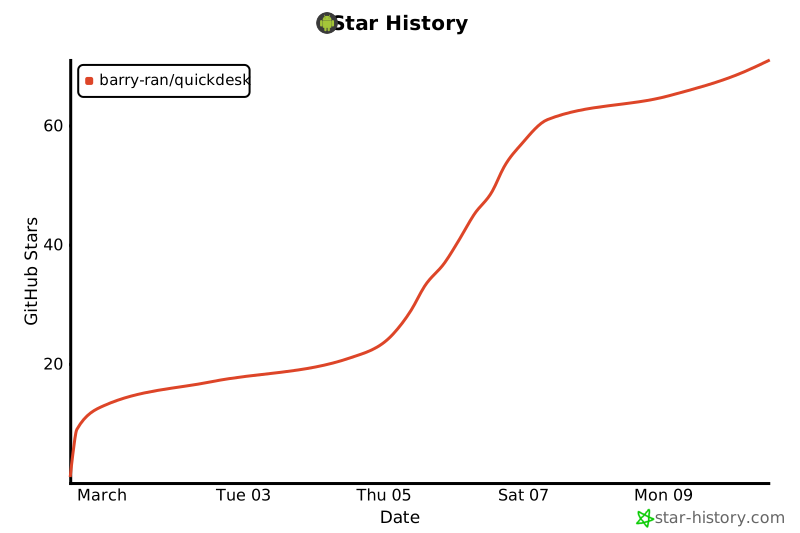](https://star-history.com/#barry-ran/QuickDesk&Date)
Ratings and comments
Sign in to rate this skill.
Sign inFree to use. If it’s helped, pass it on.