mcpc
A universal CLI client for MCP. mcpc supports persistent sessions, stdio/HTTP, OAuth 2.1, tasks, JSON output for code mode, proxy for AI sandboxes, x402, and more.
Safety scan
A static text scan, not a guarantee. Select the badge to see what was scanned and every finding.
Check it deeper on your machine
It has changed since its scan on 11 Nov 2026.
As a Claude Code plugin, install it and then ask Claude Code:
/plugin marketplace add keithmackay/mackayi/plugin install scanskillsafety@mackayiDo a deep scan of https://github.com/apify/mcpc with scanskillsafety
Or from a terminal, clone it and run it:
git clone https://github.com/keithmackay/scanskillsafety-skill ~/.claude/skills/scanskillsafetynode ~/.claude/skills/scanskillsafety/cli.cjs --deep 'https://github.com/apify/mcpc'
It checks the exact commit: every file, its packages against OSV (api.osv.dev), how it compares with this page's scan (findsafeskills.com receives the repository's address), and, if you agree, Claude reading every file with your own Claude subscription. It never runs the code.
Badge for your README

Markdown
[](/listings/apify--mcpc)HTML
<a href="/listings/apify--mcpc"><img src="/api/listings/apify--mcpc/badge.svg" alt="findsafeskills safety rating" /></a>Install
Install instructions from the README
As written by the repo's author. findsafeskills has not verified these steps.
With [Homebrew](https://brew.sh) (macOS and Linux), which brings its own Node.js:
brew install apify/tap/mcpc
Otherwise install the latest [Node.js](https://nodejs.org/en/download) or [Bun](https://bun.sh) first, then:
npm install -g @apify/mcpc

# Or with Bun
bun install -g @apify/mcpc
**Linux:** credentials use the OS keychain via the [Secret Service API](https://specifications.freedesktop.org/secret-service/). GNOME/KDE desktops work out of the box. On headless/CI systems, `mcpc` falls back to a file-based store (`~/.mcpc/credentials.json`, mode `0600`).
To force the keychain on headless systems, install `gnome-keyring` (via `apt-get`, `dnf`, or `pacman`) and run:
dbus-run-session -- bash -c "echo -n 'password' | gnome-keyring-daemon --unlock && mcpc ..."
What was scanned
The files the safety scan read, as written by the repository's author and shown as plain text. Lines with a finding are marked.
README.md · README · 1,659 lines
View this file on GitHub (read at the repository's current version: the scan did not record which commit it read)
This file has changed since it was scanned, so this is not exactly the text that was scanned, and no line is marked. The findings are listed with the safety scan above.
- # mcpc — a universal MCP CLI client
- 
- [](https://www.npmjs.com/package/@apify/mcpc)
- [](https://www.npmjs.com/package/@apify/mcpc)
- [](https://github.com/apify/mcpc/actions/workflows/ci.yml)
- [](https://github.com/apify/mcpc/blob/main/LICENSE)
- `mcpc` is a command-line client for the [Model Context Protocol (MCP)](https://modelcontextprotocol.io/)
- that maps every MCP operation to an intuitive shell command.
- Use it to manually inspect and debug MCP servers, to script repeatable MCP workflows in plain shell, or to
- give AI agents the full MCP protocol through a single `Bash()` tool call, so they can interact with any MCP
- server and its latest capabilities using the most universal programming interface there is: the UNIX shell.
- **Key features:**
- - 🔧 [**Full MCP support**](#mcp-support) - Tools, prompts, resources, async tasks, skills, notifications, and logging over stdio and Streamable HTTP.
- - 🔄 **Persistent sessions** - Keep connections to multiple servers alive in parallel, whether the server protocol is stateful or stateless.
- - 🗺️ **Progressive tool discovery** - Find relevant MCP tools on the fly to save tokens and increase accuracy.
- - 🔌 **Code mode** - JSON output composes with `jq`, `xargs`, and shell pipelines for MCP workflows as shell scripts.
- - 🔒 **Secure** - Full OAuth 2.1 support with CIMD and DCR, uses OS keychain for credentials storage.
- - 🤖 **AI sandboxing** - Proxy MCP server connections to protect credentials from AI-generated code.
- - 🪶 **Lightweight** - Minimal dependencies, works on Mac/Win/Linux, doesn't use LLMs on its own.
- - 💸 **Agentic payments** - Experimental support for the [x402](https://www.x402.org/) protocol on [Base](https://www.base.org/).
- `mcpc` is the most [MCP specification](https://modelcontextprotocol.io/specification/latest)-compliant CLI client available:
- the only one that covers tools, resources, prompts, async tasks, and skills, plus the OAuth client-credentials and
- enterprise-managed authorization extensions, on the latest protocol version. Here's how it compares to other MCP CLI
- clients (see [Related work](#related-work) for the full table, legend, and notes):
- [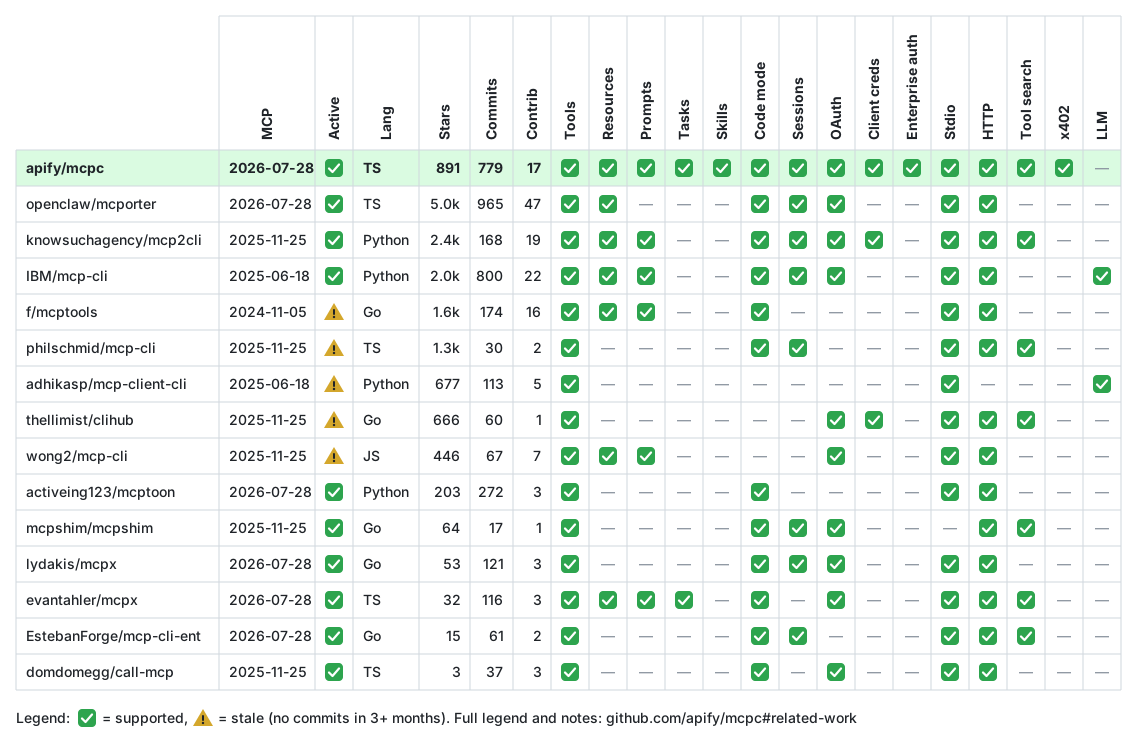](#related-work)
- 
- ## Table of contents
- <!-- START doctoc generated TOC please keep comment here to allow auto update -->
- <!-- DON'T EDIT THIS SECTION, INSTEAD RE-RUN doctoc TO UPDATE -->
- - [Motivation](#motivation)
- - [Install](#install)
- - [Quickstart](#quickstart)
- - [Usage](#usage)
- - [Sessions](#sessions)
- - [Authentication](#authentication)
- - [MCP proxy](#mcp-proxy)
- - [AI agents](#ai-agents)
- - [Agentic payments (x402)](#agentic-payments-x402)
- - [MCP support](#mcp-support)
- - [Configuration](#configuration)
- - [Security](#security)
- - [Errors](#errors)
- - [Development](#development)
- - [Related work](#related-work)
- - [License](#license)
- <!-- END doctoc generated TOC please keep comment here to allow auto update -->
- ## Motivation
- Many AI agents misuse MCP. They treat tools as prompt-time function calls, repeatedly injecting
- tool definitions and results into the context. Tokens get wasted, context rots, the
- agent gets slower and less reliable — hence the popular conclusion: _"MCP sucks, CLIs are better"_.
- `mcpc` challenges that narrative. It maps every MCP operation to an intuitive CLI command that
- agents pick up from `--help` alone. Any agent with shell access gets full MCP support without
- wiring up dozens of MCP functions. Just one `Bash()` tool, and `mcpc` handles the rest:
- ```
- ┌──────────┐ Bash() ┌────────┐ MCP ┌────────────┐
- │ AI agent │ ─────────► │ mcpc │ ────────► │ MCP server │
- └──────────┘ └────────┘ └────────────┘
- Sessions, OAuth, Tools,
- Resources, Prompts,
- Tasks, Skills, x402, ...
- ```
- CLI is the perfect _local_ interface between agents and MCP, while MCP remains the
- standard _remote_ interface for server discovery, authentication, payments, and access control.
- The two aren't exclusive – they're complementary.
- As a bonus, the same `mcpc` configuration, OAuth profiles, and live sessions can be shared across
- many AI agents on the same machine. Authenticate once, reuse everywhere.
- ## Install
- With [Homebrew](https://brew.sh) (macOS and Linux), which brings its own Node.js:
- ```bash
- brew install mcpc
- ```
- Otherwise install the latest [Node.js](https://nodejs.org/en/download) or [Bun](https://bun.sh) first, then:
- ```bash
- npm install -g @apify/mcpc
- # Or with Bun
- bun install -g @apify/mcpc
- ```
- **Linux:** credentials use the OS keychain via the [Secret Service API](https://specifications.freedesktop.org/secret-service/).
- GNOME/KDE desktops work out of the box. On headless/CI systems, `mcpc` falls back to a
- file-based store (`~/.mcpc/credentials.json`, mode `0600`).
- To force the keychain on headless systems, install `gnome-keyring`
- (via `apt-get`, `dnf`, or `pacman`) and run:
- ```bash
- dbus-run-session -- bash -c "echo -n 'password' | gnome-keyring-daemon --unlock && mcpc ..."
- ```
- ## Quickstart
- ```bash
- # List all active sessions and saved authentication profiles
- mcpc
- # Log in to a remote MCP server and save OAuth credentials for future use
- mcpc login mcp.apify.com
- # Create a persistent session and interact with it
- mcpc connect mcp.apify.com @test
- mcpc @test # show server info and capabilities
- mcpc @test tools-list # list available tools
- mcpc @test tools-call search-actors keywords:="website crawler"
- # Use JSON mode for scripting
- mcpc --json @test tools-list
- # Use a local MCP server package (stdio) referenced from a config file
- mcpc connect ./.vscode/mcp.json:filesystem @fs
- mcpc @fs tools-list
- ```
- ## Usage
- <!-- AUTO-GENERATED: mcpc --help -->
- ```
- Usage: mcpc [<@session>] [<command>] [options]
- Universal command-line client for the Model Context Protocol (MCP).
- Commands:
- connect [<server>] [@session] Connect to an MCP server and start a new named @session
- close <@session> Close a session
- restart <@session> Restart a session (losing all state)
- login <server> Log in to a server and save an OAuth profile
- logout <server> Delete an OAuth profile for a server
- clean [resources...] Clean up mcpc data (sessions, profiles, logs, all)
- grep <pattern> Search tools and instructions across all active sessions
- x402 [subcommand] [args...] Configure an x402 payment wallet (EXPERIMENTAL)
- help [command] [subcommand] Show help for a command
- Options:
- --json Output in JSON format for scripting
- --verbose Enable debug logging
- --profile <name> OAuth profile for the server ("default" if not provided)
- --timeout <seconds> Request timeout in seconds (default: 60)
- --max-chars <n> Truncate output to n characters (ignored in --json mode)
- --insecure Skip TLS certificate verification (for self-signed certs)
- -v, --version Output the version number
- -h, --help Display help
- MCP session commands (after connecting):
- <@session> Show MCP server info, capabilities, and tools overview
- <@session> grep <pattern> Search tools and instructions
- <@session> tools-list List all server tools
- <@session> tools-get <name> Get tool details and schema
- <@session> tools-call <name> [arg:=val ... | <json> | <stdin]
- <@session> tasks-list
- <@session> tasks-get <taskId>
- <@session> tasks-result <taskId>
- <@session> tasks-cancel <taskId>
- <@session> prompts-list
- <@session> prompts-get <name> [arg:=val ... | <json> | <stdin]
- <@session> completion-complete prompt|resource <ref> <arg:=val ... | <json> | <stdin>
- <@session> resources-list
- <@session> resources-read <uri> [-o <file> | --raw]
- <@session> resources-subscribe <uri> <file>
- <@session> resources-unsubscribe <uri>
- <@session> resources-templates-list
- <@session> resources-directory-read <uri>
- <@session> skills-list
- <@session> skills-get <skill> [file] [--raw]
- <@session> logging-set-level <level>
- <@session> ping
- <@session> server-discover
- <@session> logs [-n N] [--follow] [--since 1h]
- Run "mcpc" without arguments to show active sessions and OAuth profiles.
- Run "mcpc --json" to get the same data as `{ sessions: [...], profiles: [...] }`.
- Agent guide: mcpc help --skill
- ```
- [REFERENCE.md](docs/REFERENCE.md) collects the full `--help` output of every command in one page.
- In your terminal, run `mcpc help <command>` to see the same help for a single command.
- ### General actions
- With no arguments, `mcpc` lists all active sessions and saved OAuth profiles:
- ```bash
- # List all sessions and OAuth profiles (also in JSON mode)
- mcpc
- mcpc --json
- # Show command help or version
- mcpc --help
- mcpc --version
- # Clean stale sessions and old log files
- mcpc clean
- ```
- ### Server formats
- The `connect`, `login`, and `logout` commands accept a `<server>` argument in these formats:
- - **Remote URL** (e.g. `mcp.apify.com` or `https://mcp.apify.com`) — scheme defaults to `https://`
- - **Config file entry** (e.g. `~/.vscode/mcp.json:filesystem`) — `file:entry-name` syntax
- `connect` additionally supports two **bulk** forms that connect many servers at once:
- - **Config file** without an entry (e.g. `~/.vscode/mcp.json`) — connect every server in the file
- - **No argument** (`mcpc connect`) — auto-discover MCP config files in the current directory and
- your home dir (`.mcp.json`, `mcp.json`, `.cursor/mcp.json`, `.vscode/mcp.json`, `~/.claude.json`,
- Claude Desktop, Windsurf, Kiro, …) and connect everything found (run `mcpc connect --help` for the
- full list).
- ```bash
- mcpc connect # discover standard config files and connect all servers
- mcpc connect ~/.vscode/mcp.json # connect every server in one file
- ```
- Bulk connects auto-generate session names (so they don't take an `@session`) and **skip local
- stdio servers by default** — pass `--stdio` to include them. Each discovered config file is listed
- with its servers, the names of the headers they send, and their status (`● live`, `✗ failed`);
- files that can't be used are shown as `(0 servers)` or `(invalid)` with the reason, rather than
- silently ignored. The command waits for every handshake to finish (with a progress spinner in
- human mode); `--json` reports each server's details. If every server fails to connect, the command
- exits with a non-zero code.
- **Auto-discovery does not trust config files in the current directory to read environment
- variables.** A `.mcp.json` checked into a repository could carry
- `"headers": { "X": "${GITHUB_TOKEN}" }` (or `${SECRET}` in a hostname) pointed at an attacker's
- server, and a bare `mcpc connect` in that checkout would send the secret on the first request.
- So `mcpc connect` skips every project-scope entry that references a `${VAR}` — in `url`, `headers`,
- `command`, `args` or `env`, with or without `--stdio` — and shows which variables it would have
- read; it also refuses `-H`, which would go to every discovered server. Files under your home
- directory are your own and expand `${VAR}` as usual. To connect a skipped entry, review the file
- and name it explicitly (`mcpc connect ./.mcp.json`): naming a file is the trust step.
- 
- ### MCP commands
- All MCP commands go through a named session created with `connect`:
- ```bash
- # Connect to a remote server and create a session
- mcpc connect mcp.apify.com @apify
- mcpc @apify tools-list
- mcpc @apify tools-call search-apify-docs query:="What are Actors?"
- # Connect to a local server via config file entry
- mcpc connect ~/.vscode/mcp.json:filesystem @fs
- mcpc @fs tools-list
- mcpc @fs tools-call list_directory path:=/
- ```
- See [MCP support](#mcp-support) for details about all supported MCP features and commands.
- #### Command arguments
- The `tools-call` and `prompts-get` commands accept arguments as positional parameters after the tool/prompt name:
- ```bash
- # Key:=value pairs (auto-parsed: tries JSON, falls back to string)
- mcpc @session tools-call <tool-name> greeting:="hello world" count:=10 enabled:=true
- mcpc @session tools-call <tool-name> config:='{"key":"value"}' items:='[1,2,3]'
- # Force string type with JSON quotes
- mcpc @session tools-call <tool-name> id:='"123"' flag:='"true"'
- # Inline JSON object (if first arg starts with {)
- mcpc @session tools-call <tool-name> '{"greeting":"hello world","count":10}'
- # Read from stdin (automatic when no positional args and input is piped)
- echo '{"greeting":"hello","count":10}' | mcpc @session tools-call <tool-name>
- cat args.json | mcpc @session tools-call <tool-name>
- ```
- **Auto-parsing rules** for `key:=value`: valid JSON keeps its type
- (`count:=10` → number, `enabled:=true` → boolean, `cfg:='{"k":"v"}'` → object); anything
- else is a string (`greeting:=hello` → `"hello"`). Force a string literal with JSON quotes:
- `id:='"123"'`. Inline JSON (an object) is detected when the first arg starts with `{`. Stdin is
- read when no positional args are given and input is piped.
- **Pitfalls:** no spaces around `:=` (use `query:=hello world`, not `query := ...`); quote
- the whole argument when it contains shell expansions (`"query:=${VAR}"`). For complex
- inputs, prefer piping JSON via stdin.
- ### Grep (search across sessions)
- `mcpc grep` searches tools, resources, and prompts across all active sessions or within a single session:
- ```bash
- # Search tools and server instructions in all active sessions
- mcpc grep "search"
- # Search within a single session
- mcpc @apify grep "actor"
- # Search resources and prompts instead of the default tools and instructions
- mcpc grep "config" --resources --prompts
- # Regex search
- mcpc grep "search|find" -E
- # Case-sensitive search (default is case-insensitive)
- mcpc grep "Search" --case-sensitive
- # Limit results
- mcpc grep "e" -m 5
- # JSON output for scripting
- mcpc grep "actor" --json
- ```
- By default, `grep` searches tools and server instructions. Use `--resources` or `--prompts` to
- search those types instead (combine with `--tools` or `--instructions` to mix and match). Sessions
- that are crashed or unavailable are shown with their status rather than silently skipped. Like
- `grep(1)`, the command exits with code 0 when there are matches and 1 when there are none.
- The `grep` command is useful for **dynamic tool discovery**,
- also called [Tool search tool](https://www.anthropic.com/engineering/advanced-tool-use) by Anthropic
- or [Dynamic context discovery](https://cursor.com/blog/dynamic-context-discovery) by Cursor.
- Rather than loading all tools into the AI agent's context, the agent can use `grep` to discover the right tool
- for the job, and only load the relevant tools into the context when needed to reduce token usage and improve accuracy.
- <!-- TODO: explain this more, show diagram -->
- ### JSON mode
- By default, `mcpc` prints output in Markdown-ish text format with colors, making it easy for both humans and AIs to read.
- With `--json` option, `mcpc` always emits only a single JSON object (or array), to enable [scripting](#scripting).
- **For all MCP commands, the returned objects are always consistent with the
- [MCP specification](https://modelcontextprotocol.io/specification/latest).**
- On success, the JSON object is printed to stdout, on error to stderr.
- Note that `--json` is not available for `mcpc --help`. For `login`, `--json` prints a single
- `{ profile, serverUrl, scopes }` object on stdout (interactive prompts go to stderr).
- ## Sessions
- Up to protocol version `2025-11-25`, MCP was a [stateful protocol](https://modelcontextprotocol.io/specification/2025-11-25/basic/lifecycle):
- clients and servers negotiate protocol version and capabilities in an `initialize` handshake,
- and then communicate within a persistent session. Protocol version `2026-07-28` made MCP
- stateless — there is no handshake or server-side session anymore, and every request stands on its own.
- `mcpc` keeps one session-based workflow on top of both: you first `connect` a named session,
- then interact with the server through it. On stateful servers the session maps directly to the
- protocol-level MCP session. On stateless (`2026-07-28`) servers the session abstracts the
- protocol away — a lightweight **bridge process** still holds the connection, the negotiated
- protocol version, and client-side state, so everything built on "connect first, then interact"
- keeps working the same: cached tool listings, [searching across sessions](#grep-search-across-sessions)
- with `grep`, server keepalive and status checks by [periodic probing](#ping), change
- notifications, resource-to-file syncs, and automatic OAuth token refresh. It is also more
- efficient than forcing every MCP command to rediscover the server and reauthenticate.
- The protocol version is negotiated automatically (`mcpc @session` shows the result). To pin
- one exact version instead, pass `--protocol-version` to `connect` (e.g.
- `mcpc connect mcp.apify.com --protocol-version 2025-11-25`) — the connection then fails if the
- server does not support that version. Config file entries can set the same via a
- `protocolVersion` field.
- Sessions are given names prefixed with `@` (e.g. `@apify`),
- which then serve as unique references in commands.
- ```bash
- # Create a persistent session
- mcpc connect mcp.apify.com @apify
- # List all sessions and OAuth profiles
- mcpc
- # Run MCP commands in the session
- mcpc @apify tools-list
- # Restart the session (kills and restarts the bridge process)
- mcpc @apify restart # or: mcpc restart @apify
- # Close the session (terminates the bridge process)
- mcpc @apify close # or: mcpc close @apify
- # ...now the session name "@apify" is forgotten and available for future use
- ```
- ### Session lifecycle
- Session metadata is saved in `~/.mcpc/sessions.json`, [authentication tokens](#authentication)
- in the OS keychain. The bridge process keeps the session alive with periodic [pings](#ping)
- (`server/discover` probes on `2026-07-28` servers) and auto-reconnects on network failures
- or its own crashes (10s cooldown on failed retries).
- **Session states:**
- | State | Meaning |
- | ---------------- | ----------------------------------------------------------------------------------------------- |
- | 🟢`live` | Bridge process running and server responding |
- | 🟡`connecting` | Initial bridge startup in progress (`mcpc connect`) |
- | 🟡`reconnecting` | Bridge crashed or lost auth; auto-reconnecting in the background |
- | 🟡`disconnected` | Bridge process running but server unreachable; auto-recovers when server responds |
- | 🟡`crashed` | Bridge process crashed or was killed; auto-reconnects in the background |
- | 🔴`unauthorized` | Server rejected authentication (401/403) or token refresh failed; re-run `login` then `restart` |
- | 🔴`expired` | Server rejected session ID (404, stateful servers only); requires `restart` |
- `mcpc` never removes sessions automatically — failed ones stay flagged with a recovery hint
- in the error message. Use `mcpc @apify restart` to kill the bridge and open a fresh connection
- (with a fresh `MCP-Session-Id` on stateful servers), or `mcpc @apify close` to remove the
- session entirely.
- You can also remove dead sessions by running `mcpc clean`,
- and all sessions by running `mcpc clean all` (see [Cleanup](#cleanup)).
- ## Authentication
- `mcpc` supports all standard [MCP authorization methods](https://modelcontextprotocol.io/specification/latest/basic/authorization).
- ### Anonymous access
- For local servers (stdio) or remote servers (Streamable HTTP) which do not require credentials,
- `mcpc` can be used without authentication:
- ```bash
- mcpc connect mcp.apify.com @test
- mcpc @test tools-list
- ```
- ### Bearer token authentication
- For remote servers that require a Bearer token (but not OAuth), use the `--header` flag to pass the token.
- All headers are stored securely in the OS keychain for the session, but they are **not** saved as reusable
- [OAuth profiles](#oauth-profiles). This means `--header` must be provided again
- whenever you connect a new session.
- ```bash
- # Create a session with a Bearer token (token saved to keychain for this session only)
- mcpc connect https://mcp.apify.com @apify --header "Authorization: Bearer ${APIFY_TOKEN}"
- # Use the session (Bearer token is loaded from keychain automatically)
- mcpc @apify tools-list
- ```
- ### OAuth profiles
- For OAuth-enabled remote MCP servers, `mcpc` implements the full OAuth 2.1 flow with PKCE as
- mandated by the [MCP authorization spec](https://modelcontextprotocol.io/specification/2026-07-28/basic/authorization):
- `WWW-Authenticate` 401 challenges, Protected Resource Metadata and authorization server metadata
- discovery, all three [client registration approaches](#client-registration-approaches),
- [resource indicators (RFC 8707)](https://www.rfc-editor.org/rfc/rfc8707), and automatic
- refresh-token rotation.
- The OAuth authentication **always** needs to be initiated by the user calling the `login` command,
- which opens a web browser with a login screen. `mcpc` never opens the web browser on its own.
- The OAuth credentials for specific servers are securely stored as **authentication profiles** - reusable
- credentials that allow you to:
- - Authenticate once, use credentials across multiple commands or sessions
- - Use different accounts (profiles) with the same server
- - Manage credentials independently from sessions
- Key concepts:
- - **Authentication profile**: Named set of OAuth credentials for a specific server (stored in `~/.mcpc/profiles.json` + OS keychain)
- - **Session**: Active connection to a server that may reference an authentication profile (stored in `~/.mcpc/sessions.json`)
- - **Default profile**: When `--profile` is not specified, `mcpc` uses the authentication profile named `default`
- **Example:**
- ```bash
- # Login to server and save 'default' authentication profile for future use
- mcpc login mcp.apify.com
- # Use named authentication profile instead of 'default'
- mcpc login mcp.apify.com --profile work
- # Create two sessions using the two different credentials
- mcpc connect mcp.apify.com @apify-personal
- mcpc connect mcp.apify.com @apify-work --profile work
- # Both sessions now work independently
- mcpc @apify-personal tools-list # Uses personal account
- mcpc @apify-work tools-list # Uses work account
- # Re-authenticate existing profile (e.g., to refresh or change scopes)
- mcpc login mcp.apify.com --profile work
- # Delete "default" and "work" authentication profiles
- mcpc logout mcp.apify.com
- mcpc logout mcp.apify.com --profile work
- ```
- ### Client registration approaches
- When logging in, `mcpc` supports all three OAuth client registration approaches defined in the
- [MCP authorization spec](https://modelcontextprotocol.io/specification/2026-07-28/basic/authorization#client-registration-approaches),
- picking the one the authorization server advertises in its OAuth metadata:
- | **Approach** | **`mcpc login` flags** |
- | :-------------------------------------- | :---------------------------------------------------------------------------- |
- | **Pre-registration** | `--client-id` (and optional `--client-secret`) |
- | **Client ID Metadata Documents (CIMD)** | default (or `--client-metadata-url <url>`) |
- | **Dynamic Client Registration (DCR)** | fallback (or force with `--no-client-metadata-url` or `--client-name <name>`) |
- `mcpc` ships with a hosted [Client ID Metadata Document](https://apify.github.io/mcpc/client-metadata.json)
- so every installation presents the same client identity to CIMD-capable authorization servers.
- When the authorization server advertises `client_id_metadata_document_supported: true`, the CIMD
- URL is used as the `client_id`; otherwise mcpc falls back to Dynamic Client Registration.
- ```bash
- # Default: mcpc's hosted CIMD is used automatically (no flags needed).
- mcpc login mcp.apify.com
- # Pre-registered OAuth client (public or confidential) — skips CIMD.
- mcpc login mcp.example.com --client-id <id> [--client-secret <secret>]
- # Pre-registered client whose redirect URI was registered with localhost
- # instead of 127.0.0.1 (e.g. http://localhost:3118/callback).
- mcpc login mcp.example.com --client-id <id> --callback-host localhost --callback-port 3118
- # Custom CIMD: override the default with your own hosted document.
- mcpc login mcp.example.com --client-metadata-url https://example.com/my-client.json
- # Disable CIMD: force Dynamic Client Registration even if the server supports CIMD.
- mcpc login mcp.example.com --no-client-metadata-url
- # Dynamic Client Registration under a client name other than "mcpc" (disables CIMD).
- mcpc login mcp.example.com --client-name "My Agent"
- ```
- See the [MCP authorization spec](https://modelcontextprotocol.io/specification/2026-07-28/basic/authorization#client-registration-approaches)
- for details on each approach and the format of Client ID Metadata Documents.
- ### MCP authorization extensions
- Besides the interactive browser login, `mcpc` supports two official
- [MCP authorization extensions](https://modelcontextprotocol.io/extensions/client-matrix),
- selected with `mcpc login --grant <grant>`. Both save an [authentication profile](#oauth-profiles) like
- a regular login, and `mcpc` declares both extensions to every server it connects to.
- #### OAuth client credentials
- The [`io.modelcontextprotocol/oauth-client-credentials`](https://modelcontextprotocol.io/extensions/auth/oauth-client-credentials)
- extension is for non-interactive, machine-to-machine use such as CI/CD and daemons — no browser:
- `mcpc login <server> --grant client-credentials --client-id <id> --client-secret <secret>`
- (or a private-key JWT assertion via `--client-key`, RFC 7523). Access tokens are fetched and
- refreshed automatically; pin a non-discoverable token endpoint with `--token-endpoint <url>`.
- #### Enterprise-managed authorization
- The [`io.modelcontextprotocol/enterprise-managed-authorization`](https://modelcontextprotocol.io/extensions/auth/enterprise-managed-authorization)
- extension (SEP-990) is for organizations that control MCP server access centrally through their
- identity provider (e.g. Okta). You sign in once with corporate SSO, and mcpc then obtains MCP
- server tokens via identity assertion grants (ID-JAG) — no per-server consent screens:
- ```bash
- mcpc login mcp.example.com --grant id-jag \
- --idp https://acme.okta.com --idp-client-id <idp-client> \
- --client-id <mcp-as-client> --client-secret <secret>
- ```
- Both clients are pre-registered by your IT team: `--idp-client-id` at the enterprise IdP
- (add `--idp-client-secret` for confidential clients), `--client-id`/`--client-secret` at the
- MCP server's authorization server. The SSO session is kept alive with the IdP's refresh token;
- when it expires, affected sessions turn `unauthorized` with a re-login hint.
- See [MCP extensions](#mcp-extensions) for the full list of extensions `mcpc` supports.
- ### Authentication precedence
- When connecting, `mcpc` picks one auth source based on the flags you pass — explicit flags
- always win over stored profiles, and credentials are never silently downgraded. If a profile
- is missing, expired, or invalid, `mcpc` fails with an error that includes the right
- `mcpc login` command to recover.
- | Flag | Behavior |
- | ------------------------------- | ----------------------------------------------------------------------------------------------------------------------------------------------- |
- | `--header "Authorization: ..."` | Use explicit header; skip OAuth auto-detection. Cannot combine with `--profile`. |
- | `--profile <name>` | Require the named profile to exist. |
- | `--no-profile` | Connect anonymously even if a `default` profile exists. |
- | `--x402 [scheme]` | Skip OAuth auto-detection; use x402 payments instead. Optional scheme: `auto` (default), `upto`, `exact`. Combine with `--profile` to use both. |
- | _(none)_ | Use `default` profile if it exists; otherwise connect anonymously. |
- Headers set on a config file entry (`file:entry`) apply to the server that entry describes.
- ```bash
- # Default: 'default' profile if it exists, else anonymous
- mcpc connect mcp.apify.com @apify-personal
- # Specific profile (fails if missing)
- mcpc connect mcp.apify.com @apify-work --profile work
- # Explicit bearer token (no profile)
- mcpc connect mcp.apify.com @apify --header "Authorization: Bearer ${APIFY_TOKEN}"
- # Skip default profile, connect anonymously
- mcpc connect mcp.apify.com @apify-anon --no-profile
- # x402 micropayments instead of OAuth
- mcpc connect mcp.example.com @paid --x402
- ```
- ## MCP proxy
- For stronger isolation, `mcpc` can expose an MCP session as a new local proxy MCP server using the `--proxy` option.
- The proxy forwards all MCP requests to the upstream server but **never exposes the original authentication tokens** to the client.
- This is useful when you want to give someone or something MCP access without revealing your credentials.
- The proxy itself serves protocol `2025-11-25` to its clients, regardless of the protocol
- version negotiated with the upstream server. See also [AI sandboxes](#ai-sandboxes).
- ```bash
- # Human authenticates to a remote server
- mcpc login mcp.apify.com
- # Create authenticated session with proxy server on localhost:8080
- mcpc connect mcp.apify.com @open-relay --proxy 8080
- # Now any MCP client can connect to proxy like to a regular MCP server
- # The client has NO access to the original OAuth tokens or HTTP headers
- # Note: localhost/127.0.0.1 URLs default to http:// (no scheme needed)
- mcpc connect localhost:8080 @sandboxed
- mcpc @sandboxed tools-call search-actors keywords:="web scraper"
- # Optionally protect the proxy with a bearer token (stored in the OS keychain)
- mcpc connect mcp.apify.com @secure-relay --proxy 8081 --proxy-bearer-token secret123
- # To use the proxy, the caller needs to pass the bearer token in the Authorization header
- mcpc connect localhost:8081 @sandboxed2 --header "Authorization: Bearer secret123"
- ```
- **Proxy options for `connect` command:**
- | Option | Description |
- | ------------------------------ | ------------------------------------------------------------------------------ |
- | `--proxy [host:]port` | Start proxy MCP server. Default host: `127.0.0.1` (localhost only) |
- | `--proxy-bearer-token <token>` | Requires `Authorization: Bearer <token>` header to access the proxy MCP server |
- **Security model:**
- - **Localhost by default**: `--proxy 8080` binds to `127.0.0.1` only, preventing network access
- - **Tokens hidden**: Original OAuth tokens and/or HTTP headers are never exposed to proxy clients
- - **Optional auth**: Use `--proxy-bearer-token` to add another layer of security
- - **Explicit opt-in**: Proxy only starts when `--proxy` flag is provided
- **Binding to network interfaces:**
- ```bash
- # Localhost only (default, most secure)
- mcpc connect mcp.apify.com @relay --proxy 8080
- # Bind to all interfaces (allows network access - use with caution!)
- mcpc connect mcp.apify.com @relay --proxy 0.0.0.0:8080
- # Bind to specific interface
- mcpc connect mcp.apify.com @relay --proxy 192.168.1.100:8080
- ```
- When listing sessions, proxy info is displayed prominently:
- ```bash
- mcpc
- # @relay → https://mcp.apify.com (HTTP, OAuth: default) [proxy: 127.0.0.1:8080]
- ```
- ## AI agents
- `mcpc` is designed for CLI-enabled AI agents like Claude Code or Codex CLI, supporting both
- interactive **tool calling** and **[code mode](https://www.anthropic.com/engineering/code-execution-with-mcp)**.
- **Tool calling mode** - Agents call `mcpc` commands to dynamically explore and interact with MCP servers,
- using the default text output. This is similar to how MCP connectors in ChatGPT or Claude work,
- but the CLI gives you more flexibility and longer operation timeouts.
- ```bash
- # Discover available tools
- mcpc @server tools-list
- # Get tool schema
- mcpc @server tools-get search
- # Call a tool
- mcpc @server tools-call search query:="hello world"
- ```
- **Code mode** - Once agents understand the server's capabilities, they can write shell
- scripts that compose multiple `mcpc` commands with `--json` output — see
- [Scripting](#scripting) below. This can be
- [more accurate](https://www.anthropic.com/engineering/code-execution-with-mcp) and use
- fewer tokens than tool calling for complex workflows. Pair with
- [schema validation](#schema-validation) to catch breaking changes early.
- ### Scripting
- Use `--json` for machine-readable output (stdout on success, stderr on error).
- JSON output of all MCP commands follows the [MCP specification](https://modelcontextprotocol.io/specification/latest) strictly.
- ```bash
- # Chain tools across sessions
- mcpc --json @apify tools-call search-actors keywords:="scraper" \
- | jq '.content[0].text | fromjson | .items[0].id' \
- | xargs -I {} mcpc @apify tools-call get-actor actorId:="{}"
- # Batch operations
- for tool in $(mcpc --json @server tools-list | jq -r '.[].name'); do
- mcpc --json @server tools-get "$tool" > "schemas/$tool.json"
- done
- ```
- For a complete example script, see [`docs/examples/company-lookup.sh`](./docs/examples/company-lookup.sh).
- ### Schema validation
- The `tools-get` and `tools-call` commands support `--schema` to validate a tool's schema against an expected snapshot. This helps detect breaking changes early in scripts and CI:
- ```bash
- # Save expected schema
- mcpc --json @apify tools-get search-actors > expected.json
- # Validate without calling (read-only check)
- mcpc @apify tools-get search-actors --schema expected.json
- # Validate before calling (fails if schema changed incompatibly)
- mcpc @apify tools-call search-actors --schema expected.json keywords:="test"
- ```
- Available schema validation modes (`--schema-mode`):
- - `compatible` (default)
- - Input schema: new optional fields OK, required fields must have the same type.
- - Output schema: new fields OK, removed required fields cause error.
- - `strict` - Both input and output schemas must match exactly, including all fields, types, and descriptions
- - `ignore` - Skip validation completely (YOLO)
- ### AI sandboxes
- To ensure AI coding agents don't perform destructive actions or leak credentials,
- it's always a good idea to run them in a code sandbox with limited access to your resources.
- The [proxy MCP server](#mcp-proxy) feature provides a security boundary for AI agents:
- 1. **Human creates authentication profile**: `mcpc login mcp.apify.com --profile ai-access`
- 2. **Human creates session**: `mcpc connect mcp.apify.com @ai-sandbox --profile ai-access --proxy 8080`
- 3. **AI runs inside a sandbox**: If the sandbox's access is limited to `localhost:8080`,
- it can only interact with the MCP server through the `@ai-sandbox` session,
- without access to the original OAuth credentials, HTTP headers, or `mcpc` configuration.
- This ensures AI agents operate only with pre-authorized credentials, preventing unauthorized access to MCP servers.
- The human controls which servers the AI can access and with what permissions (OAuth scopes).
- **IMPORTANT:** Beware that MCP proxy will not make an insecure MCP server secure.
- Local stdio servers will still have access to your local system, and HTTP servers to provided auth credentials,
- and both can easily perform destructive actions or leak credentials on their own, or let MCP clients do such actions.
- **Always use only trusted local and remote MCP servers and limit their access to the necessary minimum.**
- ### Agent skills
- `mcpc` ships a built-in agent skill that always matches the installed version:
- ```bash
- mcpc help --skill
- ```
- No setup is needed: `mcpc help` mentions `mcpc help --skill`, so an agent can discover and load
- the guide on its own when it needs it.
- If you'd rather have the skill installed persistently (e.g. for Claude Code or any agent that
- loads `SKILL.md` files), `mcpc help --skill` prints a valid `SKILL.md` — just redirect it into
- your skills directory:
- ```bash
- mkdir -p ~/.claude/skills/mcpc
- mcpc help --skill > ~/.claude/skills/mcpc/SKILL.md
- ```
- That copy is a snapshot; re-run it after upgrading mcpc to refresh it.
- Separately, `mcpc` also acts as a **client for skills served by MCP servers** — see
- [Skills](#skills) for the `skills-list` / `skills-get` commands.
- ## Agentic payments (x402)
- > ⚠️ **Experimental.** This feature is under active development and may change.
- `mcpc` has experimental support for the [x402 payment protocol](https://www.x402.org/),
- which enables AI agents to autonomously pay for MCP tool calls using cryptocurrency.
- When an MCP server charges for a tool call (HTTP 402), `mcpc` automatically signs a USDC payment
- on the [Base](https://base.org/) blockchain and retries the request — no human intervention needed.
- This is entirely **opt-in**: existing functionality is unaffected unless you explicitly pass the `--x402` flag.
- ### How it works
- Two schemes are supported, both signed by your local wallet:
- - **`exact`** — EIP-3009 `TransferWithAuthorization`. Settles on-chain at call-time.
- - **`upto`** — Permit2 `PermitWitnessTransferFrom`. You sign a max cap; the facilitator settles accumulated usage later. First use auto-grants a one-time `USDC.approve(PERMIT2, MAX_UINT256)` (needs a tiny native ETH float for gas).
- Flow: server returns HTTP 402 with a `PAYMENT-REQUIRED` header → `mcpc` picks the best scheme per your preference, signs, and retries with `PAYMENT-SIGNATURE` → server verifies and fulfills. Tools that advertise pricing in `_meta.x402` are signed proactively, skipping the 402 round-trip.
- ### Settlement receipts
- When the server reports the settlement result — as a `PAYMENT-RESPONSE` header or on the tool
- result itself — `mcpc` hands it to you at `_meta["x402/payment-response"]` of the tool result,
- so a paid call can be reconciled against the on-chain settlement instead of inferred from the
- payload. The receipt is passed through exactly as the server sent it:
- ```bash
- mcpc --json @paid tools-call search query:="web crawler" | jq '._meta["x402/payment-response"]'
- # { "success": true, "transaction": "0x…", "network": "eip155:8453", "payer": "0x…" }
- ```
- Servers are not required to send one, and a missing or malformed receipt never fails the call.
- **Run paid calls sequentially if you need every receipt.** `mcpc` holds one receipt at a time per
- session, so when paid calls overlap only the most recent receipt is attached — the others are
- dropped (and recorded in the bridge log).
- ### Wallet setup
- `mcpc` stores a single wallet in `~/.mcpc/wallets.json` (file permissions `0600`).
- You need to create or import a wallet before using x402 payments.
- ```bash
- # Create a new wallet (generates a random private key)
- mcpc x402 init
- # Or import an existing wallet from a private key
- mcpc x402 import <private-key>
- # Show wallet address, balances, and a funding QR code
- mcpc x402
- # Remove the wallet
- mcpc x402 remove
- ```
- After creating a wallet, **fund it with USDC on Base** (mainnet or Sepolia testnet) to enable payments.
- ### Manual payment signing
- You can manually sign a payment from a server's `PAYMENT-REQUIRED` header using `x402 sign`.
- This is useful for pre-signing payments or integrating with tools outside of `mcpc`.
- ```bash
- # Sign a payment using the base64-encoded PAYMENT-REQUIRED header
- mcpc x402 sign <base64-payment-required>
- # Override the amount (in USD, e.g. 2.50 = $2.50)
- mcpc x402 sign <base64-payment-required> --amount 2.50
- # Override the expiry (in seconds from now)
- mcpc x402 sign <base64-payment-required> --expiry 7200
- # Combine overrides and use JSON output
- mcpc x402 sign <base64-payment-required> --amount 1.00 --expiry 3600 --json
- ```
- **Options:**
- | Option | Description |
- | -------------------- | ----------------------------------------------------------------------- |
- | `--amount <usd>` | Override the payment amount in USD (e.g. `0.50` for $0.50) |
- | `--expiry <seconds>` | Override the payment expiry in seconds from now (e.g. `3600`) |
- | `--scheme <val>` | Scheme preference: `auto` (default, upto > exact), `upto`, or `exact` |
- | `--no-approve` | For `upto`, skip checking and auto-approving on-chain Permit2 allowance |
- The command outputs the signed `PAYMENT-SIGNATURE` header value and an MCP config snippet
- that can be used directly with other MCP clients.
- `x402 sign` also works for plain HTTP (non-MCP) x402 v2 endpoints. Read the challenge from the
- `PAYMENT-REQUIRED` response header, sign it, then send the request again with the signature:
- ```bash
- URL=https://api.example.com/paid-resource
- REQ=$(curl -s -D - -o /dev/null "$URL" | awk -F': ' 'tolower($1)=="payment-required"{print $2}' | tr -d '\r\n')
- SIG=$(mcpc x402 sign "$REQ" --json | jq -r .paymentSignature)
- curl -s -D - -H "PAYMENT-SIGNATURE: $SIG" "$URL" # 200 + PAYMENT-RESPONSE header with the settlement tx
- ```
- ### Using x402 with MCP servers
- Pass the `--x402` flag when connecting to a session. It accepts an optional scheme preference
- (`auto`, `upto`, or `exact`); bare `--x402` defaults to `auto`.
- ```bash
- # Create a session with x402 payment support (auto picks the best advertised scheme)
- mcpc connect mcp.example.com @paid --x402
- # Pin a specific scheme — position doesn't matter, before or after positional args
- mcpc connect --x402 upto mcp.example.com @paid
- mcpc connect mcp.example.com @paid --x402 exact
- # The session now automatically handles 402 responses using your preference
- mcpc @paid tools-call expensive-tool query:="hello"
- # Restart re-uses the saved scheme from sessions.json — no need to repeat the flag
- mcpc @paid restart
- ```
- When `--x402` is active, a fetch middleware wraps all HTTP requests to the MCP server.
- If any request returns HTTP 402, the middleware transparently signs and retries. Your scheme preference is persisted in `sessions.json` and reused on every reconnect or restart.
- ### Supported networks
- | Network | Status |
- | -------------------- | ------------ |
- | Base Mainnet | ✅ Supported |
- | Base Sepolia testnet | ✅ Supported |
- ### Full x402 usage example
- This end-to-end example pays for the [Apify MCP server](https://mcp.apify.com) with no account or API key.
- [Apify](https://apify.com) is the largest and most trusted marketplace of tools for AI agents,
- with thousands of ready-made Actors for web scraping, data extraction, and automation.
- [Apify AGI](https://agi.apify.com) sells a prepaid, spend-capped API token for an x402 payment
- (`exact` scheme, USDC on Base mainnet), and `mcpc` uses that token as a Bearer credential.
- Each tool call is then billed against the token's prepaid balance.
- ```bash
- # 1. Create a wallet (or import one) and send USDC on Base to the printed address or QR code.
- # Signing is gasless, so the wallet needs no ETH.
- mcpc x402 init
- # Once sent, check that the USDC balance has arrived.
- mcpc x402
- # 2. Fetch the payment challenge for a $1 token, the minimum (the PAYMENT-REQUIRED header).
- URL='https://agi.apify.com/protocols/x402/prepaid-tokens?amount=1¤cy=usd'
- REQ=$(curl -s -D - -o /dev/null "$URL" | awk -F': ' 'tolower($1)=="payment-required"{print $2}' | tr -d '\r\n')
- # 3. Sign it with the wallet and resubmit; the server settles the payment and returns the token.
- SIG=$(mcpc x402 sign "$REQ" --scheme exact --json | jq -r .paymentSignature)
- TOKEN=$(curl -s -H "PAYMENT-SIGNATURE: $SIG" "$URL" | jq -r .token)
- # 4. Connect with the token and use the server as usual.
- mcpc connect mcp.apify.com @apify --header "Authorization: Bearer $TOKEN"
- mcpc @apify tools-list
- mcpc @apify tools-call search-actors keywords:="Google Maps"
- # 5. Check how much of the prepaid balance is left.
- curl -s -H "Authorization: Bearer $TOKEN" https://agi.apify.com/prepaid-tokens/balance
- ```
- 
- `mcpc` keeps the token only for the `@apify` session, so save `$TOKEN` if you want to reuse it elsewhere.
- See [agi.apify.com/AGENTS.md](https://agi.apify.com/AGENTS.md) for current prices, limits, and terms.
- ## MCP support
- `mcpc` aims to be the most complete MCP client on the command line. It's built on the official
- [MCP SDK for TypeScript](https://github.com/modelcontextprotocol/typescript-sdk) and supports all the
- major client-facing features of the [MCP specification](https://modelcontextprotocol.io/specification/latest),
- from tools, resources, and prompts to the newest additions like async tasks and skills. Each is exposed as
- a first-class command with consistent human-readable and `--json` output.
- Where `mcpc` stands on each part of the MCP specification:
- | **Feature** | **Status** |
- |:-----------------------------------------------------|:-----------------------------------------------------------------|
- | 📜 **Protocol version** | ✅ 2026-07-28 (auto-negotiated), falls back to 2025-11-25 or older |
- | 🔌 **Transport** | ✅ stdio and Streamable HTTP |
- | 🔑 [**Authorization**](#authentication) | ✅ Bearer + OAuth 2.1 (client credentials, DCR, CIMD, auth code) |
- | 🔄 [**Sessions**](#sessions) | ✅ Supported (with automatic keepalive) |
- | 📖 [**Server instructions**](#server-instructions) | ✅ Supported |
- | 🔧 [**Tools**](#tools) | ✅ Supported (incl. list changed notifications) |
- | ⏳ [**Async tasks**](#async-tasks) | ✅ Supported (2025-11-25 core tasks and the 2026-07-28 tasks extension) |
- | 💬 [**Prompts**](#prompts) | ✅ Supported (incl. list changed notifications) |
- | 📦 [**Resources**](#resources) | ✅ Supported (incl. subscriptions and list changed notifications) |
- | 🧠 [**Skills**](#skills) | ✅ Supported (skills extension, 2026-07-28 servers) |
- | 📝 [**Logging**](#server-logs) | ⚠️ Deprecated (removed by MCP 2026-07-28) |
- | 🔔 [**Notifications**](#list-change-notifications) | ✅ Supported |
- | 📄 [**Pagination**](#pagination) | ✅ Supported |
- | 🏓 [**Ping**](#ping) | ✅ Supported |
- | 🔍 [**Server discovery**](#server-discovery) | ✅ Supported (`server/discover`, 2026-07-28 servers) |
- | 📁 **Roots** | ❌ Not planned (deprecated by MCP) |
- | ❓ **Elicitation** | 🚧 Planned |
- | 🔤 [**Completion**](#completion) | ✅ Supported |
- | 🤖 **Sampling** | ❌ Not applicable (no LLM access) |
- Beyond the interactive browser login, the **Authorization** row also covers the two
- [MCP authorization extensions](#mcp-authorization-extensions): OAuth client credentials and
- enterprise-managed authorization.
- ### MCP extensions
- Extensions are the optional, modular parts of MCP, negotiated through the `extensions` field of
- client and server capabilities. Where `mcpc` stands on the
- [official ones](https://modelcontextprotocol.io/extensions/client-matrix):
- | **Extension** | **Identifier** | **Status** |
- |:----------------------------------------------------------------------------------------------------------------|:------------------------------------------------------------|:--------------------------------------------------------------------------------|
- | [OAuth client credentials](https://modelcontextprotocol.io/extensions/auth/oauth-client-credentials) | `io.modelcontextprotocol/oauth-client-credentials` | ✅ `mcpc login <server> --grant client-credentials` |
- | [Enterprise-managed authorization](https://modelcontextprotocol.io/extensions/auth/enterprise-managed-authorization) | `io.modelcontextprotocol/enterprise-managed-authorization` | ✅ `mcpc login <server> --grant id-jag` |
- | [Skills](https://modelcontextprotocol.io/extensions/skills/overview) | `io.modelcontextprotocol/skills` | ✅ [`skills-list`, `skills-get`, `resources-directory-read`](#skills) (MCP 2026-07-28 servers) |
- | [MCP Apps](https://modelcontextprotocol.io/extensions/apps/overview) | `io.modelcontextprotocol/ui` | ❌ Interactive HTML interfaces have no equivalent on a terminal |
- | [Tasks](https://modelcontextprotocol.io/extensions/tasks/overview) | `io.modelcontextprotocol/tasks` | ✅ [`tools-call --task/--detach`, `tasks-get`, `tasks-result`, `tasks-cancel`, `tasks-list`](#async-tasks) (MCP 2026-07-28 servers) |
- The two auth extensions and tasks are the ones a client declares: `mcpc` declares all three to
- every server it connects to, so a server can tell what this client can do before any token is
- issued, and can answer a tool call with a task handle. Skills is declared by servers only — a
- client issues `skills/list` and `skills/get` once it sees that declaration. `mcpc @session` lists
- what a server declares in return, and says which of those `mcpc` can use.
- ### Server instructions
- MCP servers can provide instructions describing their capabilities and usage. These are displayed when you connect to a server or show its session overview:
- ```bash
- # Show server info, capabilities, and instructions
- mcpc @apify
- # JSON mode
- mcpc @apify --json
- ```
- In [JSON mode](#json-mode), the resulting object adheres to the schema of the server's
- handshake result — [`InitializeResult`](https://modelcontextprotocol.io/specification/2025-11-25/schema#initializeresult)
- on `2025-11-25` connections, [`DiscoverResult`](https://modelcontextprotocol.io/specification/2026-07-28/schema#discoverresult)
- on `2026-07-28` ones — and includes the `_mcpc` field with relevant server/session metadata.
- `protocolVersion` is always the version actually in use, while `supportedVersions` (every
- version the server offers) and `_meta` come from `server/discover` and are therefore absent
- on `2025-11-25` connections.
- ```json
- {
- "_mcpc": {
- "sessionName": "@apify",
- "profileName": "default",
- "server": {
- "url": "https://mcp.apify.com"
- },
- "notifications": {
- "tools": { "listChangedAt": "2026-01-01T00:42:58.049Z" }
- }
- },
- "protocolVersion": "2026-07-28",
- "supportedVersions": ["2026-07-28", "2025-11-25"],
- "capabilities": {
- "logging": {},
- "prompts": {},
- "resources": {},
- "tools": { "listChanged": true }
- },
- "serverInfo": {
- "name": "apify-mcp-server",
- "version": "1.0.0"
- },
- "instructions": "Apify is the largest marketplace of tools for web scraping...",
- "_meta": {
- "io.modelcontextprotocol/serverInfo": {
- "name": "apify-mcp-server",
- "version": "1.0.0"
- }
- }
- }
- ```
- ### Tools
- Tools are the heart of MCP, and `mcpc` gives you the whole toolbox to discover, inspect, validate, and call them:
- ```bash
- # List tools (compact view): names, one-line descriptions, and safety/task hints
- mcpc @apify tools-list
- # List tools with full input/output schemas and descriptions
- mcpc @apify tools-list --full
- # Inspect a single tool's schema, annotations, and a ready-to-run example
- mcpc @apify tools-get search-actors
- # Call a tool with arguments
- mcpc @apify tools-call search-actors keywords:="web scraper"
- # Pass complex JSON arguments
- mcpc @apify tools-call create-task '{"name": "my-task", "options": {"memory": 1024}}'
- # Load arguments from stdin
- cat data.json | mcpc @apify tools-call bulk-import
- ```
- The compact `tools-list` is built for **[progressive tool discovery](#grep-search-across-sessions)**:
- instead of loading every tool's full schema into an agent's context up front, list just names and
- summaries, use `mcpc grep` to find the right tool for the task, and pull its full schema with
- `tools-get` only when you need it. Fewer tokens, less context rot, better accuracy. And listings never
- go stale: the [session](#sessions) bridge handles `tools/list_changed`
- [notifications](#list-change-notifications) and refreshes its cache automatically, so you always see the
- server's current tools.
- `mcpc` surfaces everything modern MCP tools can express:
- - **Safety annotations**: `read-only`, `destructive`, `idempotent`, and `open-world` hints are shown
- right next to each tool, so a human or an agent can tell a harmless query from a dangerous mutation
- before calling it.
- - **Structured output**: tool results show `structuredContent` as JSON when no other content remains
- after removing duplicate text blocks. Otherwise a hint points to `--json`, which includes the full
- result. Output schemas are shown with `tools-list --full` and `tools-get`.
- - **Rich result content**: text, images, audio, and [resource links or embedded resources](#resources)
- in tool results are all rendered (binary is summarized, never dumped to your terminal).
- - **Async tasks**: long-running tools can run in the background as [async tasks](#async-tasks); each
- tool's task support is flagged as `[task:optional]`, `[task:required]`, or `[task:forbidden]`.
- - **Schema validation**: pin a tool's schema with `--schema` to catch breaking changes in CI and
- scripts before they bite (see [Schema validation](#schema-validation)).
- ### Prompts
- List and retrieve server-defined prompt templates:
- ```bash
- # List available prompts
- mcpc @apify prompts-list
- # Get a prompt with arguments
- mcpc @apify prompts-get analyze-website url:=https://example.com
- ```
- <!-- TODO: Add example of prompt templates -->
- ### Resources
- Access server-provided data sources by URI:
- ```bash
- # List available resources
- mcpc @apify resources-list
- # Read a resource (pretty view; binary content is summarized, never dumped)
- mcpc @apify resources-read "file:///config.json"
- # Print just the content for piping
- mcpc @apify resources-read "file:///config.json" --raw | jq .
- # Save a resource to a local file (binary-safe, decodes base64 blobs)
- mcpc @apify resources-read "file:///logo.png" -o logo.png
- # List resource templates
- mcpc @apify resources-templates-list
- ```
- Subscriptions keep a local file in sync with a server resource. On subscribe, mcpc downloads
- the resource to the file; afterwards the session bridge rewrites the file whenever the server
- sends a `notifications/resources/updated` notification for the URI (the bridge re-reads the
- resource, as the notification carries no content). Requires the server capability
- `resources.subscribe`; subscriptions are re-established automatically when the session
- reconnects or restarts, and are listed in `mcpc @session` output. On the wire, mcpc uses
- `resources/subscribe` on `2025-11-25` servers and a `subscriptions/listen` stream on
- `2026-07-28` servers (re-opened automatically if it drops) — the commands are identical.
- ```bash
- # Keep ./config.json in sync with the server resource
- mcpc @apify resources-subscribe "file:///config.json" ./config.json
- # Stop syncing — the local file is kept as-is
- mcpc @apify resources-unsubscribe "file:///config.json"
- ```
- ### Completion
- Servers that declare the `completions` capability can suggest values for prompt arguments and
- resource template variables
- ([`completion/complete`](https://modelcontextprotocol.io/specification/latest/server/utilities/completion)).
- Arguments use the `prompts-get` syntax: the last one is the argument being completed, with the text
- typed so far as its value (empty for none), and any arguments before it are sent as context so the
- server can narrow its suggestions:
- ```bash
- # Suggest values for a prompt argument from what's typed so far
- mcpc @apify completion-complete prompt code_review language:=py
- # Earlier arguments are context: complete "framework" for a Python code review
- mcpc @apify completion-complete prompt code_review language:=python framework:=fla
- # Complete a variable of a resource template
- mcpc @apify completion-complete resource 'file:///{path}' path:=/ho
- ```
- Servers return at most 100 suggestions ranked by relevance; `hasMore` in the `--json` output says
- whether there were more. Completion works the same on `2025-11-25` and `2026-07-28` servers.
- ### Skills
- Implements the [MCP Skills extension](https://github.com/modelcontextprotocol/ext-skills)
- (`io.modelcontextprotocol/skills`), which requires MCP `2026-07-28` or later.
- [Agent Skills](https://agentskills.io/) are reusable markdown workflow instructions (`SKILL.md` with YAML
- frontmatter, plus any supporting files) that AI agents load on demand. A server that declares the extension
- publishes them over `skills/list` and `skills/get`, and serves their files as ordinary `skill://` resources:
- ```bash
- # List the skills the server serves, with their file manifests
- mcpc @apify skills-list
- # Read a skill's SKILL.md by name, path, or the URI of its SKILL.md
- mcpc @apify skills-get git-workflow
- mcpc @apify skills-get acme/billing/refunds
- mcpc @apify skills-get skill://git-workflow/SKILL.md
- # Read one of the skill's supporting files
- mcpc @apify skills-get pdf-processing references/FORMS.md
- # Print just the content (no header/fences) — pipe straight to an LLM or a file
- mcpc @apify skills-get git-workflow --raw > /tmp/SKILL.md
- # JSON for scripts: [{ uri, frontmatter: { name, description, ... }, resources }]
- mcpc --json @apify skills-list | jq -r '.[].frontmatter.name'
- # List a directory inside a skill (servers that declare "directoryRead": true)
- mcpc @apify resources-directory-read skill://pdf-processing/templates
- ```
- 
- Every entry from `skills-list` is complete: the skill's verbatim frontmatter plus a manifest of every
- file with its SHA-256 digest and byte size. `skills-get` uses that manifest as the spec requires —
- it fetches the entry, reads the file, and checks the bytes against the declared size and digest (and, for
- a `SKILL.md`, that the document's frontmatter is what the entry advertised). **Content that fails any of
- those checks is not printed**, and a file missing from the manifest is refused rather than read. Skills
- whose content is generated carry `"resources": "dynamic"` instead of a manifest; `mcpc` reads them but
- labels them unverified.
- Skills appear under capabilities in `mcpc @session` output when a server declares the extension in
- `capabilities.extensions["io.modelcontextprotocol/skills"]`. Skill content is treated as untrusted
- input — `mcpc` only reads and prints it; it never executes hooks, scripts, or other frontmatter-declared
- behavior, and `allowed-tools` grants nothing.
- ### List change notifications
- When connected via a [session](#sessions), `mcpc` automatically handles `list_changed`
- notifications for tools, resources, and prompts. On `2025-11-25` servers these arrive as
- unsolicited notifications; on `2026-07-28` servers (where unsolicited notifications no
- longer exist) the session bridge opts in by opening a `subscriptions/listen` stream at
- connect and re-opens it automatically if it drops — the behavior is identical from the
- outside. As a safety net on `2026-07-28` connections, the bridge's tools cache also
- expires after 60 seconds, so a missed notification can never leave `tools-list` or
- [`grep`](#grep-search-across-sessions) stale for long.
- The bridge process tracks when each notification type was last received.
- The timestamps are available in the JSON output of `mcpc @session --json` under the `_mcpc.notifications`
- field - see [Server instructions](#server-instructions).
- ### Server logs
- `mcpc` supports server logging settings (`logging/setLevel`) and log messages (`notifications/message`).
- Log messages are printed to bridge log or stderr, subject to [verbosity level](#verbose-mode).
- You can instruct MCP servers to adjust their [logging level](https://modelcontextprotocol.io/specification/latest/server/utilities/logging)
- using the `logging-set-level` command:
- ```bash
- # Set server log level to debug for detailed output
- mcpc @apify logging-set-level debug
- # Reduce server logging to only errors
- mcpc @apify logging-set-level error
- ```
- Note that this sets the logging level on the **server side**.
- The actual log output depends on the server's implementation.
- > ⚠️ **Deprecated.** MCP `2026-07-28` removed `logging/setLevel`, so `logging-set-level` works
- > only on servers using protocol `2025-11-25` or older and will be removed in a future mcpc
- > release. Server log messages (`notifications/message`) are still recorded in the bridge log.
- ### Pagination
- MCP servers may return paginated results for list operations
- (`tools-list`, `resources-list`, `prompts-list`, `resources-templates-list`).
- `mcpc` handles this automatically and always fetches all available pages using the `nextCursor`
- token - you always get the complete list without manual iteration. Keep it simple.
- ### Ping
- Sessions automatically send periodic pings to keep the [connection alive](#session-lifecycle) and detect failures early.
- Send a ping to check if a server connection is alive:
- ```bash
- # Ping a session and measure round-trip time
- mcpc @apify ping
- mcpc @apify ping --json
- ```
- Protocol version `2026-07-28` removed the `ping` request, so on servers using it `mcpc`
- sends a `server/discover` probe instead — same round trip, same liveness signal, and the
- command works identically on both protocol versions. The human-readable output says so,
- so a `server/discover` entry in the server's access log is not a surprise.
- ### Server discovery
- On `2026-07-28` connections you can also send that request yourself and see what the server
- answers right now — every protocol version it supports, its capabilities, its instructions,
- and its `_meta`:
- ```bash
- mcpc @apify server-discover
- mcpc @apify server-discover --json # DiscoverResult, verbatim
- ```
- Unlike [`mcpc @apify`](#server-instructions), which reports what the connection settled on
- when it was created, this is a live request. Protocol `2026-07-28` introduced
- `server/discover`, so the command fails on `2025-11-25` (and older) connections, where the
- `initialize` handshake carries the same information — run `mcpc @apify` there instead.
- ### Async tasks
- MCP servers can execute tools as [async tasks](https://modelcontextprotocol.io/specification/latest/basic/utilities/tasks)
- that run in the background and report progress. `mcpc` supports the full task lifecycle:
- ```bash
- # Call a tool as a task (waits for completion, shows progress spinner)
- mcpc @apify tools-call long-running-job input:="data" --task
- # Start a task and return immediately with the task ID
- mcpc @apify tools-call long-running-job input:="data" --detach
- # List active tasks
- mcpc @apify tasks-list
- # Check task status
- mcpc @apify tasks-get <taskId>
- # Get the task result (blocks until the task reaches a terminal state)
- mcpc @apify tasks-result <taskId>
- # Cancel a running task
- mcpc @apify tasks-cancel <taskId>
- ```
- 
- With `--task`, the CLI shows a progress spinner with elapsed time, server status messages,
- and progress notifications. Press **ESC** during execution to detach and get the task ID
- for later retrieval. With `--detach`, the task starts and its ID is printed immediately
- (`--json` prints the whole created `Task`: ID, status, TTL, poll interval). Use
- `tasks-result <taskId>` to fetch the final `CallToolResult` payload once the task completes.
- Tasks exist in two forms, and `mcpc` speaks both behind the same commands:
- - On MCP `2025-11-25` servers tasks are part of the core protocol. The server advertises the
- `tasks` capability, `tools-list` and `tools-get` flag per-tool support as `[task:optional]`,
- `[task:required]` or `[task:forbidden]`, and the client asks for a task with `--task`.
- - On MCP `2026-07-28` servers tasks are the [`io.modelcontextprotocol/tasks`](https://modelcontextprotocol.io/extensions/tasks/overview)
- extension, which `mcpc` declares on every request. Task creation is the **server's** call:
- a server that declares the extension may answer any `tools-call` with a task, which `mcpc`
- then polls (at the interval the server asks for) until the result is in — with or without
- `--task`. Conversely, a `--detach` call the server chooses to run synchronously prints the
- tool result instead of a task, so scripts should check for `taskId`. The extension has no
- server-side listing, so `tasks-list` shows the tasks the session created and the server
- still knows, and `tasks-cancel` reports the status the server shows right after
- acknowledging the request (cancellation is cooperative there). A task that stops to ask
- for input (`input_required`) is reported as an error — `mcpc` never prompts.
- When a server offers neither, `--task`/`--detach` and the `tasks-*` commands fail with an
- error saying so — they never fall back to a plain synchronous call, because the flags change
- the shape of the output and `--detach` callers would be left parsing a task ID that is not
- there.
- ## Configuration
- You can configure `mcpc` using a config file, environment variables, or command-line flags.
- **Precedence** (highest to lowest):
- 1. Command-line flags and config file entries (`file:entry`)
- 2. Environment variables
- 3. Built-in defaults
- ### MCP server config file
- `mcpc` supports the ["standard"](https://gofastmcp.com/integrations/mcp-json-configuration)
- MCP server JSON config file, compatible with Claude Desktop, VS Code, and other MCP clients.
- Use the `file:entry` syntax to reference a server from a config file:
- ```bash
- # Open a session to a server specified in the Visual Studio Code config
- mcpc connect .vscode/mcp.json:apify @my-apify
- mcpc @my-apify tools-list
- ```
- `mcpc` also finds these files for you: run `mcpc connect` with no arguments to auto-discover config
- files in standard locations and connect every server, or pass a file without an entry to connect all
- of its servers. See [Server formats](#server-formats).
- **Example MCP config JSON file:**
- ```json
- {
- "mcpServers": {
- "apify": {
- "url": "https://mcp.apify.com",
- "headers": {
- "Authorization": "Bearer ${APIFY_TOKEN}"
- }
- },
- "filesystem": {
- "command": "npx",
- "args": ["-y", "@modelcontextprotocol/server-filesystem", "/tmp"],
- "env": {
- "DEBUG": "mcp:*"
- }
- },
- "local-package": {
- "command": "node",
- "args": ["/path/to/server.js"]
- }
- }
- }
- ```
- **Server configuration properties:**
- For **Streamable HTTP servers:**
- - `url` (required) - MCP server endpoint URL
- - `headers` (optional) - HTTP headers to include with requests
- - `timeout` (optional) - Request timeout in seconds
- For **stdio servers:**
- - `command` (required) - Command to execute (e.g., `node`, `npx`, `python`)
- - `args` (optional) - Array of command arguments
- - `env` (optional) - Environment variables for the process
- > **Note:** Stdio servers inherit only a minimal env whitelist from the shell
- > (`PATH`, `HOME`, `SHELL`, …). Other vars — `NODE_EXTRA_CA_CERTS`, `HTTPS_PROXY`,
- > `SSL_CERT_FILE`, etc. — must be forwarded explicitly via the `env` block using
- > `${VAR_NAME}`. Anything the server writes to stderr is captured to
- > `~/.mcpc/logs/bridge-<session>.log` with a `[server stderr]` prefix, and the
- > tail is appended to the error message if `mcpc connect` fails, so you can see
- > why a stdio server failed to start.
- **Environment variable substitution:**
- Config files support environment variable substitution using `${VAR_NAME}` syntax:
- ```json
- {
- "mcpServers": {
- "secure-server": {
- "url": "https://mcp.apify.com",
- "headers": {
- "Authorization": "Bearer ${APIFY_TOKEN}",
- "X-User-ID": "${USER_ID}"
- }
- }
- }
- }
- ```
- ### Saved state
- `mcpc` saves its state to `~/.mcpc/` directory (unless overridden by `MCPC_HOME_DIR`), in the following files:
- - `~/.mcpc/sessions.json` - Active sessions with references to authentication profiles (file-locked for concurrent access)
- - `~/.mcpc/profiles.json` - Authentication profiles (OAuth metadata, scopes, expiry)
- - `~/.mcpc/wallets.json` - x402 wallet data (file permissions `0600`)
- - `~/.mcpc/bridges/` - Unix domain socket files for each bridge process
- - `~/.mcpc/logs/bridge-*.log` - Log files for each bridge process
- - OS keychain - Sensitive credentials (OAuth tokens, bearer tokens, client secrets)
- ### Environment variables
- - `MCPC_HOME_DIR` - Directory for session and authentication profiles data (default is `~/.mcpc`)
- - `MCPC_VERBOSE` - Enable verbose logging (set to `1`, `true`, or `yes`, case-insensitive)
- - `MCPC_JSON` - Enable JSON output (set to `1`, `true`, or `yes`, case-insensitive)
- - `HTTPS_PROXY` / `https_proxy` / `HTTP_PROXY` / `http_proxy` - Proxy URL for outbound connections (e.g. `http://proxy.example.com:8080`); `HTTPS_PROXY` takes precedence
- - `NO_PROXY` / `no_proxy` - Comma-separated list of hostnames/IPs to bypass the proxy (e.g. `localhost,127.0.0.1`)
- ### Cleanup
- You can clean up the `mcpc` state and data using the `clean` command:
- ```bash
- # Safe non-destructive cleanup: remove expired sessions, delete old orphaned logs
- mcpc clean
- # Clean specific resources
- mcpc clean sessions # Kill bridges, delete all sessions
- mcpc clean profiles # Delete all authentication profiles
- mcpc clean logs # Delete all log files
- # Nuclear option: remove everything
- mcpc clean all # Delete all sessions, profiles, logs, and sockets
- ```
- ## Security
- `mcpc` follows [MCP security best practices](https://modelcontextprotocol.io/specification/latest/basic/security_best_practices).
- MCP enables arbitrary tool execution and data access - treat servers like you treat shells:
- - Use least-privilege tokens/headers
- - Only use trusted servers!
- - Audit tools before running them
- ### Credential protection
- | What | How |
- | ---------------------- | ----------------------------------------------- |
- | **OAuth tokens** | Stored in OS keychain (headless fallback: `credentials.json`, `0600`) |
- | **HTTP headers** | Stored in OS keychain per-session |
- | **Stdio server `env`** | Stored in OS keychain per-session |
- | **Bridge credentials** | Passed via Unix socket IPC, kept in memory only |
- | **Process arguments** | No secrets visible in `ps aux` |
- | **x402 private key** | Stored in OS keychain (fallback: `wallets.json`, `0600`) |
- | **Config files** | Contain only metadata, never tokens |
- | **File permissions** | `0600` (user-only) for all config files |
- ### Network security
- - HTTPS enforced for remote servers (auto-upgraded from HTTP)
- - OAuth callback binds to `127.0.0.1` only
- - Credentials never logged, even in verbose mode
- ### AI security
- See [AI sandboxes](#ai-sandboxes) for details.
- ## Errors
- `mcpc` provides clear error messages for common issues:
- - **Connection failures**: Displays transport-level errors with retry suggestions
- - **Session timeouts**: Automatically attempts to reconnect or prompts for session recreation
- - **Invalid commands**: Shows available commands and correct syntax
- - **Tool execution errors**: Returns server error messages with context
- - **Bridge crashes**: Detects and cleans up orphaned processes, offers restart
- ### Exit codes
- - `0` - Success
- - `1` - Client error (invalid arguments, command not found, etc.)
- - `2` - Server error (tool execution failed, resource not found, etc.)
- - `3` - Network error (connection failed, timeout, etc.)
- - `4` - Authentication error (invalid credentials, forbidden, etc.)
- ### Verbose mode
- To see what's happening, enable detailed logging with `--verbose`.
- ```bash
- mcpc --verbose @apify tools-list
- ```
- This causes `mcpc` to print detailed debug messages to stderr.
- ### Logs
- View the bridge log for a session with `mcpc @<session> logs` (run with
- `--help` for `--follow`, `-n`, and `--since` options). The underlying file
- lives at `~/.mcpc/logs/bridge-@<session>.log` and is rotated automatically
- (10MB per file, max 5 files). The main `mcpc` process doesn't save log
- files, but supports [verbose mode](#verbose-mode).
- ### Troubleshooting
- **"Cannot connect to bridge"**
- - Bridge may have crashed. Try: `mcpc @<session-name> tools-list` to restart the bridge
- - Check bridge is running: `ps aux | grep '[m]cpc/dist/bridge'`
- - Check socket exists: `ls ~/.mcpc/bridges/`
- **"Session not found"**
- - List existing sessions: `mcpc`
- - Create new session if expired: `mcpc @<session-name> close` and `mcpc connect <server> @<session-name>`
- **"Authentication failed"**
- - List saved OAuth profiles: `mcpc`
- - Re-authenticate: `mcpc login <server> [--profile <name>]`
- - For bearer tokens: provide `--header "Authorization: Bearer ${TOKEN}"` again
- ## Development
- The initial version of `mcpc` was developed and [launched by Jan Curn](https://x.com/jancurn/status/2007144080959291756) of [Apify](https://apify.com)
- with the help of Claude Code, during late nights over Christmas 2025 in North Beach, San Francisco.
- See [CONTRIBUTING](./CONTRIBUTING.md) for development setup, architecture overview, and contribution guidelines.
- ## Related work
- ### MCP CLI clients
- <!-- Stars, contributors, commits, and activity as of 2026-11-05. -->
- | Tool | MCP | Active | Lang | Stars | Commits | Contrib | Tools | Resources | Prompts | Tasks | Skills | Code mode | Sessions | OAuth | Client creds | Enterprise auth | Stdio | HTTP | Tool search | x402 | LLM |
- | ------------------------------------------------------------------------------------------------------------------- | ---------- | ------ | ------ | ----: | ------: | ------: | ----- | --------- | ------- | ----- | ------ | --------- | -------- | ----- | ------------ | --------------- | ----- | ---- | ----------- | ---- | --- |
- | **[apify/mcpc](https://github.com/apify/mcpc)** | 2026-07-28 | ✅ | TS | 1.1k | 823 | 22 | ✅ | ✅ | ✅ | ✅ | ✅ | ✅ | ✅ | ✅ | ✅ | ✅ | ✅ | ✅ | ✅ | ✅ | — |
- | [modelcontextprotocol/inspector (mcpdo)](https://github.com/modelcontextprotocol/inspector/tree/main/clients/mcpdo) | 2026-07-28 | ✅ | TS | 11.2k | 4815 | 140 | ✅ | ✅ | ✅ | ✅ | ✅ | — | ✅ | ✅ | — | ✅ | ✅ | ✅ | — | — | — |
- | [openclaw/mcporter](https://github.com/openclaw/mcporter) | 2026-07-28 | ✅ | TS | 5.1k | 1021 | 62 | ✅ | ✅ | — | — | — | ✅ | ✅ | ✅ | — | — | ✅ | ✅ | — | — | — |
- | [knowsuchagency/mcp2cli](https://github.com/knowsuchagency/mcp2cli) | 2025-11-25 | ✅ | Python | 2.4k | 195 | 26 | ✅ | ✅ | ✅ | — | — | ✅ | ✅ | ✅ | ✅ | — | ✅ | ✅ | ✅ | — | — |
- | [IBM/mcp-cli](https://github.com/IBM/mcp-cli) | 2025-06-18 | ⚠️ | Python | 2.0k | 800 | 22 | ✅ | ✅ | ✅ | — | — | ✅ | ✅ | ✅ | — | — | ✅ | ✅ | — | — | ✅ |
- | [f/mcptools](https://github.com/f/mcptools) | 2024-11-05 | ⚠️ | Go | 1.6k | 174 | 16 | ✅ | ✅ | ✅ | — | — | ✅ | — | — | — | — | ✅ | ✅ | — | — | — |
- | [philschmid/mcp-cli](https://github.com/philschmid/mcp-cli) | 2025-11-25 | ⚠️ | TS | 1.3k | 30 | 2 | ✅ | — | — | — | — | ✅ | ✅ | — | — | — | ✅ | ✅ | ✅ | — | — |
- | [adhikasp/mcp-client-cli](https://github.com/adhikasp/mcp-client-cli) | 2025-06-18 | ⚠️ | Python | 675 | 113 | 5 | ✅ | — | — | — | — | — | — | — | — | — | ✅ | — | — | — | ✅ |
- | [thellimist/clihub](https://github.com/thellimist/clihub) | 2025-11-25 | ⚠️ | Go | 668 | 60 | 1 | ✅ | — | — | — | — | — | — | ✅ | ✅ | — | ✅ | ✅ | ✅ | — | — |
- | [wong2/mcp-cli](https://github.com/wong2/mcp-cli) | 2025-11-25 | ⚠️ | JS | 447 | 67 | 7 | ✅ | ✅ | ✅ | — | — | — | — | ✅ | — | — | ✅ | ✅ | — | — | — |
- | [activeing123/mcptoon](https://github.com/activeing123/mcptoon) | 2026-07-28 | ✅ | Python | 422 | 535 | 5 | ✅ | — | — | — | — | ✅ | — | — | — | — | ✅ | ✅ | — | — | — |
- | [avelino/mcp](https://github.com/avelino/mcp) | 2026-07-28 | ✅ | Rust | 75 | 156 | 9 | ✅ | ✅ | ✅ | — | — | — | — | ✅ | — | — | ✅ | ✅ | — | — | — |
- | [mcpshim/mcpshim](https://github.com/mcpshim/mcpshim) | 2025-11-25 | ✅ | Go | 66 | 17 | 1 | ✅ | — | — | — | — | ✅ | ✅ | ✅ | — | — | — | ✅ | ✅ | — | — |
- | [lydakis/mcpx](https://github.com/lydakis/mcpx) | 2026-07-28 | ✅ | Go | 55 | 122 | 3 | ✅ | — | — | — | — | ✅ | ✅ | ✅ | — | — | ✅ | ✅ | — | — | — |
- | [arcadeai-labs/mcpx](https://github.com/arcadeai-labs/mcpx) | 2026-07-28 | ✅ | TS | 37 | 124 | 3 | ✅ | ✅ | ✅ | ✅ | — | ✅ | — | ✅ | — | — | ✅ | ✅ | ✅ | — | — |
- | [EstebanForge/mcp-cli-ent](https://github.com/EstebanForge/mcp-cli-ent) | 2026-07-28 | ✅ | Go | 15 | 66 | 2 | ✅ | — | — | — | — | ✅ | ✅ | — | — | — | ✅ | ✅ | ✅ | — | — |
- | [mcp2cli/source-code](https://github.com/mcp2cli/source-code) | 2026-07-28 | ✅ | Rust | 12 | 93 | 3 | ✅ | ✅ | ✅ | ✅ | — | ✅ | ✅ | ✅ | — | — | ✅ | ✅ | — | — | — |
- | [domdomegg/call-mcp](https://github.com/domdomegg/call-mcp) | 2025-11-25 | ✅ | TS | 4 | 55 | 3 | ✅ | — | — | — | — | ✅ | — | ✅ | — | — | ✅ | ✅ | — | — | — |
- | [ConsulTent/mcpcli](https://github.com/ConsulTent/mcpcli) | 2026-07-28 | ✅ | Go | 0 | 95 | 3 | ✅ | ✅ | ✅ | — | — | — | — | ✅ | ✅ | — | ✅ | ✅ | — | — | — |
- **Legend:** ✅ = supported, ⚠️ = stale (no commits in 3+ months), **MCP** = latest [MCP protocol version](https://modelcontextprotocol.io/specification/latest/basic/index#protocol-version) the client supports, per its pinned SDK/own implementation, **Commits** = total commits, **Contrib** = contributors, **Tasks** = [async tasks](https://modelcontextprotocol.io/specification/latest/basic/utilities/tasks), **Skills** = [skills extension](https://modelcontextprotocol.io/extensions/skills/overview), **Client creds** = [OAuth client credentials](https://modelcontextprotocol.io/extensions/auth/oauth-client-credentials) extension (machine-to-machine login, no browser), **Enterprise auth** = [enterprise-managed authorization](https://modelcontextprotocol.io/extensions/auth/enterprise-managed-authorization) extension (ID-JAG issued by a corporate IdP), **x402** = [x402 payment protocol](https://www.x402.org/) support, **LLM** = requires/uses an LLM.
- **Notes:**
- - [thellimist/clihub](https://github.com/thellimist/clihub) is a code generator that compiles MCP tools into standalone CLI binaries, rather than a runtime client ([HN discussion](https://news.ycombinator.com/item?id=47157398)).
- - [knowsuchagency/mcp2cli](https://github.com/knowsuchagency/mcp2cli) also talks to OpenAPI and GraphQL APIs directly, and can encode output as [TOON](https://github.com/toon-format/toon) to save tokens.
- - [mcp2cli/source-code](https://github.com/mcp2cli/source-code) is a Rust tool that turns each MCP server into its own named CLI app (`email send ...`), with typed flags generated from the tools' JSON Schema; unrelated to [knowsuchagency/mcp2cli](https://github.com/knowsuchagency/mcp2cli).
- - [activeing123/mcptoon](https://github.com/activeing123/mcptoon) is tools-only and focuses on token efficiency: tool listings, schemas, and results are encoded as [TOON](https://github.com/toon-format/toon) or its own compact formats instead of JSON.
- - [IBM/mcp-cli](https://github.com/IBM/mcp-cli) and [mcp-client-cli](https://github.com/adhikasp/mcp-client-cli) integrate an LLM (Ollama, OpenAI, etc.) for chat-style interaction, while the other tools are pure CLI clients.
- - [domdomegg/call-mcp](https://github.com/domdomegg/call-mcp) can also call connectors configured in claude.ai by reusing the Claude Code OAuth token, with no separate login.
- - [avelino/mcp](https://github.com/avelino/mcp) is a Rust CLI that turns configured MCP servers into terminal commands (`mcp <server> <tool>`), with a server registry and a proxy mode; it holds no persistent sessions.
- - [ConsulTent/mcpcli](https://github.com/ConsulTent/mcpcli) is a Go client and inspector (`mcp`) with a REPL and a protocol-version compatibility probe.
- - [lydakis/mcpx](https://github.com/lydakis/mcpx) is a Unix-composable client (`mcpx <server> <tool>`), not [arcadeai-labs/mcpx](https://github.com/arcadeai-labs/mcpx).
- - [f/mcptools](https://github.com/f/mcptools) depends on a Go MCP library capable of `2025-03-26`, but its own client code hardcodes `2024-11-05` (its README notes HTTP/SSE support is limited to that version).
- - MCP versions for [knowsuchagency/mcp2cli](https://github.com/knowsuchagency/mcp2cli) and [adhikasp/mcp-client-cli](https://github.com/adhikasp/mcp-client-cli) reflect their locked/tested SDK version; both allow a looser dependency range that could resolve to a newer SDK on a fresh install.
- ### Code mode and dynamic tool discovery
- These resources describe the "code mode" pattern (replacing many tool definitions with `search` + `execute`) and dynamic tool discovery:
- - [Code mode](https://www.anthropic.com/engineering/code-execution-with-mcp) - Anthropic's blog post on code execution with MCP
- - [Code mode at Cloudflare](https://blog.cloudflare.com/code-mode/) - Cloudflare's implementation of the code mode pattern
- - [Advanced tool use](https://www.anthropic.com/engineering/advanced-tool-use) - Anthropic's engineering post on tool search
- - [Claude tool search](https://platform.claude.com/docs/en/agents-and-tools/tool-use/tool-search-tool) - Claude platform docs
- - [Dynamic context discovery](https://cursor.com/blog/dynamic-context-discovery) - Cursor's approach to dynamic tool discovery
- - [cmcp](https://github.com/assimelha/cmcp) (~32 stars, Rust) - MCP proxy aggregating servers behind `search()` + `execute()`
- - [cloudflare-mcp](https://github.com/mattzcarey/cloudflare-mcp) (~128 stars, TS) - MCP server for the Cloudflare API using code mode
- - [infinite-mcp](https://github.com/day50-dev/infinite-mcp) (~6 stars, Python) - Meta-MCP server that exposes 1000+ pre-indexed MCP servers via semantic search and dynamic tool discovery
- ### Other
- - [mcpGraph](https://github.com/TeamSparkAI/mcpGraph) - MCP server that orchestrates directed graphs of MCP tool calls
- ## License
- Apache-2.0 - see [LICENSE](./LICENSE) for details.
Ratings and comments
Sign in to rate this skill.
Sign inFree to use. If it’s helped, pass it on.